Asia Growth Slows on Commodities, Covid and Rising Interest Rates
IMF Blog, April 25, 2022
Source details
- Canonical URL
- Asia Growth Slows on Commodities, Covid and Rising Interest Rates
Other formats
Bibliographic details
- Authors: Anne-Marie Gulde-Wolf, Shanaka J Peiris
- Published: April 25, 2022
Regional growth outlook and inflation
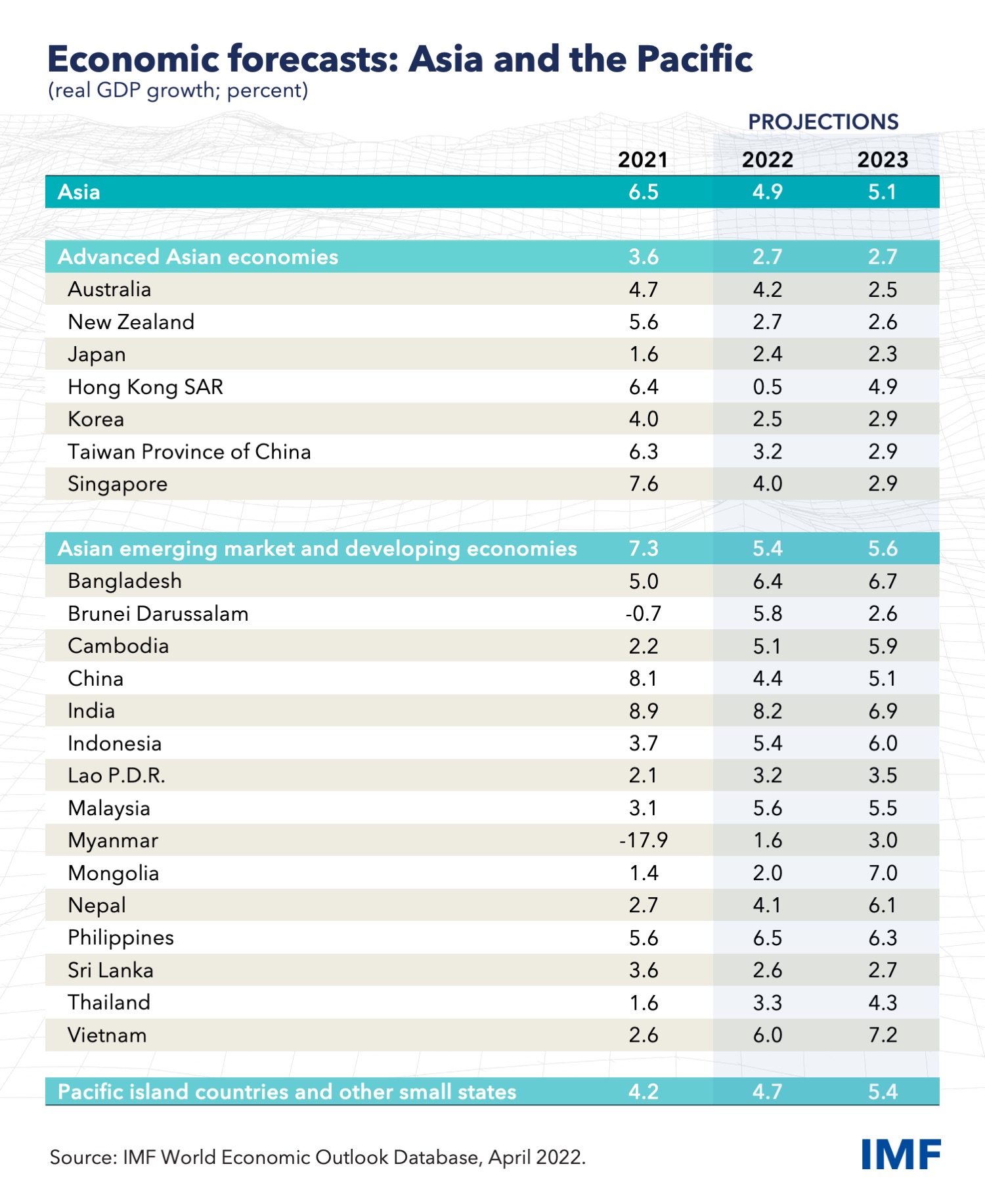
- Regional gross domestic product will expand by 4.9 percent, 0.5 percentage points less than we forecast in January and slower than last year’s 6.5 percent growth rate.
- Inflation is estimated to rise faster in many countries, though from relatively low levels.
- Our latest World Economic Outlook lowered the 2022 global growth estimate by 0.8 percentage point to 3.6 percent.
- The World Economic Outlook reduction reflects a 1.1 percentage point cut for the euro area, now seen expanding 2.8 percent.
- We project growth in China to slow to 4.4 percent this year.
Main headwinds and transmission channels
- War in Ukraine
- Poses the biggest challenge for economic growth.
- Advanced economies in the region hurt most by reduced demand from Europe.
- Emerging markets affected via higher global commodity prices.
- Global commodity price shocks
- Most of Asia’s emerging and developing economies are net importers of oil, gas, and metals, making them vulnerable to rising global commodity prices.
- Deterioration in terms of trade will likely reduce growth, weaken currencies, and worsen current-account balances.
- High food and fuel costs add to inflation pressures, especially in lower-income countries where they constitute a large share of consumer spending.
- Covid-19 developments
- Coronavirus infections in most of Asia have retreated from omicron peaks and mobility indicators are approaching pre-pandemic levels.
- China is a notable exception: lockdowns in Shanghai and elsewhere idle a wide range of activity and threaten further disruptions to regional and global supply chains.
- Tightening global financial conditions
- Government bond yields in major Asian economies have begun rising as the Federal Reserve starts to lift US interest rates.
- Forecasts assume continued tightening abroad and rising inflation at home will lead many Asian central banks to hike rates, placing a drag on investment.
- Longer-term risks
- Intensification of the war in Ukraine could further increase food and energy prices, stressing vulnerable households and potentially causing social unrest.
- A materially faster or larger tightening of US monetary policy than markets expect could cause disruptive capital outflows; downside risk is mitigated where countries have strong buffers and amplified where high debt exists.
- A greater slowdown in China due to broader lockdowns or continued weakness in the real estate sector would have large implications for the region.
- Potential fragmentation of supply chains and added geopolitical tensions are longer-term risks to a region that has benefited from globalization.
Policy trade-offs and recommended responses
- Overarching principle
- Strong and coordinated policy responses tailored to country-specific circumstances are required to address pressures on growth and manage short-term trade-offs.
- Protect the most vulnerable from rising fuel and food costs
- Examples of targeted and temporary protections: a Philippine cash-transfer program and New Zealand’s reduction in public transport fares.
- Social unrest has already flared where these pressures exacerbate vulnerabilities, such as Sri Lanka.
- Anchor medium-term fiscal policy frameworks to ensure debt sustainability
- With output gaps still large in many countries, withdrawal of fiscal stimulus must be well calibrated to support the pandemic recovery.
- Some countries with fiscal space, including China and Japan, responded to recent headwinds with fiscal measures to support recovery this year.
- Countries most vulnerable to debt distress will need consolidation sooner, and some may benefit from debt treatment under the Common Framework.
- Monetary and macroprudential policy
- Tighten monetary policy where inflation is rising faster, such as Singapore, or above central-bank targets, as in Korea.
- Use macroprudential policies to limit financial stability risks amid high household debt levels, including addressing significant increases in housing prices in some countries.
- Structural reforms to boost long-term growth
- Enact economic reforms, particularly in Asia’s emerging economies, to mitigate scarring from the pandemic.
- Overhauls needed in areas that boost productivity, such as non-tariff barriers and product and labor markets.
- Education reforms are essential to address long-term effects of school closures, which were substantial in South Asia and low-income and developing countries.
IMF Blog: Asia Growth Slows on Commodities, Covid and Rising Interest Rates — April 25, 2022