Climate Change Mitigation Will Cause Large Adjustments in Current Account Balances
IMF Blog, August 16, 2022
Source details
- Canonical URL
- Climate Change Mitigation Will Cause Large Adjustments in Current Account Balances
Other formats
Bibliographic details
- Authors: Rudolfs Bems, Luciana Juvenal
- Published: August 16, 2022
Overview
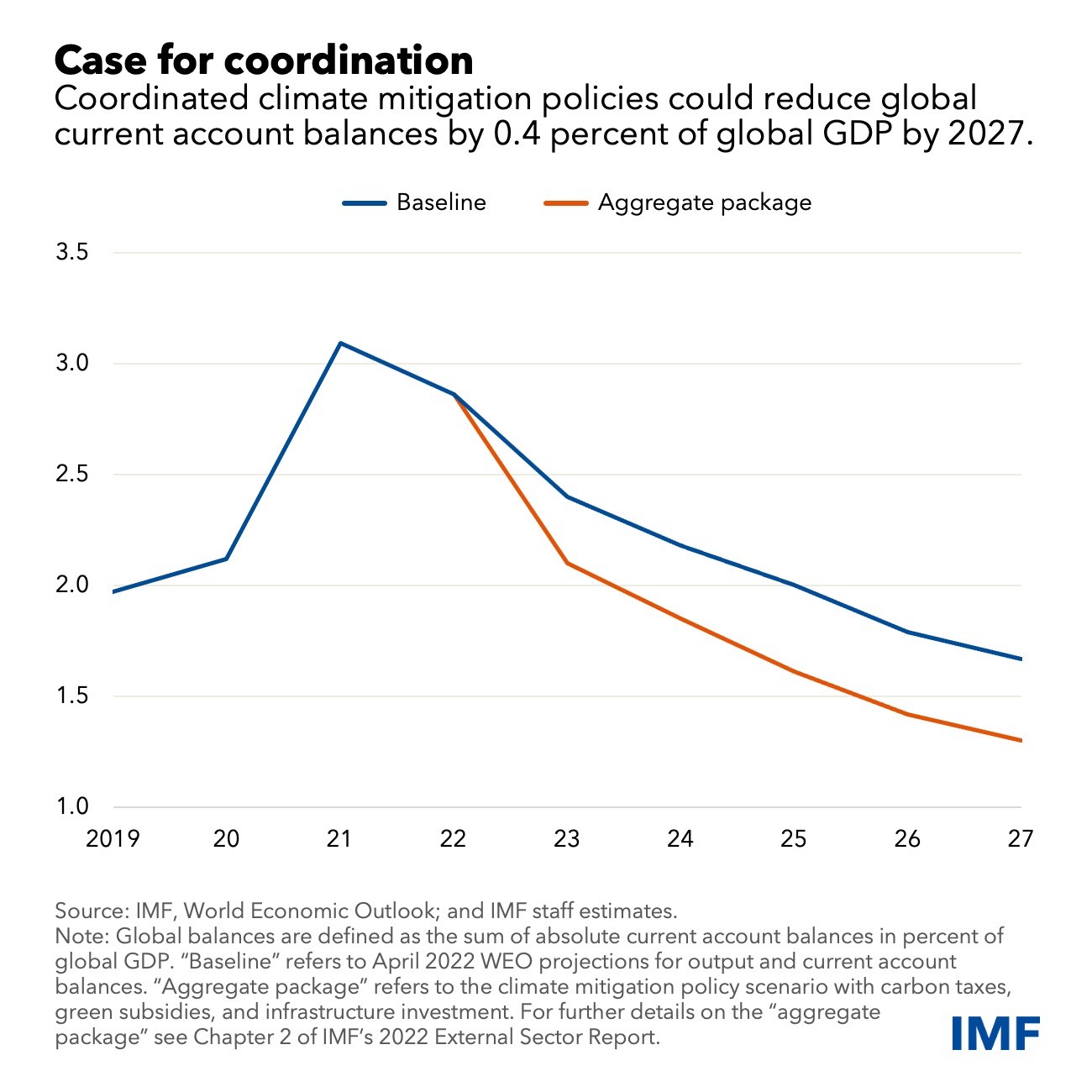
- A climate mitigation policy mix of carbon taxes, green subsidies, and infrastructure investment could reduce global balances by a quarter by 2027.
- Analysis is drawn from the IMF’s External Sector Report and presented as the IMF’s Chart of the Week.
- Authors: Rudolfs Bems, Luciana Juvenal — August 16, 2022.
Key findings
- The carbon tax has the biggest effect on current account balances.
- By discouraging energy usage, economic activity is likely to shift toward more labor-intensive, low-carbon sectors.
- Global interest rates are likely to fall in the longer term because of the decline in investment in fossil fuels, following an initial infrastructure investment-induced rise.
- Current account effects will differ across countries:
- Greener economies: different (generally smaller) adjustments.
- More fossil-fuel-dependent economies: current account balances may increase because of the sharp fall in investment in carbon-intensive sectors.
- The shift in global capital flows is likely toward greener advanced economies, imposing a disproportionate burden of economic adjustment on lower-income fossil-fuel-exporting developing countries, which historically have contributed little to carbon emissions.
Mechanisms and scenarios
- Policy mix components considered:
- Carbon taxes (largest single driver of current account changes).
- Green subsidies.
- Infrastructure investment (initially raises interest rates through investment demand; longer-term effect lowers interest rates via reduced fossil-fuel investment).
- Economic reallocation:
- Reduced energy usage → increased activity in labor-intensive, low-carbon sectors.
- Reduced investment in carbon-intensive sectors → capital reflows toward greener economies.
Distributional implications
- Capital flows shift toward greener advanced economies.
- Lower-income fossil-fuel-exporting developing countries face a disproportionate adjustment burden despite historically low emissions contributions.
- Outcomes vary by country depending on fossil fuel dependency and green sector readiness.
Policy recommendations and coordination
- Increased burden sharing in mitigation efforts could help limit the shift in capital flows. This includes:
- Higher carbon taxes and emission cuts for advanced economies.
- Accelerating investment in green energy and renewables in developing countries via increased financing and technology transfers from advanced countries.
- Emphasis: Both advanced and developing countries must participate in reducing emissions.
- To succeed, policy coordination and burden-sharing arrangements will be key.
Rudolfs Bems and Luciana Juvenal — August 16, 2022