Emerging Market Countries and the Crisis: How Have They Coped?
IMF Blog, April 19, 2010
Source details
- Canonical URL
- Emerging Market Countries and the Crisis: How Have They Coped?
Other formats
Bibliographic details
- Authors: RezaMoghadam
- Published: April 19, 2010
Context and overview
- Author: Reza Moghadam
- Date: April 19, 2010
- Summary points:
- "Only a year ago, we were in the throes of the biggest global crisis since the Great Depression."
- The IMF "supported the global response by increasing its resources and overhauling its lending framework to help those facing financing pressures."
- "Six months ago, we took a preliminary look at the design and performance of IMF-supported programs in emerging markets." A forthcoming paper expands the analysis to a broader group of EMs, examining factors determining crisis impact, policy responses, recovery dynamics, and medium-term sustainability.
Impact
- Findings on initial shock transmission:
- "The initial impact of the crisis—whether measured in terms of output contraction or widening of sovereign spreads—was, as expected, more pronounced in EMs that were more integrated with the global economy through trade and capital flows."
- "Accounting for these linkages, the impact was less intense in countries with better pre-crisis fundamentals and lower external vulnerability indicators."
- Role of international reserves:
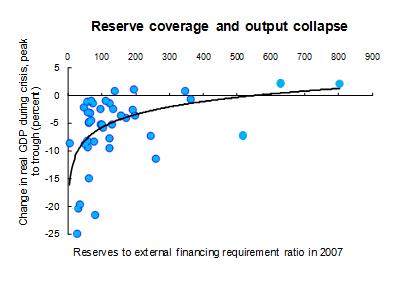
- "Holding more reserves helped, but only up to a point."
- "Emerging markets with greater pre-crisis holdings of international reserves relative to external financing needs—perceived insurance against external vulnerability—saw smaller output contractions."
- "But this effect was pronounced only when reserves cover was low or moderate. For countries with ample reserves, having more reserves carried little additional benefit."
- Banking sector dynamics:
- "Avoiding excesses in the banking sector also helped."
- "Countries that had domestic credit booms in the run up to the crisis tended to experience credit busts during the crisis; these busts were more pronounced in countries with fixed exchange rate regimes."
Policy response
- Fiscal and monetary space:
- "Countries that entered the crisis with more policy space and less binding financing constraints were able to react with more aggressive fiscal and monetary stimuli."
- "Those with lower public debt and better budget balances going into the crisis were able to accommodate the economic downturn better by letting their fiscal positions ease more substantially."
- "Those with lower pre-crisis inflation and sovereign spreads were able to cut interest rates more."
- Exchange rate regime effects:
- "There is also evidence that the exchange rate regime mattered—flexible regimes were able to provide greater monetary stimulus."
Recovery
- Links between policy action and recovery speed:
- "There is evidence that countries that were able to increase public spending more rapidly have experienced faster recoveries."
- This is presented as "a concrete example of how better fundamentals—or more policy space—have helped."
- Exchange rate adjustment:
- "The positive role of the exchange rate as an adjustment mechanism is also becoming evident: countries with more flexible exchange rate regimes are recovering faster."
Exit and medium-term challenges
- Divergent post-crisis challenges by vulnerability:
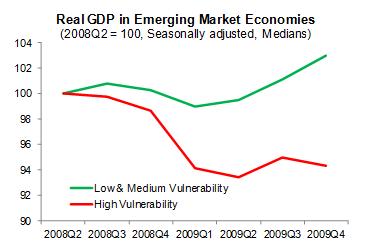
- "Those that entered the crisis with high vulnerabilities face larger output losses (relative to pre-crisis projections)."
- "If current account deficits persist, their external debt-to-GDP ratios could remain elevated."
- Policy implication: "This group of EMs will need to sustain adjustment over the medium term to bring vulnerabilities back down to more moderate levels."
- Cyclical conundrum for low-vulnerability, fast-recovering EMs:
- Recovery and "emerging inflation pressures would normally imply higher policy rates (in a Taylor rule framework)," but raising rates "in the face of continued accommodative policies in the advanced economies could prompt excessive capital inflows, possibly fueling asset price bubbles."
- Observed behavior: "This may be why many fast-recovering emerging markets are taking a cautious approach in withdrawing monetary stimulus."
Lessons and policy implications
- Core lesson: "good policies beget good outcomes."
- Policy guidance:
- "Investing during good times to develop a sound policy framework that delivers stronger fundamentals and lower vulnerabilities yields large dividends during crises."
- Evidence: "In the current crisis, low-vulnerability countries had lower output declines, more space to undertake countercyclical policies, and quicker recoveries."
- Institutional implication: maintain buffers and sound macroprudential frameworks to limit credit booms and to preserve policy space for countercyclical action.
Cross posted in the Huffington Post.
References
- biggest global crisis since the Great Depression
- increasing its resources
- overhauling its lending framework
- recovery
- design and performance of IMF-supported programs in emerging markets
- https://www.imf.org/wp-content/uploads/2010/04/moghadam041910a.jpg
- https://www.imf.org/wp-content/uploads/2010/04/moghadam041910b.jpg
- https://www.imf.org/wp-content/uploads/2010/04/moghadam041910c.jpg
- https://www.imf.org/wp-content/uploads/2010/04/moghadam041910d.jpg