Fiscal Policy in Latin America: Prudence Today Means Prosperity Tomorrow
IMF Blog, December 11, 2013
Source details
- Canonical URL
- Fiscal Policy in Latin America: Prudence Today Means Prosperity Tomorrow
Other formats
Bibliographic details
- Authors: Alejandro Werner
- Published: December 11, 2013
Fiscal position and recent history
- Public finances in most Latin American countries strengthened significantly before the global financial crisis.
- Government debt ratios declined by 16½ percentage points on average between 2002 and 2012, reflecting rapid GDP growth, falling interest costs, and solid primary surpluses in the first half of the period.
- The average maturity of debt outstanding has increased, reducing rollover and interest rate risks.
- Debt issuance in financially integrated economies has shifted decisively toward local-currency bonds, lowering exchange rate risk.
- Several countries—including Brazil, Chile, Colombia, Mexico, and Peru—have introduced or strengthened their fiscal responsibility frameworks since 2000.
Drivers of past fiscal strength and recent reversal
- Favorable external conditions supported fiscal improvements:
- Commodity exporters benefited from a sustained surge in global commodity prices.
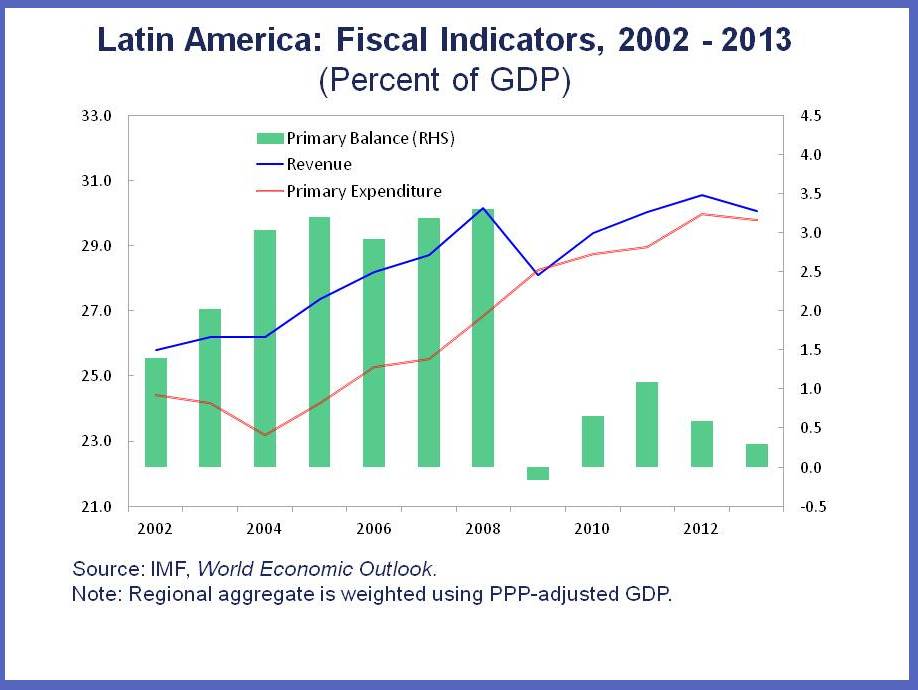
- From 2002 to 2008, fiscal revenue in the region grew from below 26 percent to above 30 percent of GDP.
- The marked fall in global interest rates reduced average government interest bills by almost 2 percentage points of GDP over the course of the decade.
- Expansionary fiscal policies since 2009:
- Since 2009, countries have generally increased public deficits, drawing down on their fiscal coffers.
- Primary expenditure climbed from 24½ percent to 30 percent of GDP on average across Latin America over 2002–12.
- Increases in the ratio of primary spending to GDP were particularly large in Argentina, Ecuador, and Venezuela, where the ratio surged by 12-23 percentage points.
- As a result, fiscal balances are now significantly weaker than prior to the global financial crisis in most countries.
Assessment of current conditions and policy implications
- Cyclical context:
- Economic activity is slowing but output levels are still close to potential.
- Tight labor markets, infrastructure bottlenecks, and widening current account deficits point to limited spare capacity.
- It is hard to argue that more fiscal easing is needed; launching a new stimulus now would undermine credibility of countercyclical policy.
- Monetary policy is better suited to respond to a normal cyclical slowdown.
- Structural considerations:
- IMF research suggests potential growth rates in the region are coming down (see Chapter 3 of the May 2013 REO).
- Growth of physical capital is expected to moderate, reflecting expected normalization of external financing conditions and stabilization of commodity prices.
- Employment growth is likely to be limited going forward—labor participation rates are already elevated, and unemployment has fallen to record lows.
- Unless total factor productivity growth picks up, output growth is likely to stay below the rates observed over the past decade.
- Attempts to maintain unrealistically high growth targets through fiscal stimulus would weaken public finances.
Policy recommendations and priorities
- Preserve and strengthen fiscal balances to:
- Better buffer the impact of future headwinds, such as rising real interest rates and a possible decline in global commodity prices.
- Address current imbalances, including widening external current account deficits and persistently high inflation in some countries.
- Lay the basis for meeting the future challenge of population aging.
- Undertake expenditure reviews:
- After a long period of continuous increases in public spending, now may be a good time to launch a thorough expenditure review to increase efficiency and reduce wasteful or untargeted expenditure.
- Avoid new fiscal stimulus given limited spare capacity and the need to restore countercyclical credibility.
Alejandro Werner, December 11, 2013.
Content in this bundle
- A política fiscal da América Latina: Prudência hoje significa prosperidade amanhã