Banking on the Government
IMF Blog, June 4, 2014
Source details
- Canonical URL
- Banking on the Government
Other formats
Bibliographic details
- Authors: Jesus Gonzalez-Garcia, Francesco Grigoli
- Published: June 4, 2014
Prevalence and role of state-owned banks
- Government ownership of banks remains common worldwide.
- On average, state-owned banks hold 21 percent of the assets of the banking system worldwide.
- In Latin American and Caribbean countries, the public banks’ share is about 15 percent.
- Some countries exhibit very large public-bank shares: Argentina, Brazil, Uruguay, and Costa Rica are all over 40 percent.
- Functions performed by state-owned banks:
- Provide financing for projects that benefit the rest of the economy.
- Provide countercyclical lending (lending more when the economy is weak).
- Fulfill functions not performed by private banks.
- Potential drawback: public banks often respond to government needs, which can weaken fiscal discipline by allowing the public sector access to financing that might not be available from other sources.
Empirical analysis: dataset and approach
- Study uses a panel dataset for 123 countries to test associations between the presence of state-owned banks and:
- Credit to the public sector.
- Fiscal deficits.
- Public debt ratios.
- Crowding out of credit to the private sector.
Key quantitative findings
- A one percentage point increase in the share of assets of the banking system that is owned by the government is associated with an increase in credit to the public sector as a percent of total assets ranging between 0.4 and 0.5 percentage points.
- Each additional percentage point in the share of the banking system’s assets owned by the government is associated with:
- Public debt being higher by 0.2–0.3 percent of GDP.
- A larger overall deficit of the public sector by 0.15 percent of GDP.
- Evidence of crowding out:
- An increase in the share of assets of banks owned by the government of one percentage point is associated with a decrease in the share of credit to the private sector (relative to the share devoted to the public sector) of slightly more than 0.5 of a percentage point.
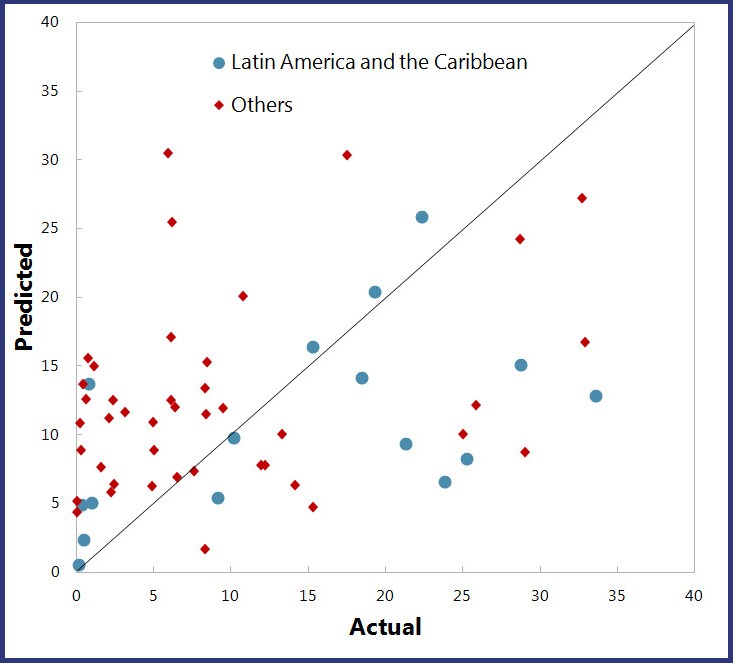
- Descriptive evidence and charts indicate that many Latin American and Caribbean economies obtain even more public-sector credit than the average results imply (majority of those economies lie to the right of the 45 degrees line in the chart referenced).
Policy implications and recommendations
- Policymakers aiming for fiscal consolidation should improve the governance environment for public sector entities and state-owned banks.
- Put in place objective conditions that promote fiscal discipline, not only by addressing revenues and expenditures but also by assessing financing sources.
- Pay special attention to financing sources that could become captive for public entities.
- Close monitoring and control of the lending practices of commercial banks owned by the government is critical to maintain fiscal discipline.
Banking on the Government, Jesus Gonzalez-Garcia, Francesco Grigoli, June 4, 2014.