Let Bank Supervisors Do Their Jobs
IMF Blog, February 13, 2019
Source details
- Canonical URL
- Let Bank Supervisors Do Their Jobs
Other formats
Bibliographic details
- Authors: Tobias Adrian, Aditya Narain
- Published: February 13, 2019
Key message
- Healthy banking sector supports a healthy economy; strong and stable banking systems are a matter of public concern.
- Supervisors must have freedom and flexibility to identify weak points and take prompt corrective action to preserve financial stability.
- Operational independence prevents supervisors from succumbing to “capture” by industry or political actors.
Lessons from the global financial crisis
- The crisis demonstrated the costs of insufficient supervisory independence and capture.
- The IMF and World Bank highlight that diluting regulatory frameworks or failing to take corrective action increases systemic risk.
- A decade after regulatory lapses helped provoke the most painful financial crisis in a century, policymakers must renew their commitment to vigilant, independent, and accountable supervision.
International standards and developments
- The Financial Stability Board’s 2010 report on enhanced supervision stated that operational independence of supervisory agencies “is critical to ensuring supervisory effectiveness.”
- The Basel Committee on Banking Supervision elevated the issue in the 2012 revisions to its core principles for effective banking supervision.
- The revised standards require supervisors to possess:
- operational independence,
- transparent processes,
- sound governance,
- legal protection, and
- sound budgetary processes.
- Laws should spell out banking supervisors’ responsibilities and objectives; objectives should be published and regulators held accountable through a transparent framework.
Observed shortcomings and compliance
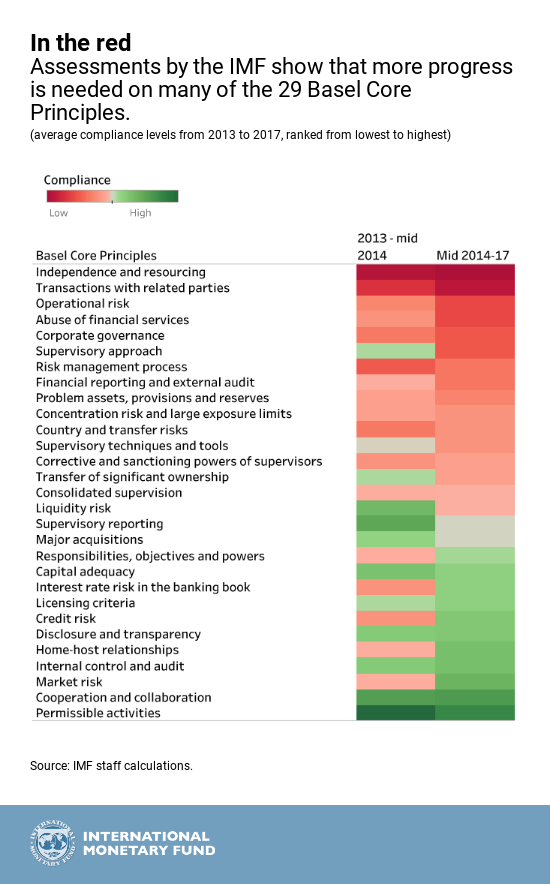
- Of the 29 Basel Core Principles, the IMF and the World Bank found progress to be weakest on independence and resources—to the extent that almost no country is fully compliant.
- Weak governance and inadequate human and budgetary resources remain the greatest shortcomings, creating opportunities for outside influence and pressure.
- These vulnerabilities affect both emerging market economies and advanced economies, and are a concern whether supervision is housed inside or outside the central bank.
- Joint financial sector assessment reports by the IMF and the World Bank often identify potential for government interference in prudential decisions, especially in countries where state-owned financial institutions play dominant roles.
Balancing independence and accountability
- Operational independence is not unlimited; supervisors must be held accountable for actions and inactions.
- Diluting the regulatory framework—easing supervision or failing to take corrective action—undermines the mandate of banking supervisors.
- If policymakers wish to support specific sectors or industries, they should use budget resources rather than creating market distortions or weakening prudential regimes.
Policy recommendations
- Give supervisors a clear mandate.
- Provide adequate human and budgetary resources.
- Establish strong governance structures and legal protections.
- Require publication of supervisors’ objectives and a transparent accountability framework.
- Resist political or industry pressure that would weaken prudential oversight.
- Use targeted budgetary support for sectors that need nurturing, rather than undermining supervisory standards.
Tobias Adrian and Aditya Narain — February 13, 2019