End of the Oil Age: Not Whether But When
IMF Blog, September 12, 2017
Source details
- Canonical URL
- End of the Oil Age: Not Whether But When
Other formats
Bibliographic details
- Authors: Reda Cherif, Fuad Hasanov, Aasim M Husain
- Published: September 12, 2017
Overview
- A transportation revolution driven by electric vehicles (EVs), renewable electricity, and other technologies could transform the oil market in the coming decades.
- Quote highlighted: “The stone age came to an end not for a lack of stones, and the oil age will end, but not for a lack of oil.” — Sheikh Zaki Yamani.
Historical analogy: coal to oil
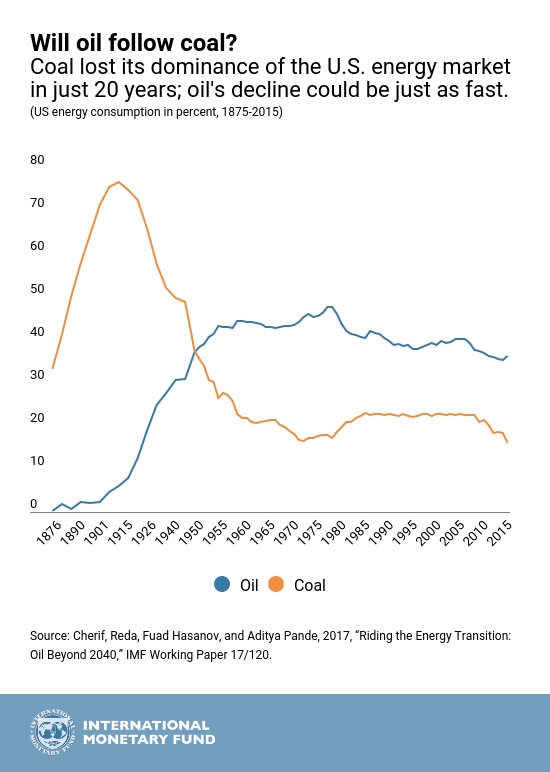
- A hundred years ago, coal accounted for close to 80 percent of US energy consumption.
- Within 20 years, coal’s share fell to one-half.
- Within 40 years, coal’s share fell to one-fifth as oil displaced coal as the main energy source.
- The displacement occurred despite coal being cheaper than oil, because oil powered motor vehicles—transforming transportation.
Electric vehicles: tipping point and projections
- Automobiles currently account for about 45 percent of oil consumption in the world.
- The year 1917—when Ford first sold a mass-produced, affordable vehicle—was described as a tipping point for motor vehicles.
- Electric vehicles may be approaching a similar tipping point: several companies are starting to offer models for about $35,000, roughly the average price of a new motor vehicle in the United States today.
- IMF working paper prediction: electric cars could represent 90 percent of the stock of cars in advanced economies and more than half in emerging market economies by 2040.
- Other studies predict sizable displacement of motor vehicles by EVs, albeit at a slower pace.
Renewables and electricity generation
- Oil’s share of the market for electricity generation and heating is already less than 20 percent globally.
- The cost of producing electricity from solar power has fallen by 80 percent since 2008.
- The cost of producing electricity from wind power has fallen by 60 percent since 2008.
- Unsubsidized solar and wind energy are already competitive in 30 countries.
- The World Economic Forum projects solar and wind will become cheaper than coal and natural gas in more than 60 percent of the world in the next few years.
- Even without further technological advances, penetration of renewables will spread as capacity investments already underway are completed.
Implications for oil demand and prices
- Over the next 20 years, the spread of renewables and EVs will crowd out the demand for oil substantially.
- If climate change concerns intensify, the transformation of the world oil market could be even faster.
- Additional technologies that could accelerate displacement include fuel cells, hydrogen-based power generation, ride sharing, and autonomous driving.
- Outlook for prices: by 2040 oil will be much cheaper than it is today, and the equivalent of $50 a barrel might seem impossibly high then.
- Short-term price direction remains uncertain: “it is hard to say which way oil prices will go next week or next month.”
Policy and industry responses
- Many car companies are investing heavily in electric vehicle technologies; example cited: Volvo announced all its models will have electric motors by 2019.
- Many oil-exporting countries have launched wide-ranging diversification drives to prepare their economies for cheaper oil, given reliance on oil revenue to finance government programs and generate jobs.
- The article recommends readiness for structural change in energy and transportation sectors as a prudent policy response.
Source: End of the Oil Age: Not Whether But When (IMF blog post, September 12, 2017).
Content in this bundle
- WEF_Renewable_Infrastructure_Investment_Handbook
- Executive Summary
- Staff Discussion Note