The Uneven Path Ahead: The Effect of Brexit on Different Sectors in the UK Economy
IMF Blog, December 4, 2018
Source details
- Canonical URL
- The Uneven Path Ahead: The Effect of Brexit on Different Sectors in the UK Economy
Other formats
Bibliographic details
- Authors: Jiaqian Chen
- Published: December 4, 2018
Context and overarching findings
- The United Kingdom is set to leave the European Union in March 2019.
- The EU is the UK’s largest trading partner, accounting for nearly half of the UK’s trade in goods and services.
- Brexit will increase barriers to trade in goods and services and reduce labor mobility, reducing or eliminating some benefits of frictionless trade and potentially lowering foreign direct investment that had been stimulated by EU membership.
- A frictionless border previously enabled UK firms to specialize in activities with comparative advantage and highest value added; free labor mobility enabled the UK to hire talent from across the EU.
Quantified scenarios and economy-wide impacts
- FTA scenario:
- Assumes a broad free trade pact between the UK and EU, including an agreement on services trade, but with some restrictions on migration.
- UK output will be about 2½ to 4 percent lower in the long run compared to a no-Brexit scenario.
- Translates into a cost of about £900 to £1300 per capita.
- WTO scenario:
- Assumes the UK loses any preferential access to the EU market and adopts WTO tariff schedules for trade in goods, with an even stricter migration regime.
- Decline in real output relative to no Brexit would be between 5 and 8 percent in the long run.
- Translates into a cost of about £1700 to £2700 per capita.
- Assumptions:
- Estimates account for higher trade barriers, potential reductions in foreign direct investment flows, and lower net migration.
- Trading relations with non-EU countries are assumed unchanged.
- The economic impact of the deal agreed at the November 2018 EU summit is not modelled; the FTA scenario falls in the spectrum of outcomes consistent with the Political Declaration.
- Comparability:
- The IMF’s estimates of the long-term effects are similar to those of other analysts.
Sectoral heterogeneity and specific vulnerabilities
- Trade- and integration-sensitive sectors will be more affected: sectors with stronger trade links with the EU, larger increases in tariffs or non-tariff costs, or greater sensitivity to price changes will suffer more.
- Manufacturing:
- Chemicals and transport equipment would be particularly affected due to potentially big increases in trade barriers and significant integration in the European production supply chain.
- Automotive and exports:
- 56 percent of cars produced in the UK are exported to the EU.
- Financial services:
- About ¼ of UK-produced financial services are related to EU clients.
- Financial services output could fall by as much as 15 percent in the FTA scenario.
- Firms might need to set up subsidiaries in the EU to continue providing some services.
Employment implications and regional effects
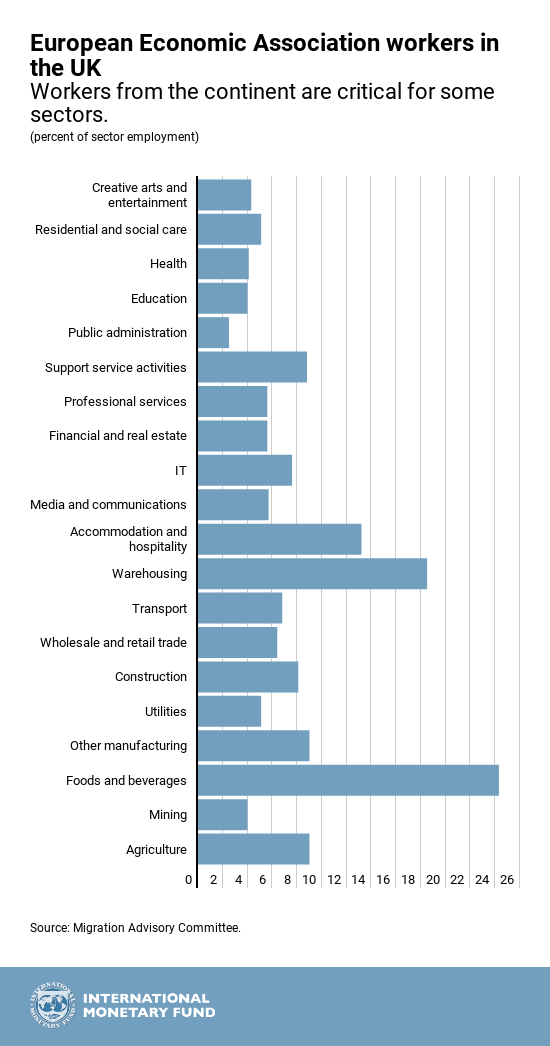
- Labor availability in sectors that rely more heavily on migrant workers, both low- and high-skilled, could be affected by future changes in immigration policy.
- Brexit may usher in a prolonged period of higher structural unemployment, reversing some recent employment gains, as workers separate from highly-affected industries but move only gradually to less-affected sectors and regions.
Policy recommendations
- Implement active labor market policies such as retraining and assistance with job placement to facilitate worker relocation across sectors and regions.
- Focus support on workers rather than specific industries or jobs.
- Make credit more easily available to entrepreneurs to enable flexible responses and higher productivity.
- Continue efforts to boost housing supply to help workers move from more negatively-affected regions to areas where jobs are more plentiful.
Source: The United Kingdom is set to leave the European Union in March 2019 — IMF blog article “The Uneven Path Ahead: The Effect of Brexit on Different Sectors in the UK Economy” by Jiaqian Chen, December 4, 2018.
References
- https://www.imf.org/wp-content/uploads/2018/12/eng-nov-28-uk1-1.png
- https://www.imf.org/wp-content/uploads/2018/12/copy-eng-nov-9-uk2-4.png
- https://www.imf.org/wp-content/uploads/2018/12/eng-nov-28-uk3-1.png
- https://www.imf.org/wp-content/uploads/2018/12/eng-nov-28-uk4-1.png
- https://www.imf.org/wp-content/uploads/2018/12/eng-nov-28-uk5.png
- UK Economic Outlook
- UK and the IMF
- Euro Economic Outlook