A Global Picture of Public Wealth
IMF Blog, June 18, 2019
Source details
- Canonical URL
- A Global Picture of Public Wealth
Other formats
Bibliographic details
- Authors: Jason Harris, Abdelhak Senhadji
- Published: June 18, 2019
New data and coverage
- Database covers 38 countries’ public assets and liabilities and includes low-income, emerging market, and advanced economies.
- Expands coverage from the October Fiscal Monitor by adding seven countries: Mexico, Malta, North Macedonia, Senegal, Armenia, Uzbekistan, and Lithuania.
- The countries in the database now cover almost 63% of global GDP.
- For 17 countries there are time series data at the public sector level.
- Data are provided by level of government and include both financial and nonfinancial corporations.
- Granular asset categories include land, buildings, cash, and equity; liabilities include debt, loans, and pensions.
Aggregate magnitudes and composition
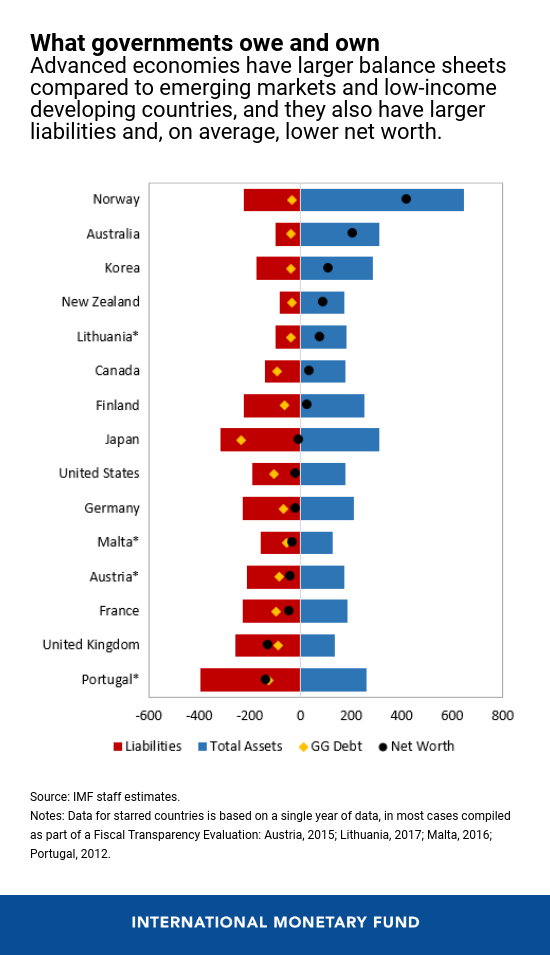
- Total public sector assets in these 38 countries are worth $103 trillion, or 216% of GDP.
- Assets consist of public infrastructure such as bridges and roads, financial assets such as bank deposits, as well as natural resource reserves in the ground.
- Total liabilities stand at $93 trillion.
- Liabilities comprise some $44 trillion of general government debt, $22 trillion of current pension obligations, and the debt of state-owned enterprises.
- Net worth—assets minus liabilities—comes to $10 trillion or 21% of GDP for this group of countries.
Analytical uses and findings
- Goal: better assess fiscal risks and evaluate government policies by knowing more about what you own and owe.
- The Fiscal Monitor shows that having large assets does not necessarily reduce how vulnerable a country is to large debts; this will depend on the nature of the assets.
- The Fiscal Monitor includes a fiscal stress test for the United States, analysis of public investment plans financed by a domestic revenue mobilization effort in Indonesia, and the crossholdings within the public sector in Japan.
- These public sector balance sheet data enable fiscal stress tests and other tools used by investors and financial market experts.
Policy implications and potential gains from better asset management
- Better management of government assets could earn 3 percent of GDP in extra revenues each year—that is more than the interest payments advanced countries pay to cover their debt.
- Countries doing balance sheet work:
- United Kingdom: spent several years compiling data and is currently undertaking a balance sheet review.
- Australia and New Zealand: have looked at the balance sheet effects of policies for years.
- The IMF has used the public sector balance sheet approach in consultations with member countries, for instance in some of the Nordic countries.
Data access and purpose
- The data are made free and publicly available to encourage transparency and more research.
- Intended uses for academics and research institutions:
- Better understand the state of a government’s finances and their evolution over time.
- Compare developments across similar countries.
- Explore key questions around balance sheets and macroeconomic links.
- Enable a more meaningful debate around returns on public assets.
Jason Harris; Abdelhak Senhadji — June 18, 2019.