Reform Doesn’t Have to Cost Votes
IMF Blog, October 18, 2019
Source details
- Canonical URL
- Reform Doesn’t Have to Cost Votes
Other formats
Bibliographic details
- Authors: Davide Furceri, Jonathan D Ostry, Chris Papageorgiou
- Published: October 18, 2019
Research scope and methods
- Studied the economic and regulatory environment in 90 advanced and developing economies.
- Indicators examined include interest rate and credit controls, entry barriers, restrictions on external payments and receipts, trade tariffs, and employment protection.
- Data coverage: 1973–2014.
- Electoral outcomes analyzed for countries in the sample with fully democratic and open elections; key electoral analysis based on 66 democratic countries.
Main empirical findings
- On average, structural reforms are associated with electoral costs, but effects depend on type of reform and timing within the electoral cycle.
- Timing effect:
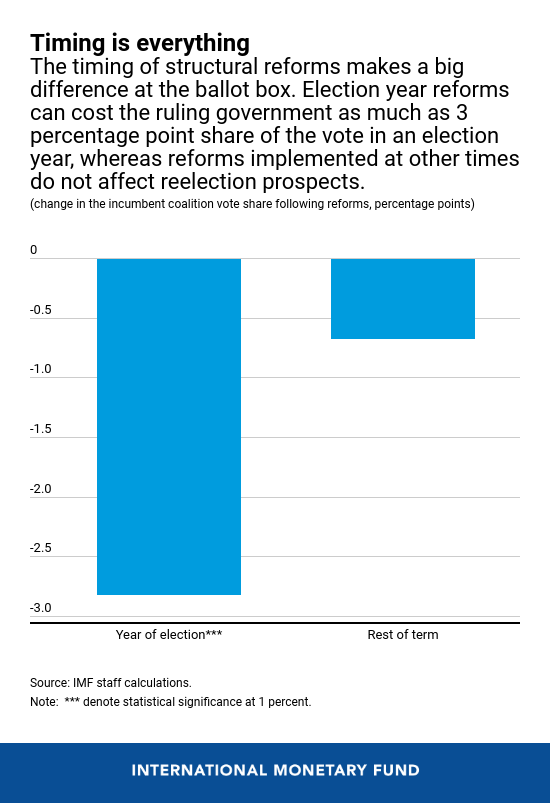
- Reforms implemented swiftly after elections are generally benign or politically favorable, allowing governments to reap medium-term economic gains.
- Reforms enacted on the eve of an election heighten electoral risks due to short-term dislocation effects.
- A major reform just before an election costs the government coalition an average 3 percentage points in its share of the vote.
- Economic conditions effect:
- Reforms tend to be politically easier when growth is strong; voters may attribute gains to reform or to underlying economic conditions.
- Reforms are more challenging politically under weak economic conditions.
- Crisis periods can present reform opportunities without electoral costs if leaders build consensus and show strong ownership (examples: Spain in 1979; Peru in 1995).
- Heterogeneity by reform type:
- Reforms that engender increased income inequality—particularly financial sector deregulation (banking sector privatization, removing controls on credit and interest rates) and opening to financial flows under some conditions—can exact a higher electoral cost.
Policy implications and recommendations
- Design and timing:
- Act swiftly following an electoral victory to carry out reforms during the political honeymoon period.
- Implement reforms when economic conditions are favorable: “repair the roof when the sun is shining.”
- Distributional considerations:
- Factor in harms to income distribution and take well-communicated upfront steps to offset side effects.
- Strengthen social safety nets and active labor market programs to help displaced workers find new jobs, recognizing that reforms often imply simultaneous job creation and destruction.
- Process and ownership:
- Ensure strong ownership of the reform agenda and enhance dialogue with business and civil society to build broad-based support—this is especially important when economic conditions are tough.
Context and motivation
- Structural reforms aim to raise productivity, investment, employment, and economic resilience; they include measures such as reducing regulatory barriers to competition, opening to trade and financial flows, and increasing labor market flexibility.
- There is a pressing need for well-designed, appropriately timed, and carefully implemented structural reforms, particularly in emerging market and developing economies where deregulation has stalled, with substantial potential medium-term output gains in both advanced and developing economies.
Source: IMF blog post “Reform Doesn’t Have to Cost Votes” (October 18, 2019) by Davide Furceri, Jonathan D. Ostry, Chris Papageorgiou.