The Economic Cost of Devaluing “Women’s Work”
IMF Blog, October 15, 2019
Source details
- Canonical URL
- The Economic Cost of Devaluing “Women’s Work”
Other formats
Bibliographic details
- Authors: Kristalina Georgieva, Cristian Alonso, Era Dabla-Norris, Kalpana Kochhar
- Published: October 15, 2019
Overview
- As much as half of the world’s work is unpaid. And most of it is done by women.
- Unpaid work is not counted as part of economic activity because it is difficult to measure based on values in the marketplace.
- Estimates place the economic value of unpaid work between 10 and 60 percent of GDP.
- Reducing gender imbalances in unpaid work is part of the United Nations Sustainable Development Goals.
- Reducing and redistributing unpaid work is framed as an economic imperative that can raise productivity and foster stronger economies.
Key findings and statistics
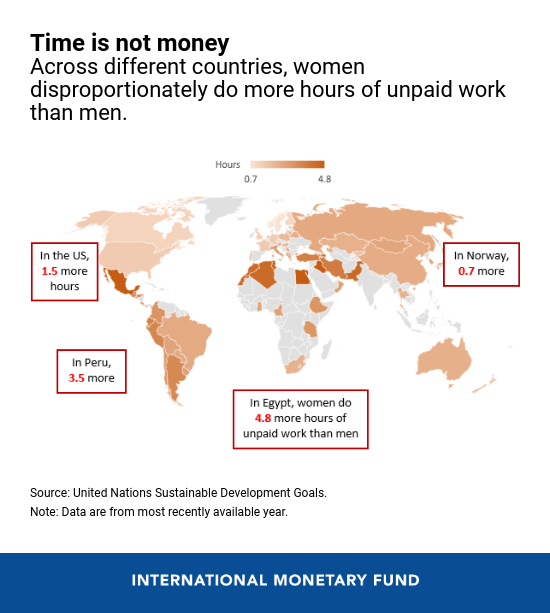
- Women do 4.4 hours of unpaid work on average around the world and men only 1.7 hours.
- Country examples:
- Norway: women do 3.7 hours of unpaid work, men contribute 3.
- Egypt: women do 5.4 hours per day of unpaid work and men only 35 minutes.
- US: women do 3.8 hours of unpaid work and men do 2.4 hours.
- More than 80 percent of unpaid work hours are devoted to domestic chores aside from child and elder care.
- UNICEF estimates that women spend 200 million hours per day worldwide simply fetching water.
- According to UNESCO, 130 million school-age girls are not in school.
- In India, women spend more than an hour every day collecting firewood.
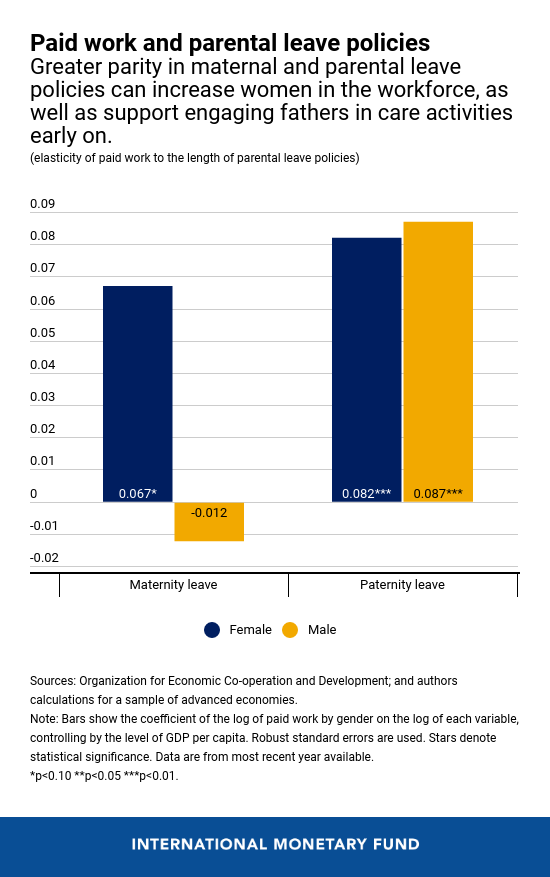
- Iceland’s parental leave policy sets the length of leave at nine months and earmarks three for each parent.
How unpaid work affects economies
- By not fully engaging women, economies misallocate resources—having women do low-productivity tasks at home instead of participating in higher-productivity market activities.
- The economy misses exploiting complementarity between women and men in the workplace, resulting in lower productivity and economic growth.
- Social institutions and values can constrain the redistribution of unpaid work by preventing men from sharing the burden at home.
- Some unpaid work is done by choice and childrearing has societal value, but the dominance of domestic chores in unpaid work hours highlights structural constraints limiting women's market opportunities.
- Women may choose to stay at home or work only part-time if market wages are too low or do not represent equal pay for equal work.
Drivers and constraints
- Cultural norms, lack of public services and infrastructure, and absence of family-friendly policies often drive unequal shares of unpaid work.
- Limited access to education and health care restricts women’s human capital and labor market opportunities.
- Insufficient infrastructure (water, sanitation, electricity, transportation) increases time spent on low-productivity domestic tasks.
Policy recommendations and interventions
- Improve basic infrastructure in developing economies: water supply, sanitation, electricity, and transportation to free women from low-productivity tasks.
- Expand internet access to enable participation in the gig economy and flexible work arrangements.
- Ensure access to education and health care for women and guarantee their use to build human capital.
- Enshrine women’s rights in law to help reshape social institutions and values that limit access to education and healthcare.
- Promote efficient and flexible labor markets, including active labor market policies to facilitate job matching.
- Encourage flexible work arrangements, which are associated with less female unpaid work and better work-life balance.
- Implement family-friendly policies:
- Invest in early childhood education and care to facilitate women’s return to work.
- Adopt greater parity in maternal and parental leave policies to smooth women’s return to work and engage fathers in care activities early on (example: Iceland’s nine-month leave with three months earmarked for each parent).
- Private sector engagement is necessary alongside decisive government action to seize large potential gains.
Examples and supporting evidence
- Mexico and Brazil: better access to electricity, water, and less expensive appliances helped boost female labor force participation.
- Switzerland: active labor market policies facilitate job matching and are cited as supportive of redistributing unpaid work.
- Pakistan: security concerns lead many families to choose not to send girls to school, illustrating non-infrastructural barriers to service use.
Source: Kristalina Georgieva, Cristian Alonso, Era Dabla-Norris, Kalpana Kochhar — October 15, 2019.