Global Shipping Costs Are Moderating, But Pressures Remain
IMF Blog, January 13, 2022
Source details
- Canonical URL
- Global Shipping Costs Are Moderating, But Pressures Remain
Other formats
Bibliographic details
- Authors: Parisa Kamali
- Published: January 13, 2022
Recent trends and key statistics
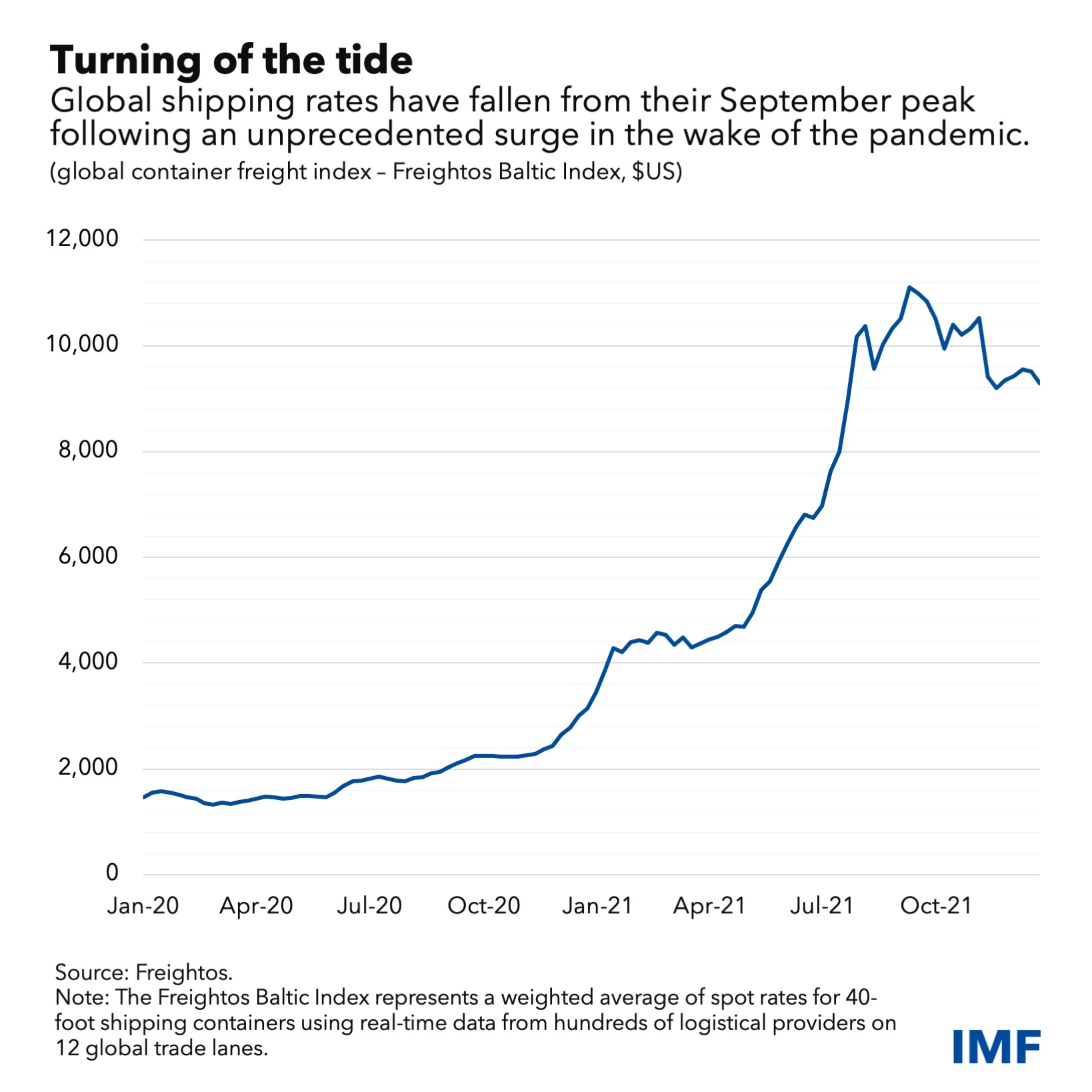
- Container rates have "more than quadrupled since the start of the pandemic," with some of the biggest gains concentrated "in the first three quarters of last year."
- Global container rates began to pull back from their record in September and have since declined by 16 percent, "mostly due to falling rates for trans-Pacific eastbound routes, the main sea link from China to the United States."
- The traditional peak shipping season is "typically from August to October."
- Publication date and author: Parisa Kamali, January 13, 2022.
Drivers of recent changes
- Demand-side: Consumers "unleashed pent-up savings to buy new merchandise" while the pandemic continued to snarl supply chains.
- Supply-side constraints and disruptions:
- Lockdowns, labor shortages, and strains on logistics networks led to shipping-cost increases and significantly lengthened delivery times, though those pressures are easing.
- Backlogs and port delays.
- Labor shortages in related occupations.
- Supply chain disruptions moving inland.
- Shipping-industry challenges such as slow capacity growth and consolidation that concentrated the market power of a few carriers.
- Policy action: "The US recently ordered some ports to expand operating hours and boost efficiency to reduce congestion and ease supply bottlenecks."
Outlook and distributional impacts
- Although rates have subsided, they "may remain elevated through the end of the year."
- If the pandemic is controlled in the future, demand for tradable goods "might gradually decline as some service-providing sectors, such as travel and hospitality, recover."
- Price pass-through and sectoral effects:
- "Higher shipping costs and goods shortages are expected to boost merchandise prices."
- UNCTAD projects that "if freight rates remain elevated through 2023, global import price levels and consumer price levels could rise by 10.6% and 1.5%, respectively."
- Impact would be "disproportionately larger for small, developing islands which heavily rely on imports that arrive by sea."
- "Higher freight rates will also result in larger increases in the final price of low-value-added products." Smaller developing economies that export many of these goods "could become less competitive and face difficulties with their economic recoveries."
- Final prices of products highly integrated into global value chains, such as "electronics and computers," will also be more affected by higher freight rates.
Policy implications and recommended responses
- Returning to pre-pandemic shipping rates will require:
- Greater investment in infrastructure.
- Digitalization in the freight industry.
- Implementation of trade facilitation measures.
Source: IMF Blog — "Global Shipping Costs Are Moderating, But Pressures Remain" (Parisa Kamali, January 13, 2022).