Soaring Inflation Puts Central Banks on a Difficult Journey
IMF Blog, August 1, 2022
Source details
- Canonical URL
- Soaring Inflation Puts Central Banks on a Difficult Journey
Other formats
Bibliographic details
- Authors: Tobias Adrian, Christopher Erceg, Fabio Natalucci
- Published: August 1, 2022
Context and central message
- Publication date: August 1, 2022.
- Authors: Tobias Adrian, Christopher Erceg, Fabio Natalucci.
- Central banks initially expected to tighten monetary policy very gradually as inflation was seen as driven by supply shocks from the pandemic and Russia’s invasion of Ukraine.
- With inflation climbing to multi-decade highs and price pressures broadening to housing and other services, central banks now recognize the need to move more urgently to avoid an unmooring of inflation expectations and damaging their credibility.
- The Federal Reserve, Bank of Canada, and Bank of England have already raised interest rates markedly and signaled more sizable hikes this year. The European Central Bank recently lifted rates for the first time in more than a decade.
Developments in real interest rates and financial conditions
- Central bank actions and communications have led to a significant rise in real (inflation-adjusted) interest rates on government debt since the start of the year.
- Short-term real rates are still negative.
- United States:
- The real rate forward curve (one-year-ahead real interest rates one to 10 years out implied by market prices) has risen across the curve to a range between 0.5 and 1 percent.
- This path is roughly consistent with a “neutral” real policy stance that allows output to expand around its potential rate.
- The Fed’s Summary of Economic Projections in mid-June suggested a real neutral rate of around 0.5 percent, and policymakers saw a 1.7 percent output expansion both this year and next, which is very close to estimates of potential.
- Euro area:
- The real rate forward curve, proxied by German bunds, has shifted up but remains deeply negative, consistent with real rates converging only gradually to neutral.
- Effects on broader markets:
- Higher real interest rates on government bonds have spurred an even larger rise in borrowing costs for consumers and businesses and contributed to sharp declines in equity prices globally.
- The modal view of central banks and markets is that tightening of financial conditions will be enough to push inflation down to target levels relatively quickly.
Baseline forces that could moderate inflation
- Monetary and fiscal tightening should cool demand for energy and non-energy goods, especially in interest-sensitive categories like consumer durables, causing goods prices to rise more slowly or even fall.
- Energy prices may fall in the absence of additional disruptions in commodity markets.
- Supply-side pressures should ease as the pandemic relaxes and production disruptions become less frequent.
- Slower economic growth should eventually push down service-sector inflation and restrain wage growth.
- Market-based measures of inflation expectations point to a return of inflation to around 2 percent within the next two or three years for both the United States and Germany.
- Central bank forecasts, surveys of economists and investors, and the Fed’s latest quarterly projections point to a similar moderation in the rate of price increases.
Upside risks and sources of persistence
- The magnitude of the inflation surge has been a surprise; substantial uncertainty about the outlook remains.
- Upside risks appear strong and inflation could become entrenched, de-anchoring inflation expectations.
- Service inflation (housing rents to personal services) appears to be picking up from already elevated levels and is unlikely to come down quickly.
- Rapid nominal wage growth in strong labor markets could produce “second round effects”:
- Nominal wages could start rising rapidly, faster than firms could reasonably absorb.
- Associated increases in unit labor costs could be passed into prices, translating into more persistent inflation and rising inflation expectations.
- Geopolitical intensification could reignite energy price surges or compound disruptions, lengthening a period of high inflation.
- Market signals:
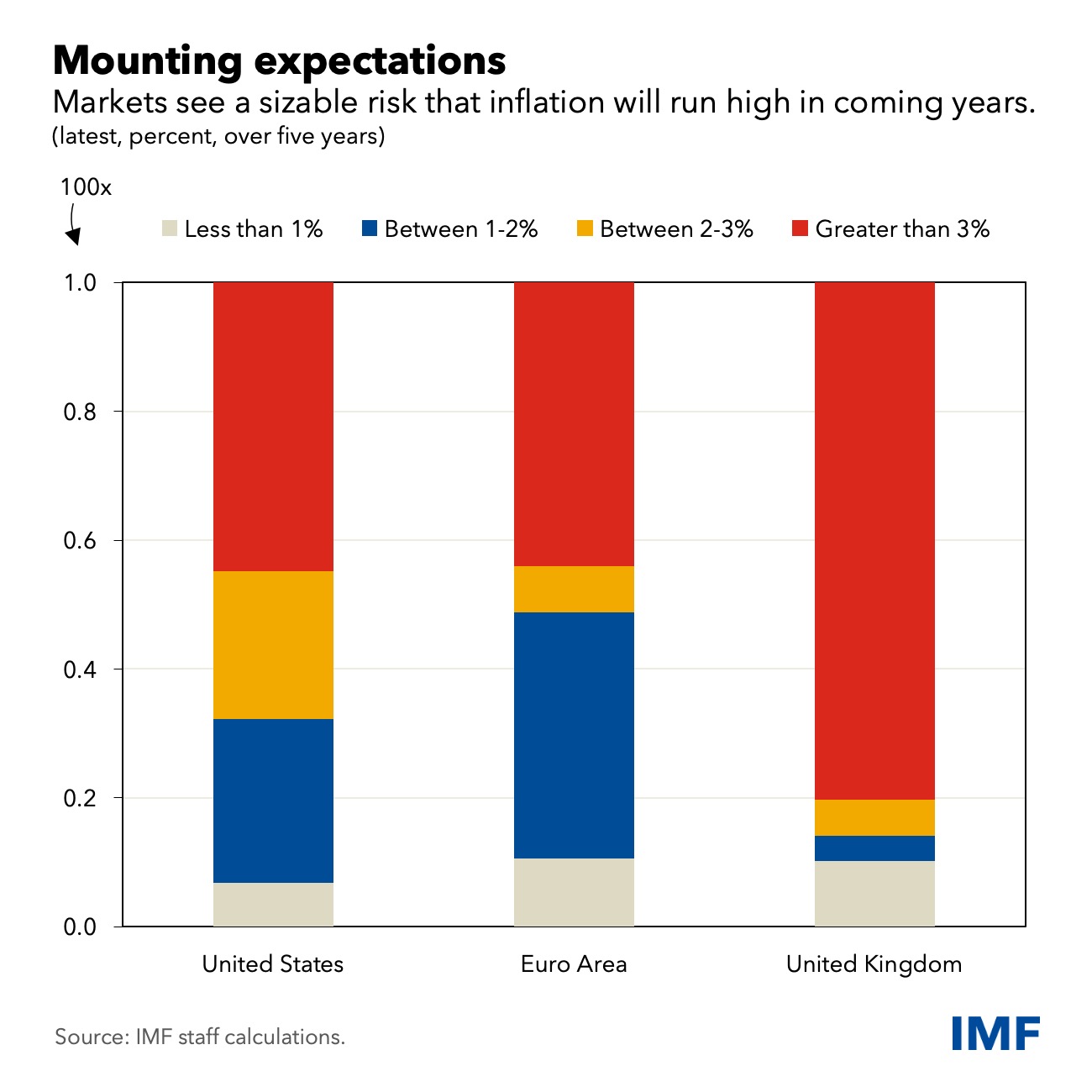
- Markets signal a high probability of inflation rates of over 3 percent persisting in coming years in the United States, euro area and the United Kingdom.
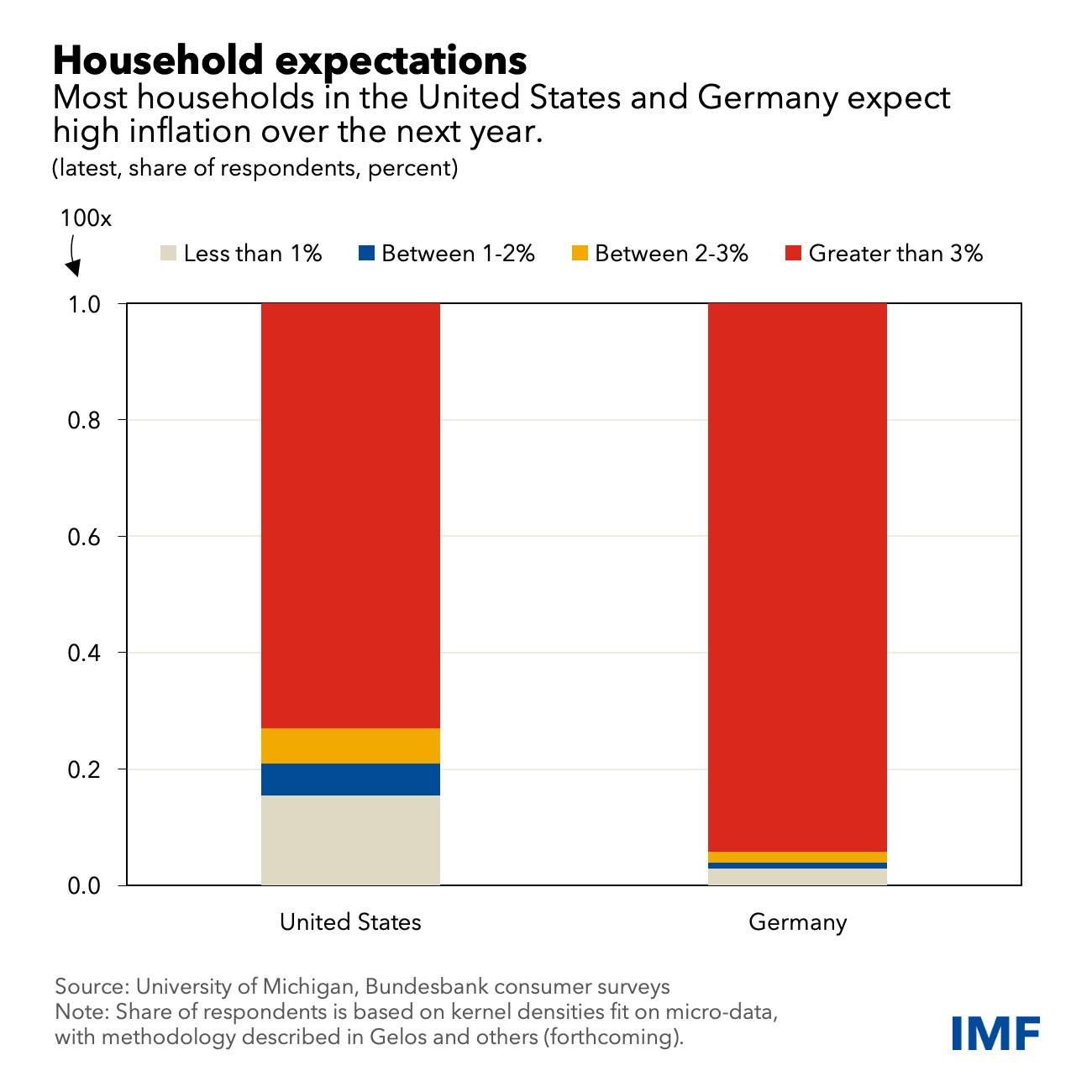
- Household surveys in the United States and Germany show people expect high inflation over the next year and put considerable odds on it running well above target over the next five years.
- It is possible inflation comes down more quickly than central banks envision if supply chain disruptions ease and global policy tightening results in fast declines in energy and goods prices.
Policy implications and costs of delayed action
- If upside risks materialize and high inflation becomes entrenched, central banks will need to tighten more aggressively to cool the economy, and unemployment will likely have to rise significantly.
- Faster policy rate tightening amid already poor liquidity may cause a further sharp decline in risk asset prices—affecting equities, credit, and emerging market assets.
- Tightening financial conditions may be disorderly, testing financial system resilience and putting large strains on emerging markets.
- Public support for tight monetary policy may be undermined by mounting economic and employment costs.
- Restoring price stability is paramount and necessary for sustained economic growth.
- Historical lesson: The high inflation of the 1960s and 1970s shows that moving too slowly to restrain inflation entails a much more costly subsequent tightening to re-anchor inflation expectations and restore policy credibility.
- Recommendation: Central banks should be resolute and keep the experience of past high-inflation episodes firmly in their sights as they navigate the difficult road ahead.
Soaring Inflation Puts Central Banks on a Difficult Journey — Tobias Adrian, Christopher Erceg, Fabio Natalucci, August 1, 2022.
Content in this bundle
- Fomcprojtabl20220615