Fiscal Policy Can Help People Rebound From Cost of Living Crisis
IMF Blog, October 12, 2022
Source details
- Canonical URL
- Fiscal Policy Can Help People Rebound From Cost of Living Crisis
Other formats
Bibliographic details
- Authors: Vitor Gaspar, Raphael Lam, Paolo Mauro, Roberto Piazza
- Published: October 12, 2022
Trade-offs and context
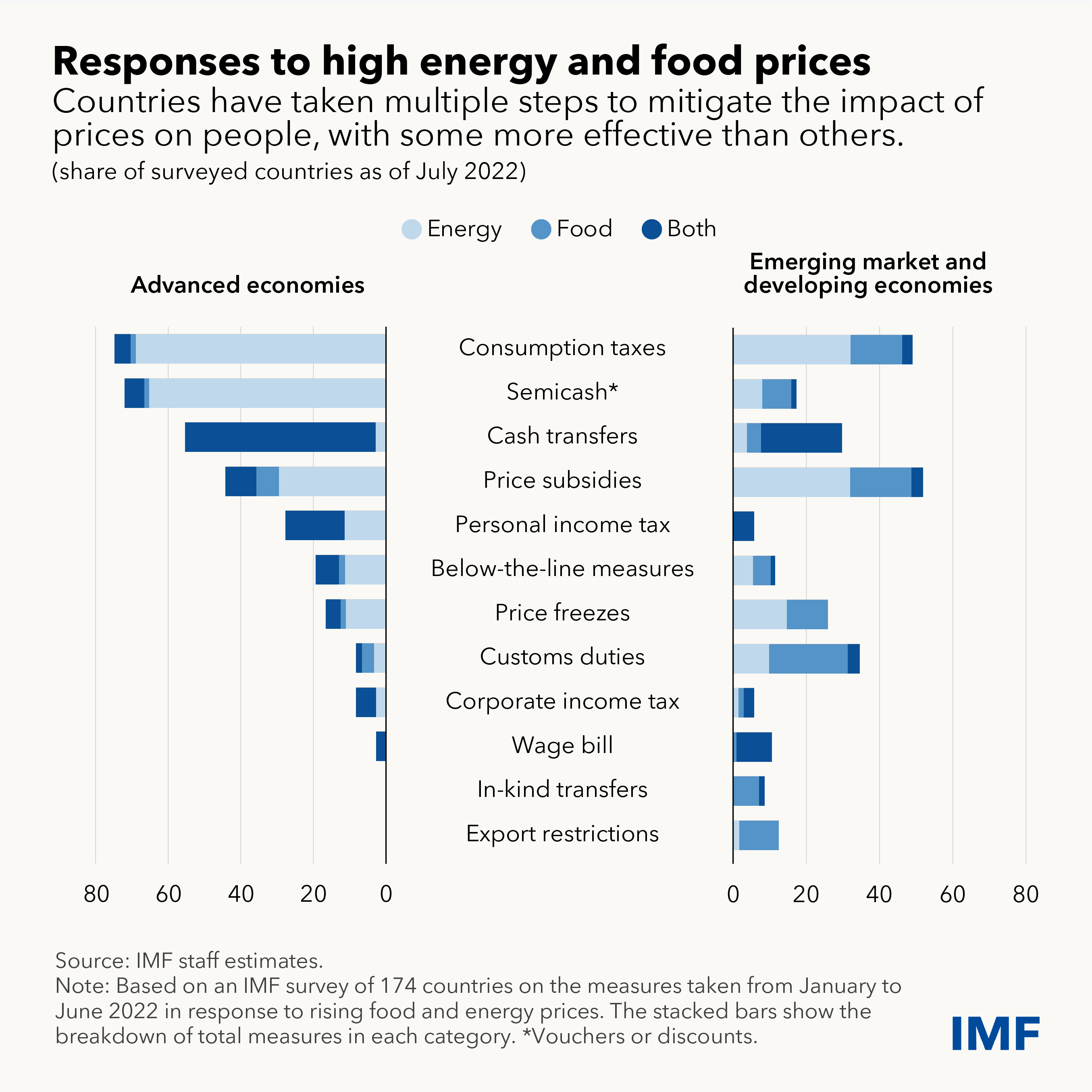
- Governments face difficult trade-offs amid sharp increases in food and energy prices: protect low-income families from large real income losses and ensure access to food and energy, while reducing vulnerabilities from large public debts and maintaining a tight fiscal stance to avoid working at cross-purposes with monetary policy.
- Food prices have been up by half since 2019 and supply disruptions have persisted in both food and energy markets.
- Most governments face further pressure on public finances already strained by the pandemic: rising inflation, weakening currencies, and climbing interest rates have led to surging credit spreads in many countries and higher interest expense going forward.
- Global public debt is projected to remain elevated at 91 percent of GDP in 2022—after receding from a historic high in 2020—and remains about 7.5 percentage points higher than pre-pandemic levels.
- Low-income countries are particularly vulnerable: nearly 60 percent of the poorest economies are in debt distress or at high risk of it.
Food and energy response
- Policymakers should prioritize targeted support through social safety nets to the most vulnerable people given high debt levels and rising borrowing costs.
- Possible measures include providing discounts on utility bills (for basic usage) to vulnerable low- and middle-income families.
- Allowing energy prices to adjust is crucial to preserving incentives to curb energy use and increase supply.
- Governments should avoid attempting to limit price increases through price controls, subsidies, or tax cuts when faced with long-lasting supply shocks and broad-based inflation because such measures would be costly to budgets and ultimately ineffective.
- Many low-income countries will need greater global efforts in humanitarian assistance and emergency financing due to limited domestic resources.
- In a time of high inflation, policies to address high food and energy prices should not add to aggregate demand; demand pressures force central banks to raise interest rates even higher, making it more expensive to service government debt.
- A tightening fiscal stance sends a powerful signal that policymakers are aligned in their fight against inflation.
Fostering economic resilience
- Governments need to build resilience over time to a range of adverse shocks—pandemic, global financial crisis, natural disasters, and other adverse events—by preparing for rainy days and building fiscal buffers gradually to allow swift and flexible crisis responses.
- Several fiscal tools used during the pandemic can become part of a more permanent toolkit, depending on countries’ capacity and available fiscal space:
- Job-retention schemes stabilized more than 40 percent of individual income loss in the European Union.
- Exceptional financial support to companies can prevent widespread bankruptcies but should be reserved for severe crises because it exposes governments to sizable fiscal risks.
- Social safety nets help people bounce back from unemployment, sickness, or poverty and can be made readily scalable and better targeted with digital technology.
- Countries should rethink the role of fiscal policy in a shock-prone era—how it can better buffer against losses during crises and build resilience—and learn from experiences across the world.
Key statistics and findings
- Median fiscal cost of measures introduced to address higher food and energy prices estimated at 0.6 percent of national gross domestic product, on top of pre-existing subsidies, among countries for which estimates were available.
- Food prices have been up by half since 2019.
- Global public debt projected at 91 percent of GDP in 2022.
- Public debt remains about 7.5 percentage points higher than pre-pandemic levels.
- Nearly 60 percent of the poorest economies are in debt distress or at high risk of it.
- Job-retention schemes stabilized more than 40 percent of individual income loss in the European Union.
This blog is based on the October 2022 Fiscal Monitor, “Helping People Bounce Back.”