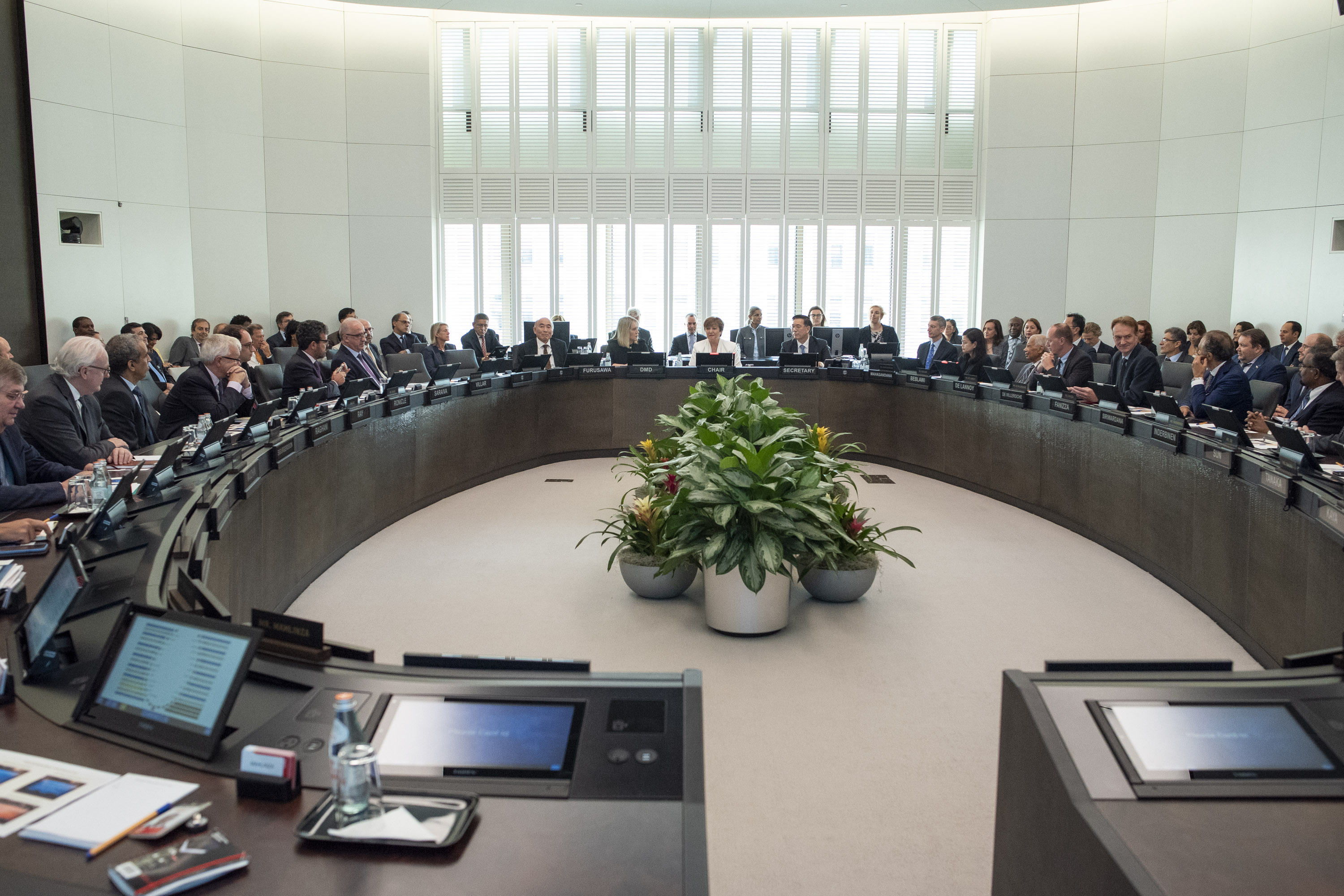
IMF Executive Board Discusses Paper “Toward an Integrated Policy Framework”
IMF News, October 8, 2020
Source details
- Canonical URL
- IMF Executive Board Discusses Paper “Toward an Integrated Policy Framework”
Other formats
Bibliographic details
- Published: October 8, 2020
Overview
- Press Release No. 20/307
- Date: October 8, 2020
- IMF Communications Department, MEDIA RELATIONS; PRESS OFFICER: Maria Candia; Phone: +1 202 623-7100; Email: MEDIA@IMF.org
- The Executive Board met on September 28, 2020 to discuss staff analytical work on an Integrated Policy Framework (IPF) aimed at helping formulate appropriate responses to fluctuations in international capital flows and other shocks.
- The staff paper summarizes key analytical findings and will serve as an input into a forthcoming review of the IMF’s Institutional View on the Liberalization and Management of Capital Flows. It does not propose changes to the IMF’s operational framework at the present juncture.
Purpose and Scope of the IPF
- Aim: provide a systematic analytical approach to selecting an appropriate policy mix for managing large and volatile capital flows and preserving macroeconomic and financial stability in the face of domestic and external shocks.
- Jointly considers the role and interactions of: monetary policy, exchange rate (including foreign exchange intervention), macroprudential policy, and capital flow management policies, accounting for country circumstances.
- Methodology: modeling for small, open economies, empirical analysis, and a review of country experiences; developed by IMF staff from various departments.
Key Analytical Findings
- The appropriate policy mix depends on:
- the nature of shocks,
- country characteristics,
- initial conditions.
- In countries with flexible exchange rates, deep foreign exchange markets, and continuous market access, allowing full exchange rate adjustment to economic and financial shocks is typically optimal.
- In such cases, the findings indicate no rationale for capital flow management measures (as noted by a few Directors).
- In the presence of frictions and vulnerabilities common in emerging market and developing economies:
- Flexible exchange rates still provide significant benefits,
- Other tools (macroprudential measures, foreign exchange intervention, capital flow management measures) can, under certain circumstances, help:
- enhance monetary autonomy,
- improve financial and price stability,
- reduce output volatility.
- Precautionary capital flow management measures can lower risks to financial stability under certain conditions, though such measures tend to become “sticky” and policymakers’ ability to adjust them over the financial cycle needs consideration.
- Reliance on IPF tools is not a substitute for warranted economic adjustment, deep markets, healthy balance sheets, and strong institutions.
Executive Board Assessment — Directors’ Main Messages
- Directors welcomed the discussion and the IPF analytical workstream.
- They recognized policymakers often face difficult tradeoffs in pursuing domestic and external stabilization objectives amid volatile capital flows.
- Directors agreed the IPF offers valuable analytical insights into how country characteristics, initial conditions, and the nature of shocks affect whether the use of multiple policy tools is warranted.
- Appreciations and suggested extensions:
- Appreciated advances in modeling, extensive empirical work, and informative case studies.
- Many Directors stressed integrating fiscal policy more fully into the analysis.
- Suggested exploring more deeply multilateral implications or spillovers of IPF policies.
- Suggested extending analysis of intertemporal tradeoffs and deriving lessons from the COVID-19 crisis.
- Some Directors suggested other potential extensions of the framework.
- Emphasis on communication and credibility:
- A systematic framework can help central banks employing multiple tools communicate policy decisions and enhance credibility.
- Models provide a useful guide, but real-life complexity and tradeoffs suggest need for caution and judgment in applying IPF tools and for clear communication of actions and objectives.
- Safeguards and metrics:
- Operationalization should include safeguards to minimize risk of inappropriate use.
- Ensuring robustness and developing metrics to assess country characteristics will be essential.
- Cautioned against mechanical application of safeguards; emphasized need for judgment.
Policy Implications and Recommendations
- Use of policy tools should be guided by a clear framework and an assessment of costs and benefits.
- Balance macroeconomic and financial stabilization benefits of IPF policies against potential costs in terms of market development and other unintended consequences.
- Persistent use of IPF tools may perpetuate vulnerabilities that rationalize their deployment.
- Tools should not be used to:
- support misaligned exchange rates,
- substitute for warranted macroeconomic adjustment.
- The Fund’s role:
- Assist members in fostering deeper markets, strengthening institutions, and addressing underlying vulnerabilities.
Implementation Considerations
- Complexity of application:
- Endogeneity of policy and country conditions and determining the nature and source of shocks are practical challenges.
- Country experiences should be assessed in detail and carefully integrated into the framework.
- Directors affirmed that Fund policy advice remains guided by the Institutional View on the Liberalization and Management of Capital Flows and other existing Fund policies.
- Communication: careful communication of the IPF’s analytical findings is important, acknowledging assumptions, limitations, and qualifications.
Next Steps
- The IPF’s analytical findings are intended to serve as an input for the upcoming review of the Institutional View, along with the report by the Independent Evaluation Office on IMF Advice on Capital Flows.
- Reference note: An explanation of any qualifiers used in summings up can be found here: http://www.IMF.org/external/np/sec/misc/qualifiers.htm.
IMF Executive Board Discusses Paper “Toward an Integrated Policy Framework”, Press Release No. 20/307, October 8, 2020
Content in this bundle
References
- https://www.imf.org/-/media/images/imf/bios/imfboard.jpg
- The Executive Board
- IMF COVID-19 Hub
- Policy Tracker
- Financial Assistance
- Questions & Answers
- Policy Paper: Toward an Integrated Policy Framework
- Press Releases
- PRESS CENTER
- http://www.IMF.org/external/np/sec/misc/qualifiers.htm
- https://www.imf.org/en/home