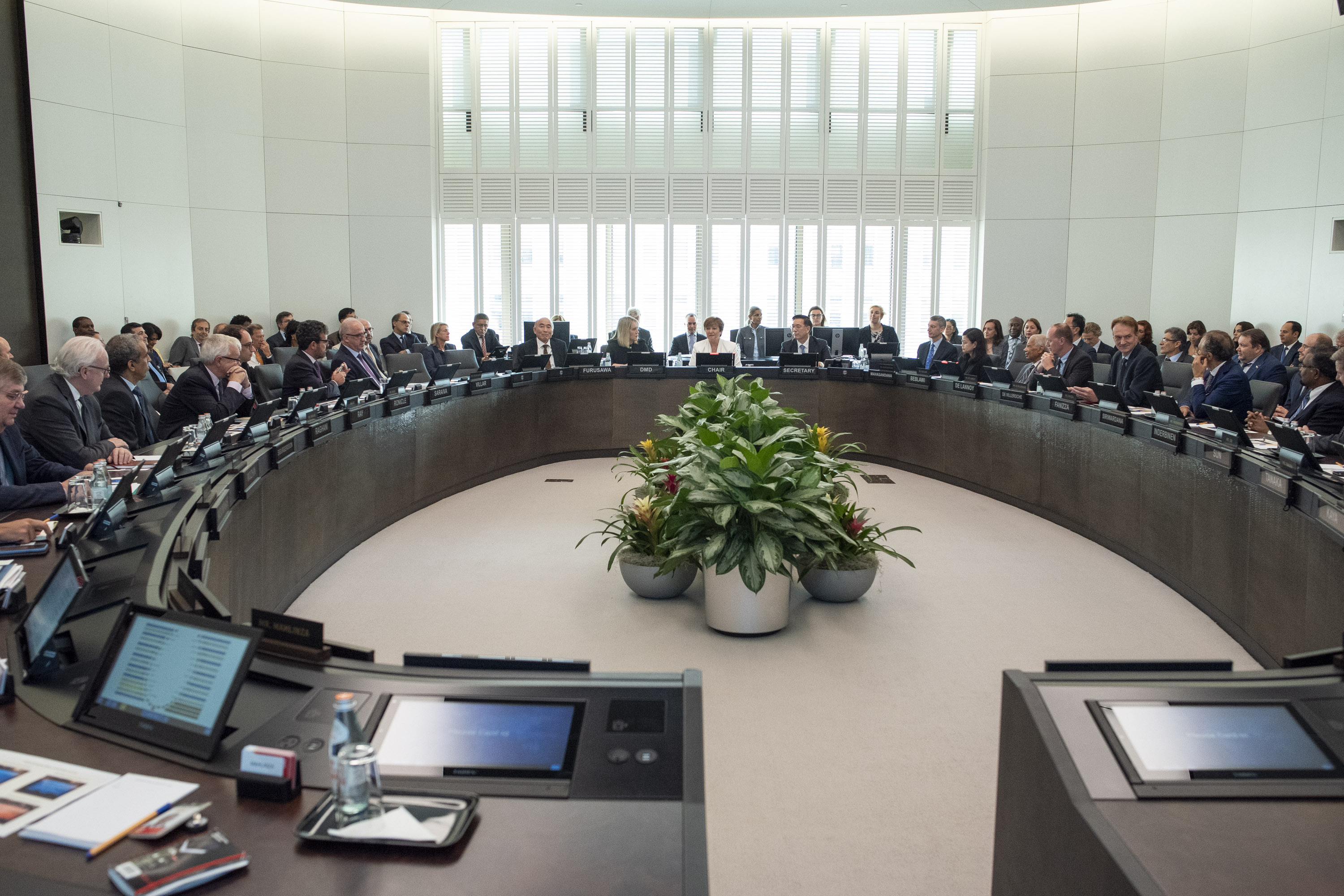
IMF Executive Board Completes Second Review Under the Extended Credit Facility for Zambia and Approves US$187 Million Disbursement
IMF News, December 20, 2023
Source details
- Canonical URL
- IMF Executive Board Completes Second Review Under the Extended Credit Facility for Zambia and Approves US$187 Million Disbursement
Other formats
Bibliographic details
- Published: December 20, 2023
Program review and disbursement
- The Executive Board completed the second review of the 38-month Extended Credit Facility (ECF) Arrangement for Zambia.
- Completion of the second review allows for an immediate disbursement of SDR 139.88 million (about US$187 million).
- The disbursement brings Zambia’s total disbursement under the ECF to SDR 419.64 million (about US$561 million).
- Zambia’s ECF Arrangement was adopted on August 31, 2022, for a total of SDR 978.2 million (100 percent of quota, about US$1.3 billion).
- The ECF supports Zambia’s 8th National Development Plan objectives: entrench macroeconomic stability, attain debt and fiscal sustainability, foster inclusive growth, and improve livelihoods, especially for the vulnerable.
Program performance and conditionality
- Overall program performance: satisfactory despite a challenging domestic and global environment.
- Quantitative performance criteria: All but one quantitative performance criteria for the second review were met.
- The authorities requested a waiver of nonobservance for missing the end-June 2023 net international reserve target as they have put in place corrective measures.
- Structural conditionality: Four out of seven structural benchmarks were met; two others were completed with minor delays.
- Debt treatment and creditor engagement:
- The authorities agreed on a Memorandum of Understanding (MoU) with the Official Creditor Committee (OCC) on October 14, 2023, reflecting the June 2023 debt treatment agreement and consistent with IMF program parameters.
- The authorities remain committed to reaching an agreement with private external creditors that respects comparability of treatment (CoT) as defined by the OCC and is consistent with IMF program parameters.
- The IMF statement emphasizes that prompt implementation of the MoU and agreement with private creditors on comparable terms are critical to restore debt sustainability over the medium term.
Economic performance and outlook
- Growth:
- Real GDP growth: 6.2 (2021), 5.2 (2022), 4.3 (2023), 4.7 (2024, proj.), 4.8 (2025, proj.).
- Growth was revised upwards to 4.3 percent in 2023 due to strong performance in the non-agricultural and non-mining sectors, despite weakened mining production.
- Inflation:
- Inflation annual average: 22.0 (2021), 11.0 (2022), 11.4 (2023), 7.8 (2024, proj.).
- Inflation end-of-year: 16.4 (2021), 9.9 (2022), 13.0 (2023), 8.6 (2024, proj.), 7.0 (2025, proj.).
- Public finances (central government):
- Revenue (% GDP): 22.4 (2021), 20.4 (2022), 20.9 (2023), 21.2 (2024, proj.), 21.9 (2025, proj.).
- Expenditure (% GDP): 30.5 (2021), 28.2 (2022), 27.7 (2023), 27.4 (2024, proj.), 27.3 (2025, proj.).
- Fiscal balance (cash basis, % GDP): -8.1 (2021), -7.8 (2022), -6.8 (2023), -6.1 (2024, proj.), -5.4 (2025, proj.).
- Fiscal balance (commitment basis, % GDP): -13.9 (2021), -6.4 (2022), -3.8 (2023), -3.3 (2024, proj.).
- Public debt (% GDP): 112.1 (2021), 110.9 (2022), … (2023).
- Money and credit:
- Broad money (% change): 3.7 (2021), 24.5 (2022), 18.4 (2023), 15.6 (2024, proj.).
- Credit to private sector (% change): 34.2 (2021), 31.4 (2022), 26.8 (2023), 22.6 (2024, proj.).
- 3-month Treasury bill interest rate (%): 12.8 (2021), 9.6 (2022).
- Balance of payments and external sector:
- Current account (% GDP): 9.7 (2021), -1.8 (2022).
- FDI (% GDP): 3.1 (2021), 1.2 (2022), 1.3 (2023), 2.0 (2024, proj.), 2.9 (2025, proj.).
- Reserves (in months of imports): 3.3 (2021), 3.4 (2022), 4.0 (2023), 5.0 (2024, proj.).
- REER (% change): 30.3 (2021).
- Sources for indicators: Zambian authorities, and IMF Staff estimates and projections.
Policy recommendations, central bank and governance measures
- Fiscal policy:
- Sustain fiscal consolidation to safeguard macroeconomic stability.
- Scale up revenue mobilization, including broadening the tax base and removing exemptions, to preserve social spending, clear domestic arrears, and address development needs.
- Public financial management reforms to enhance budget execution and the quality of government spending.
- Debt and creditor engagement:
- Prompt implementation of the MoU with official bilateral creditors.
- Reach agreement with private creditors consistent with the program’s parameters and comparability of treatment.
- Monetary and exchange rate policy:
- The Bank of Zambia stands ready to tighten monetary policy further to ensure inflation falls within the monetary policy band.
- Maintain exchange rate flexibility and step up the pace of reserve accumulation to strengthen external resilience.
- Financial sector and inclusion:
- Continue financial sector reforms to promote financial stability and inclusion.
- Governance and structural reforms:
- Enhance procurement, disclose beneficiary ownership, enhance access to public information, and combat corruption to foster private investment and inclusive growth.
- Integrate climate mitigation and adaptation strategies into national policies.
IMF Executive Board Completes Second Review Under the Extended Credit Facility for Zambia and Approves US$187 Million Disbursement (Press Release No. 23/468, December 20, 2023).