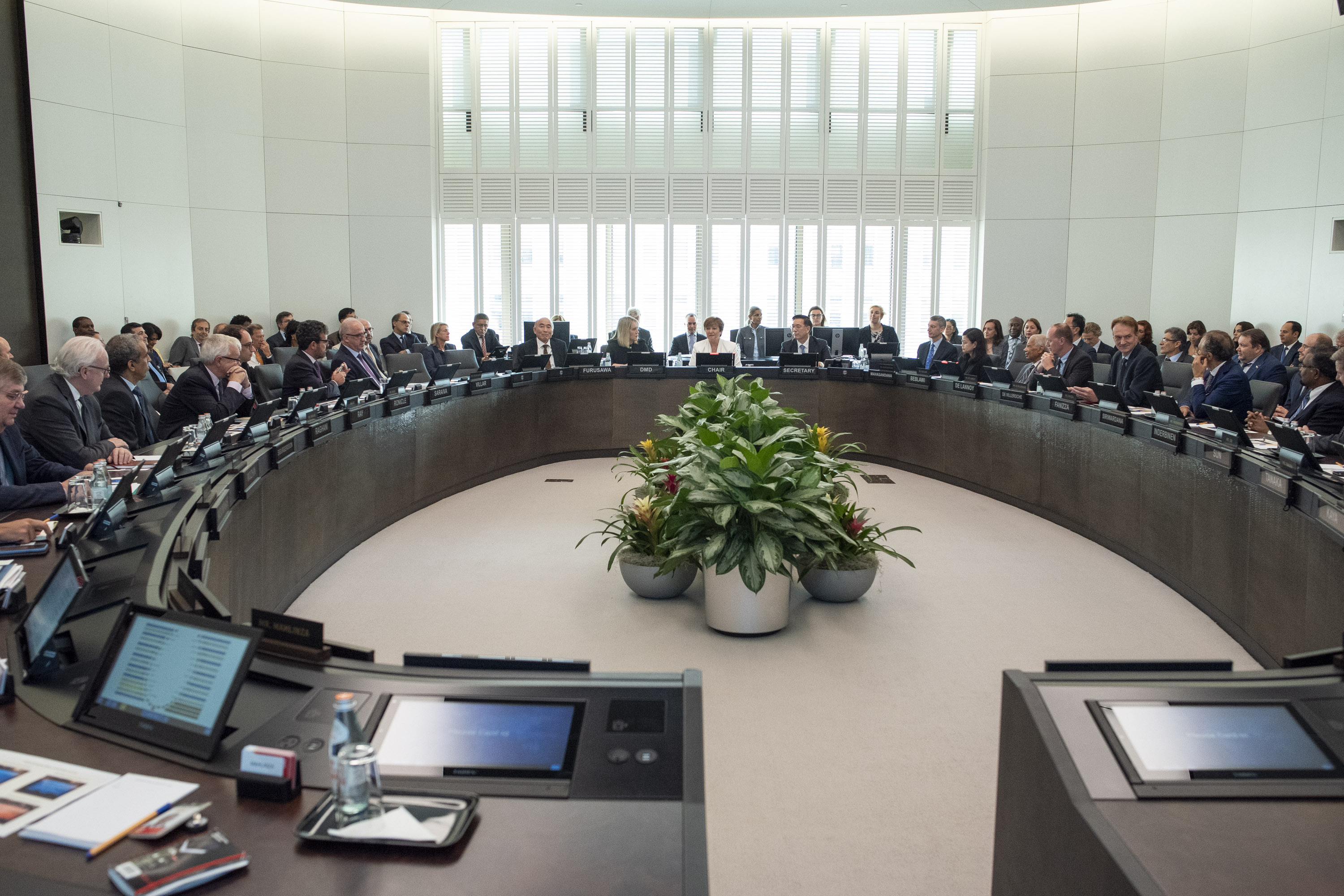
Jordan—IMF Executive Board Completes Third Review of the Extended Fund Facility Arrangement and Approves US$ 700 Million Arrangement under the Resilience and Sustainability Facility
IMF News, June 25, 2025
Source details
- Canonical URL
- Jordan—IMF Executive Board Completes Third Review of the Extended Fund Facility Arrangement and Approves US$ 700 Million Arrangement under the Resilience and Sustainability Facility
Other formats
Bibliographic details
- Published: June 25, 2025
Executive Board decisions and financing
- The Executive Board completed the third review under the Extended Fund Facility (EFF) Arrangement with Jordan, providing immediate access to the equivalent of SDR 97.784 million (about US$134 million).
- Jordan’s four-year EFF arrangement has access amounting to SDR 926.37 million (about US$1.3 billion, equivalent to 270 percent of Jordan’s quota in the IMF). The arrangement was approved on January 10, 2024.
- The immediate EFF purchase brought total purchases under the EFF arrangement to the equivalent of SDR 437.454 million (about $595 million).
- The Executive Board approved a new 30-month arrangement under the Resilience and Sustainability Facility (RSF) with access equivalent to SDR 514.65 million (about US$ 700 million, equivalent to 150 percent of Jordan’s quota).
Program objectives and reform focus
- Purpose of RSF arrangement:
- Address longer-term vulnerabilities in the water and electricity sectors.
- Enhance the authorities’ ability to address public health emergencies, including future pandemics.
- Strengthen Jordan’s longer-term balance of payments stability by promoting economic resilience and sustainability.
- Augment policy space and financial buffers to mitigate risks from those challenges.
- RSF reform measures focus on:
- (i) enhancing the energy sector’s financial sustainability and energy efficiency;
- (ii) improving the water sector’s financial sustainability and water management;
- (iii) strengthening fiscal and financial sector resilience;
- (iv) enhancing pandemic preparedness.
- EFF and RSF support Jordan’s structural reform agenda to foster inclusive private sector-led growth by enhancing the business environment and improving labor market policies, including to expand opportunities for youth and women.
Recent macroeconomic developments and outlook
- Growth:
- Growth reached 2.5 percent in 2024.
- Economic activity is expected to gradually strengthen in the coming years, supported by continued sound macroeconomic policies and accelerated reform implementation.
- Selected projections: Real GDP growth — 2023: 2.9; 2024: 2.5; 2025 Proj.: 2.7.
- Inflation and monetary stance:
- Inflation remains stable and low, reflecting the Central Bank of Jordan’s (CBJ) firm commitment to monetary and financial stability and the exchange rate peg.
- Consumer Price Index (annual average) — 2024: 2.2; 2025 Proj.: 2.3; 2026 Proj.: 2.6.
- External sector and reserves:
- Jordan’s external position remains stable, with the current account deficit projected to remain close to 6 percent of GDP.
- The CBJ’s gross international reserves increased to over US$20 billion by end-2024, with reserve adequacy exceeding 100 percent of the Fund’s ARA metric.
- Gross reserves (in months of imports) — 2023: 6.9; 2024: 7.7; 2025 Proj.: 7.1.
- In percent of Reserve Adequacy Metric — 2023: 101; 2024: 110; 2025 Proj.: 105.
- Financial sector and credit:
- The financial sector remains healthy and well-capitalized.
- Broad money (percent change) — 2023: 6.1; 2024: 5.1; 2025 Proj.: 5.6.
- Credit to the private sector (percent change) — 2023: 1.7; 2024: 4.6; 2025 Proj.: 6.0.
- Labor market:
- Unemployment — 2023: 22.0; 2024: 21.4.
- Fiscal sector and public debt:
- Authorities continue gradual fiscal consolidation to place public debt on a downward path while creating room for social assistance and needed public investment.
- Selected government finance indicators (in percent of GDP):
- Revenue and grants 2/ — 2023: 25.2; 2024: 24.9; 2025 Proj.: 25.4; 2026 Proj.: 26.0.
- Expenditures 2/ — 2023: 30.6; 2024: 31.4; 2025 Proj.: 31.2; 2026 Proj.: 30.5.
- Overall central government balance — 2023: -5.4; 2024: -6.4; 2025 Proj.: -5.8; 2026 Proj.: -4.5.
- Central government primary balance (exc. grants, NEPCO and WAJ) — 2023: -2.7; 2024: -2.8; 2025 Proj.: -2.0; 2026 Proj.: -1.0.
- Combined public sector balance 3/ — 2023: -3.6; 2024: -2.4.
- Government gross debt 4/ — 2023: 113.5; 2024: 114.7; 2025 Proj.: 115.7; 2026 Proj.: 114.9.
- Government gross debt, net of SSC holdings of government debt 4/ — 2023: 89.0; 2024: 90.2; 2025 Proj.: 89.7; 2026 Proj.: 87.5.
- FDI (in percent of GDP) — 2023: 3.6; 2024: 3.0; 2025 Proj.: 3.3; 2026 Proj.: 3.4.
- Nominal GDP (JD billions) — 2023: 36.3; 2024: 37.9; 2025 Proj.: 39.8; 2026 Proj.: 42.0.
- Notes and data sources:
- CPI: Consumer Price Index (annual average).
- Fiscal measures: Includes the programmed amount of fiscal measures that are needed to meet fiscal targets.
- Combined public sector balance: Sum of the primary central government balance (exc. grants and net transfers to NEPCO-electricity company and WAJ-water company) and the net loss of NEPCO, WAJ and water sector distribution companies.
- Government gross debt: Government's direct and guaranteed debt (including NEPCO and WAJ debt). SSC stands for Social Security Corporation.
- Sources: Jordanian authorities; and Fund staff estimates and projections.
Key policy recommendations and authorities’ actions (from the Acting Chair’s statement)
- Fiscal policy:
- Continue the course of gradual fiscal consolidation and strengthening fiscal sustainability.
- Further enhance revenue mobilization and spending efficiency.
- Take contingency measures as needed to keep public debt on a steady downward path, while protecting priority social and capital spending.
- Improve the efficiency and viability of public utilities to preserve public finance sustainability and improve service delivery.
- Monetary and financial stability:
- Maintain monetary policy appropriately focused on safeguarding monetary and financial stability and supporting the exchange rate peg.
- Continue strengthening systemic risk analysis, financial sector oversight, and crisis management at the central bank.
- Structural reforms and external support:
- Accelerate structural reforms to improve the business environment, promote competition, and attract private investment to create a dynamic and resilient private sector and foster job-rich growth.
- Strong and timely donor support remains essential to help Jordan navigate the external environment, host refugees, and meet development objectives.
- RSF-specific reforms:
- Implement reforms to enhance energy sector financial sustainability and energy efficiency, improve water sector financial sustainability and water management, strengthen fiscal and financial sector resilience, and enhance pandemic preparedness.
International Monetary Fund press release — June 25, 2025.
References
- https://www.imf.org/-/media/images/imf/bios/imfboard.jpg
- The Executive Board
- PRESS CENTER
- Jordan and the IMF
- IMF-World Bank Debt Sustainability Framework for Low-Income Countries -- A Factsheet
- Special Drawing Rights (SDRs) -- A Factsheet
- Press Releases
- Extended Fund Facility (EFF)
- Press Release No. 24/004
- Resilience and Sustainability Facility (RSF)
- https://www.imf.org/en/home