Central, Eastern, and South-Eastern Europe: Safeguarding the Recovery as the Global Liquidity Tide Recedes
IMF Blog, April 29, 2014
Source details
- Canonical URL
- Central, Eastern, and South-Eastern Europe: Safeguarding the Recovery as the Global Liquidity Tide Recedes
Other formats
Bibliographic details
- Authors: Reza Moghadam, Aasim M Husain, Anna Ilyina
- Published: April 29, 2014
Economic growth and headline projection
- Growth is gathering momentum in most of Central, Eastern, and South-Eastern Europe (CESEE) in the wake of the recovery in the euro area.
- Excluding the largest economies—Russia and Turkey—the IMF’s latest Regional Economic Issues report projects the region to grow 2.3 percent in 2014, almost twice last year’s pace.
Key risks and recent market developments
- An unusual constellation of risks clouds the outlook: geopolitical tensions surrounding Russia and Ukraine; more challenging global financial conditions as monetary policy in advanced economies normalizes; and the possibility of protracted weak growth in the euro area.
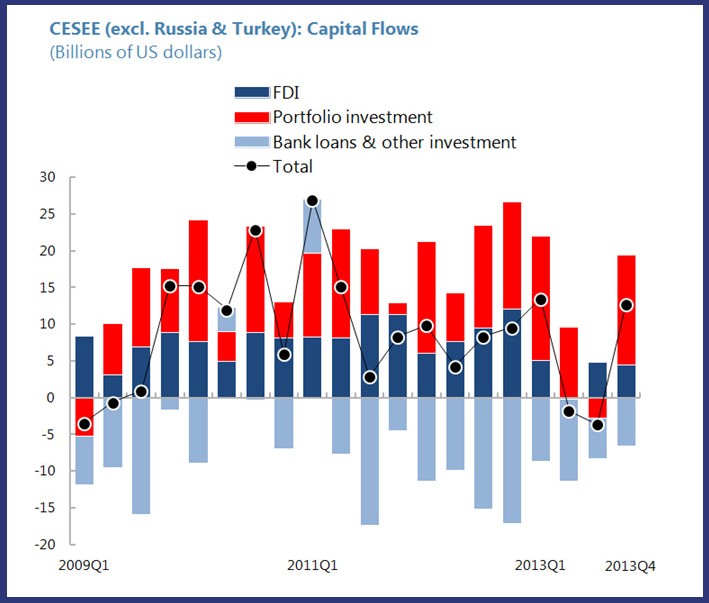
- As market jitters over Fed tapering intensified, portfolio outflows from the region (excluding Russia and Turkey) exceeded inflows in 2013Q3—for the first time since 2009.
- Episodes of investor retrenchment occurred in May and June last year and again in January of the current year, reflecting exposure to currency movements and sudden shifts in foreign investor appetite.
Regional vulnerabilities and exposure
- The region comprises 22 countries: Albania, Belarus, Bosnia and Herzegovina, Bulgaria, Croatia, Czech Republic, Estonia, Hungary, Kosovo, Latvia, Lithuania, Macedonia, Moldova, Montenegro, Poland, Romania, Russia, Serbia, Slovak Republic, Slovenia, Turkey, and Ukraine.
- Most countries have greatly improved their current account positions since 2007, but many still have a high stock of external debt and large refinancing needs.
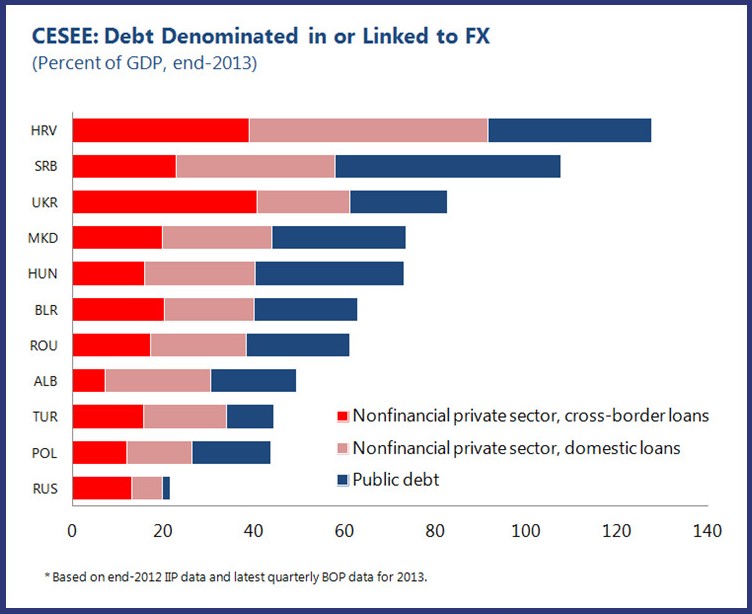
- Increased borrowing in foreign currency and from non-residents raises exposure to currency movements and sudden shifts in foreign investor appetite.
- Most countries rely on a few common creditors (large cross-border banks or global asset management companies), making them vulnerable to spillovers through those lenders.
- Austrian banks serve as the largest cross-border lenders to the region, on a scale equivalent to over 60 percent of Austria’s GDP. A shock to a country in which Austrian banks have high exposure, or a shock in Austria itself, could prompt readjustment of the entire portfolio of regional exposures by Austrian banks.
Empirical and simulation findings
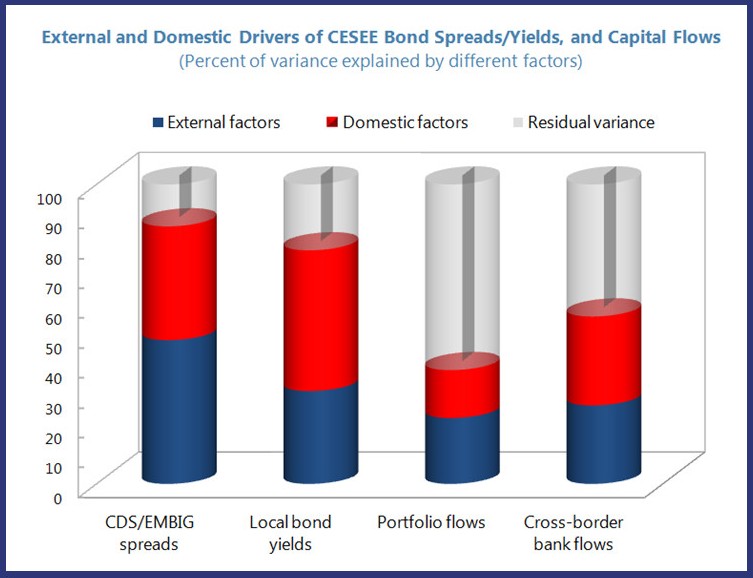
- Empirical analysis in the April 2014 report confirms that higher interest rates in advanced economies, higher global investor risk aversion, and tighter global liquidity conditions have been associated with increased funding costs and reduced capital flows to CESEE countries.
- Simulation analysis in the April 2014 report shows that a faster U.S. economic recovery, which would presumably accompany faster normalization, would boost growth. However, for most countries, this positive effect could be more than offset by the contractionary impact of tighter global monetary conditions and financial market volatility.
- Weak host-country macroeconomic and banking sector fundamentals (asset quality, profitability, heavy reliance on non-deposit funding) increase the risk of outside lenders cutting back cross-border funding.
Policy implications and recommendations
- Bigger buffers matter a great deal in reducing the effects of external shocks and unlocking higher growth potential.
- Better domestic fundamentals—such as higher economic growth potential and lower fiscal and current account deficits—are strongly associated with lower sovereign bond yields, helping countries better manage their debt burden by allowing them to borrow at a lower cost.
- Less favorable domestic factors—such as higher public sector debt or lower market liquidity—tend to push yields higher.
- Strong and measured policies will be essential:
- Countries with exchange rate and monetary policy flexibility should continue to use it as the principal line of defense during episodes of market volatility.
- Diversifying funding sources and deepening the local investor base will reduce countries’ vulnerability to shocks and to contagion through common lenders.
- Rebuilding fiscal space and addressing problems exposed by the crisis—structural weaknesses that are holding back growth and keeping unemployment unacceptably high and high levels of nonperforming loans that are hamstringing credit—will raise growth potential and help to safeguard against external shocks.
Reza Moghadam, Aasim M. Husain, Anna Ilyina; April 29, 2014
Content in this bundle
- Orta, Doğu ve Güneydoğu Avrupa: Küresel Likidite Dalgası Çekilirken Toparlanmayı Korumak
References
- IMF’s latest Regional Economic Issues report
- https://www.imf.org/wp-content/uploads/2014/04/figure-11.jpg
- https://www.imf.org/wp-content/uploads/2014/04/figure-21.jpg
- https://www.imf.org/wp-content/uploads/2014/04/figure-33.jpg
- https://www.imf.org/wp-content/uploads/2014/04/figure-41.jpg
- https://www.imf.org/wp-content/uploads/2014/04/figure-5.jpg