Targeted Policies Mean True Transformation in Africa
IMF Blog, May 8, 2014
Source details
- Canonical URL
- Targeted Policies Mean True Transformation in Africa
Other formats
Bibliographic details
- Authors: Antoinette M Sayeh
- Published: May 8, 2014
Overview
- Author: Antoinette M. Sayeh
- Date: May 8, 2014
- Central question: What concrete policies can make growth in sub-Saharan Africa more inclusive and reduce poverty?
Recent growth and human development outcomes
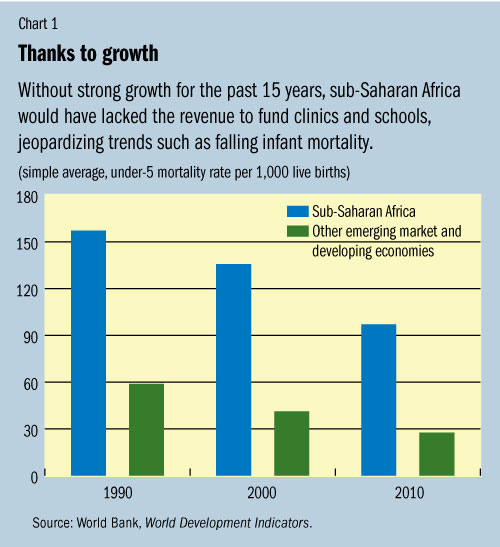
- Growth in sub-Saharan Africa over the past 15 years has on average been quite strong.
- Several human development indicators, including infant and maternal mortality, primary school enrollment and completion rates, have improved.
- Despite improvements, many countries will not be able to meet the United Nations Millennium Development Goals, especially that of halving poverty.
- Conclusion: Strong growth is necessary to generate revenue for clinics, schools, and qualified nurses and teachers, but growth has not been sufficiently inclusive in many countries.
Structural transformation: Mozambique versus Vietnam
- Both Mozambique and Vietnam delivered remarkably similar growth in GDP per capita over extended periods and both transitioned from centrally planned economies after prolonged wars.
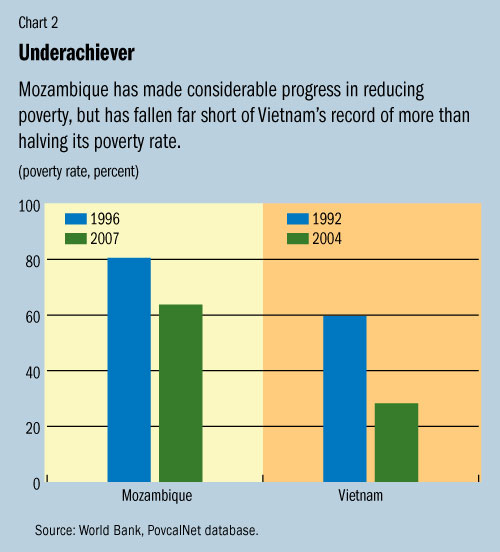
- Divergence in poverty reduction:
- Vietnam managed to more than halve its poverty between 1992 and 2004.
- Mozambique made progress but fell well short of Vietnam’s achievement.
- Two key drivers of Vietnam’s stronger poverty reduction:
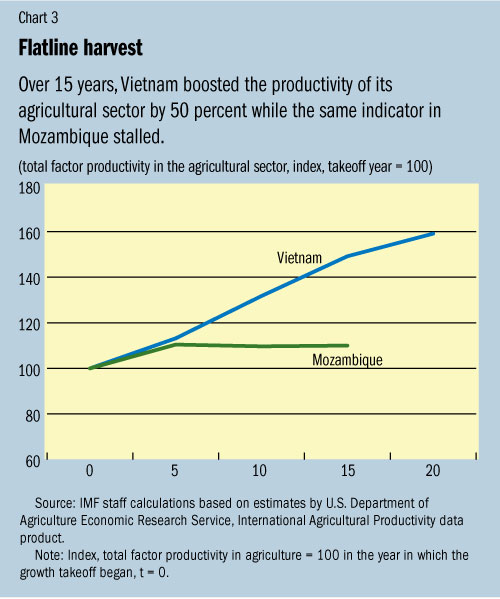
- Sustained increases in agricultural productivity in staple crops (rice) and cash crops (coffee).
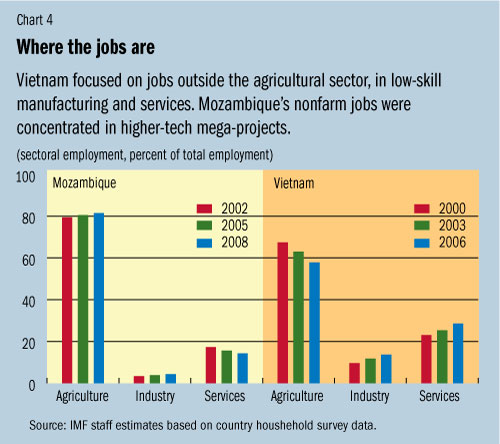
- Significant generation of employment outside agriculture, especially in low-skill manufacturing and services.
- Productivity comparison (agriculture, 15-year period):
- Vietnam: total factor productivity in the agricultural sector improved by 50 percent.
- Mozambique: total factor productivity in the agricultural sector improved by less than 15 percent.
- Mozambique’s high economic growth has largely emanated from “mega-projects”—aluminum smelters, coal mines—which are capital intensive and typically do not employ many people, limiting direct poverty-reduction impacts.
Policy recommendations ("biggest bang for the buck")
- Maintain macroeconomic, financial, and social stability as prerequisites for sustained improvements in income and social indicators.
- Create physical infrastructure and incentive structures that allow the economy to create more productive jobs.
- Prioritize absorption of a rapidly growing young labor force:
- By 2020 more than a third of the working-age population in sub-Saharan Africa will be below the age of 25.
- Absorbing these people into productive activities is crucial to avoid social tensions and political instability.
- Support household enterprises (largely in agriculture and services) to increase their productivity, because:
- This is where most people in sub-Saharan Africa are—around 60–70 percent of the population.
- Promote financial inclusion to foster more inclusive growth by:
- Encouraging savings and removing financing obstacles to entrepreneurial activities.
- Lowering transaction costs for the poor (for example, mobile money transfers) facilitates financial inclusion more rapidly than creating specialized financial institutions.
Key takeaways
- Targeted policies that promote structural transformation—raising agricultural productivity and expanding non-agricultural employment—can make growth more inclusive and accelerate poverty reduction.
- Complement public-revenue-generating mega-projects with policies that increase labor productivity for a broad segment of the population.
- Financial inclusion and support to household enterprises offer high returns in terms of poverty reduction and inclusive growth.
- Shared growth is described as more likely to be stronger and more durable, making inclusivity both a moral and pragmatic imperative.
Source: Antoinette M. Sayeh, "Targeted Policies Mean True Transformation in Africa", May 8, 2014.