Too Much At Stake: Moving Ahead with Energy Price Reforms
IMF Blog, July 31, 2014
Source details
- Canonical URL
- Too Much At Stake: Moving Ahead with Energy Price Reforms
Other formats
Bibliographic details
- Authors: Ian Parry
- Published: July 31, 2014
Energy, environment, and macroeconomic implications
- Energy use delivers substantial economic benefits but drives major environmental harms, including:
- Predicted global warming of "around 3–4 degrees Celsius by the end of the century".
- Outdoor air pollution "causing over three million premature deaths a year".
- These environmental impacts have macroeconomic implications that justify price-based policy responses.
- The IMF applies its expertise in tax design and administration to advise how energy tax systems can ensure prices reflect adverse environmental impacts.
Methodology and scope
- The IMF-developed approach:
- Quantifies environmental damages in a "sensible and reasonably simple" way.
- Is applied "in over 150 countries" to derive implications for efficient taxes on coal, natural gas, gasoline, and road diesel.
- Calculates human health damages from air pollution by estimating population exposure to power plant and vehicle emissions and the associated increased risk of diseases (e.g., heart and lung diseases).
- The methodology is flexible to accommodate alternative valuations (e.g., global warming damages, differing valuations of health risk) and is presented as a starting point for debate.
Policy instruments and tax design recommendations
- General recommendations:
- Focus on "smarter taxes, not higher taxes."
- Use environmental taxes or similar pricing instruments to "get prices right" by reflecting environmental side effects in energy prices.
- Recycle revenues to lower other distortionary taxes or meet fiscal objectives, improving environmental and health outcomes while limiting macroeconomic costs.
- Finance ministers have a central role in administration and in restructuring tax systems away from taxes "likely to be most harmful for efficiency and growth, such as income taxes," toward carefully designed energy taxes.
- Tax base recommendations:
- Carbon emissions: price through levies on fossil fuel suppliers in proportion to a fuel’s carbon content, building off existing motor fuel taxes.
- Local air pollution: levy similar charges on fuel supply, but provide credits/refunds for emissions capture (e.g., sulfur dioxide "scrubbing" at power plants) because net emissions determine damages.
- Motor vehicles: charges on kilometers driven (varying with urban road class and time of day) are the most effective long-term solution for congestion; interim step is to reflect carbon, pollution, congestion, and accident risks in fuel taxes.
- Tax rate recommendation:
- Set rates "in line with environmental damages" so pricing ensures only environmental improvements with net benefits are induced.
Key quantitative findings from the assessment
- Coal:
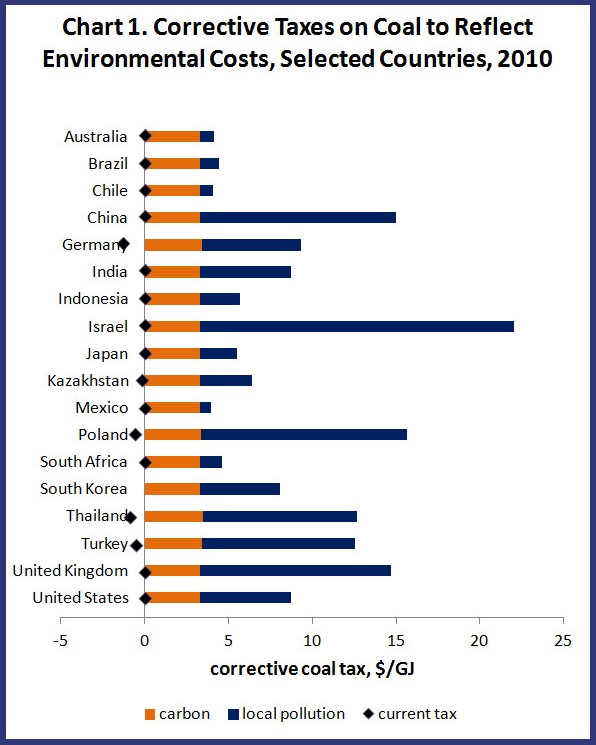
- Carbon charges shown in Chart 1 amount to "$3.3 per gigajoule of energy (about two-thirds of the average world price)".
- Air pollution damages exceed "$10 per gigajoule" in countries like China and Poland.
- Air pollution damages are "less than $1 per gigajoule" in Australia and Chile.
- Gasoline and road fuels:
- Corrective taxes on gasoline are "substantial across advanced, emerging, and developing countries", driven more by congestion and accident costs than by air pollution and carbon emissions.
- Aggregate global impacts of implementing corrective fossil fuel taxes (relative to the current situation):
- Estimated reduction in global carbon emissions of "23 percent".
- Save "63 percent" of fossil fuel pollution deaths.
- Provide fiscal benefits averaging "2.6 percent of countries’ gross domestic product".
Framing and caveats
- Some controversies are acknowledged, including valuation of global warming damages and cross-country differences in valuing health risks.
- The approach is described as a flexible starting point, not a definitive final settlement.
Ian Parry, July 31, 2014 — Too Much At Stake: Moving Ahead with Energy Price Reforms
Content in this bundle
- 事关重大:推进能源价格改革; 作者:Ian Parry; iMFdirect博客; 2014年7月31日
- 多くの効果がここに: 燃料改革を前進させる; イアン・パリー iMFdirect ブログ 2014年7月31日掲載
- Ставки слишком высоки: проведение реформ цен на энергоносители; Иэн Перри; Блог iMFdirect