Legacies, Clouds and Uncertainties
IMF Blog, October 7, 2014
Source details
- Canonical URL
- Legacies, Clouds and Uncertainties
Other formats
Bibliographic details
- Authors: Olivier Blanchard
- Published: October 7, 2014
Global outlook and headline projections
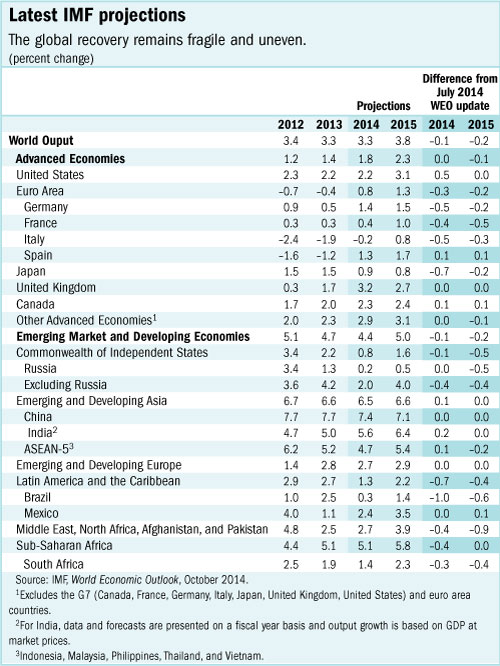
- We forecast world growth to be 3.3% in 2014, down 0.1% from our July forecast, and 3.8% in 2015, down 0.2% from our July forecast.
- The recovery continues, but it is weak and uneven.
- Economic evolutions are becoming more differentiated across countries due to differing impacts of past legacies and lowered expectations about future potential growth.
Two dominant forces shaping outcomes
- Legacy effects from the financial crisis: debt overhangs, high unemployment, and other after‑effects continue to weigh on demand and balance sheets.
- Anticipated weaker futures: downward revisions of potential growth are reducing confidence, demand, and growth today.
- These two forces operate with varying intensity across countries, increasing differentiation in growth trajectories.
Advanced economies: heterogeneity and constraints
- United States and the United Kingdom are leaving the financial crisis behind and achieving decent growth; even so, potential growth is lower than in the early 2000s.
- Japan is growing, but faces major macroeconomic and fiscal challenges due to high public debt inherited from the past and very low potential growth going forward.
- The euro area nearly stalled earlier this year, even in the core; both legacies (primarily in the south) and low potential growth nearly everywhere are slowing recovery.
Emerging markets: adjustments and divergence
- For emerging market economies as a whole, potential growth is now forecast to be 1.5% lower than it was in 2011.
- China is maintaining high growth despite the end of a housing and a credit boom; rebalancing is likely to imply slightly lower growth, viewed as a healthy development.
- India has recovered from its relative slump and, thanks in part to policy and a renewal of confidence, growth is expected to exceed 5% again.
- Russia faced low growth before the Ukraine crisis due to uncertain investment prospects; the crisis has made it worse.
- Brazil is weighed down by uncertain prospects and low investment.
- Low income developing countries continue to do remarkably well despite a slowdown in commodity prices; we forecast their growth rate to b 6.1% in 2014, 6.5 in 2015.
Downside risks
- Extended period of low interest rates has led to some search for yield; financial markets may be too complacent about the future.
- Macroprudential tools are the right instruments, but there is concern they may not be up to the task.
- Geopolitical risks have become more relevant:
- So far, little evidence that the Ukraine crisis has had measurable effects beyond affected countries and immediate neighbors.
- Turmoil in the Middle East has not substantially affected the level or volatility of energy prices to date, but risks of future effects remain.
- A stalling of the recovery in the euro area is a material risk: demand could weaken further and low inflation could turn into deflation. This is not the baseline, but would be a major global issue if it occurred.
Policy implications and recommendations
- Advanced economies must address both legacies of the crisis and low potential growth:
- While improving bank balance sheets has been a major focus, debt overhang of firms and households remains an issue in a number of countries.
- So long as demand remains weak, monetary accommodation and low interest rates remain essential.
- Fiscal policy stance in the euro area:
- Low spreads on sovereign bonds suggest past fiscal consolidation has built credibility; this credibility should not be threatened.
- There is scope for fiscal policy to sustain the recovery: infrastructure investment, even if debt financed, may be justified to help demand in the short run and supply in the medium run.
- Being ready to do more if the risk of stalling materializes is important.
- Raise potential growth where possible:
- Higher potential growth would ease fiscal and financial challenges, but increasing potential output is a tall order and expectations should remain realistic.
- Specific structural reforms in most countries can help; the challenge is to identify which reforms are most needed and politically feasible rather than relying on the generic mantra of “structural reforms.”
- Overarching policy challenge:
- Reestablish confidence through a clear plan to deal with both the legacies of the crisis and the challenge of low potential growth.
Source: Olivier Blanchard, "Legacies, Clouds and Uncertainties", October 7, 2014.
Content in this bundle
- 危机遗留问题、阴影和不确定性; iMFdirect博客; 2014年10月7日
- 遺産、暗雲、不確実性: オリビエ・ブランシャール iMFdirect ブログ 2014年10月7日掲載
- Наследие кризиса, угрозы, неопределенность; Оливье Бланшар; Блог iMFdirect; 7 октября 2014 года