(Yet) Another Year of Subpar Growth: Latin America and the Caribbean in 2015
IMF Blog, January 21, 2015
Source details
- Canonical URL
- (Yet) Another Year of Subpar Growth: Latin America and the Caribbean in 2015
Other formats
Bibliographic details
- Authors: Alejandro Werner
- Published: January 21, 2015
Regional overview
- Regional growth is projected at just 1¼ percent, about the same low rate as in 2014 and almost 1 percentage point below our previous forecast.
- Global growth forecast for 2015 stands at 3½ percent.
- Challenging external conditions—particularly weaker dynamics in the euro area, China, and Japan—are important drags for many countries despite improved U.S. prospects.
- Investment has slowed every single year since 2010 and is forecast to decline in 2015.
Winners and losers from cheaper oil
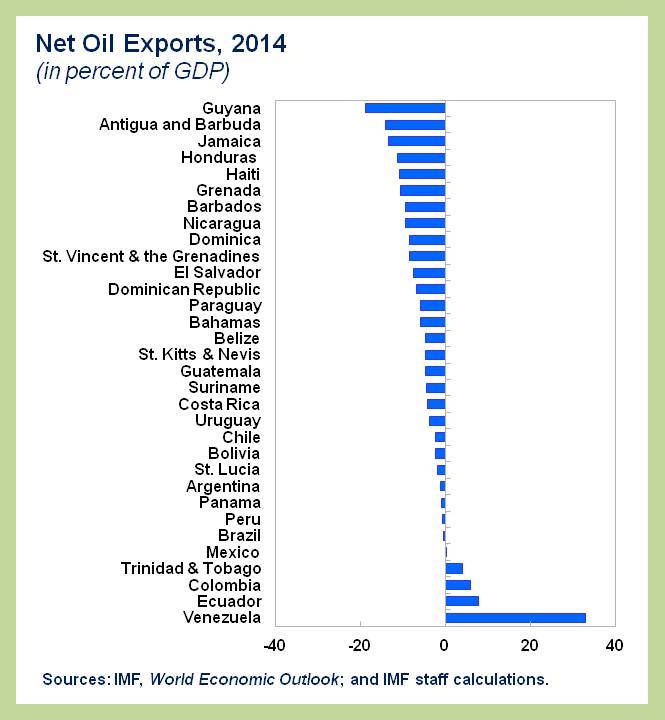
- The drop in oil prices is expected to be broadly neutral for Latin America and the Caribbean at large, but with very different effects across individual countries.
- Venezuela
- Economy now forecast to contract by 7 percent in 2015.
- Each $10 decline in oil prices worsens Venezuela’s trade balance by 3½ percent of GDP.
- Loss in export revenue causes mounting fiscal problems and a sharper economic downturn.
- Bolivia, Colombia, Ecuador
- Lower oil prices are dampening growth prospects; fiscal balances will suffer from falling oil revenue, but initial positions are strong enough to weather the impact.
- Mexico
- Has protected its 2015 oil revenue through financial hedging.
- Petroleum sector plays a relatively modest role in the economy, so overall impact is limited.
- Oil importers (notably in Central America and the Caribbean)
- Generally benefit from cheaper oil.
- Some rely on subsidized oil deliveries from Venezuela under Petrocaribe; diminishing Petrocaribe support could cause short-term cash flow pressures in the public sector for some recipients.
- Longer-run effect
- Persistent weakness in oil prices would limit the potential from developing untapped hydrocarbon resources in countries including Argentina, Brazil, and Mexico.
Dimmed prospects in South America
- Weakness in metals and agricultural commodity prices, plus disappointing global growth, are weighing on South America.
- Exports are now expected to grow by only 1 percent on average this year.
- Country highlights
- Brazil
- Private sector confidence has remained stubbornly weak.
- Economic activity is anemic; output projected to expand only 0.3 percent this year.
- Authorities’ renewed commitment to rein in the fiscal deficit and reduce inflation should help shore up confidence.
- Chile and Peru
- Growth expectations pared back since October.
- In Chile, uncertainty over the impact of policy reforms seems to be weighing on investment.
- In Peru, weak exports and investment have driven a sharp recent slowdown; concerted policy action and new mining operations are expected to support a significant rebound this year.
- Argentina
- Despite some easing of exchange rate pressures and better-than-expected 2014 growth, Argentina continues to struggle with large macroeconomic imbalances.
- The economy is expected to contract in 2015.
Brighter conditions up North, Central America, and the Caribbean
- Mexico
- Projected to grow by 3.2 percent in 2015.
- Growth is solid though less than previously expected due to lingering sluggishness in domestic demand that offsets positive U.S. spillovers.
- Central America
- Outlook improved due to lower oil prices and the robust U.S. recovery.
- Remittances grew 9 percent (year-on-year) in the first three quarters of 2014 and, together with stronger exports, will underpin domestic activity.
- Caribbean
- Tourism-dependent economies have started to see a recovery in tourist arrivals.
Policy implications and recommendations
- Lower oil prices
- Will alleviate external and fiscal vulnerabilities in some countries.
- Provide an opportunity to phase out costly and poorly targeted energy subsidies, which are common across the region.
- South America
- Broad weakness of commodity prices has widened current account deficits further; flexible exchange rates can help cushion this external shock.
- Fiscal policy will need to adjust because earlier forecasts for commodity revenue and output growth are no longer realistic.
- Supply-side reforms (urgency emphasized)
- Boosting growth prospects and sustaining poverty reduction will require determined efforts to:
- Improve the business environment.
- Raise productivity.
- Increase saving and investment.
- Closing note
- It’s not too late for good New Year’s resolutions to address domestic weaknesses and improve growth prospects.
Alejandro Werner, January 21, 2015
Content in this bundle
- (Mais) um ano de crescimento abaixo da média: América Latina e Caribe em 2015; 20 de janeiro de 2015
- wreo1014