Fiscal Arrangements in Federations: Four Lessons for Europe
IMF Blog, February 25, 2015
Source details
- Canonical URL
- Fiscal Arrangements in Federations: Four Lessons for Europe
Other formats
Bibliographic details
- Authors: Martine Guerguil
- Published: February 25, 2015
Overview and purpose
- Publication: "Designing a European Fiscal Union: Lessons from the Experience of Fiscal Federations" (Routledge).
- Author of page summary: Martine Guerguil.
- Date: February 25, 2015.
- Scope: Examines the experience of 13 federal states to inform debate on whether the European Union needs closer fiscal integration and a stronger fiscal center.
- Core questions addressed by the book:
- What is the role of centralized fiscal policies in federations, and hence the size, features, and functions of the central budget?
- What institutional arrangements are used to coordinate fiscal policy between the federal and subnational levels?
- What are the links between federal and subnational debt, and how have subnational financing crises been handled, when they occurred?
Four salient features and comparative findings
- Central budget size and stabilizing role
- Unlike federations, the EU’s budget is extremely small and nearly entirely dependent on transfers from its members.
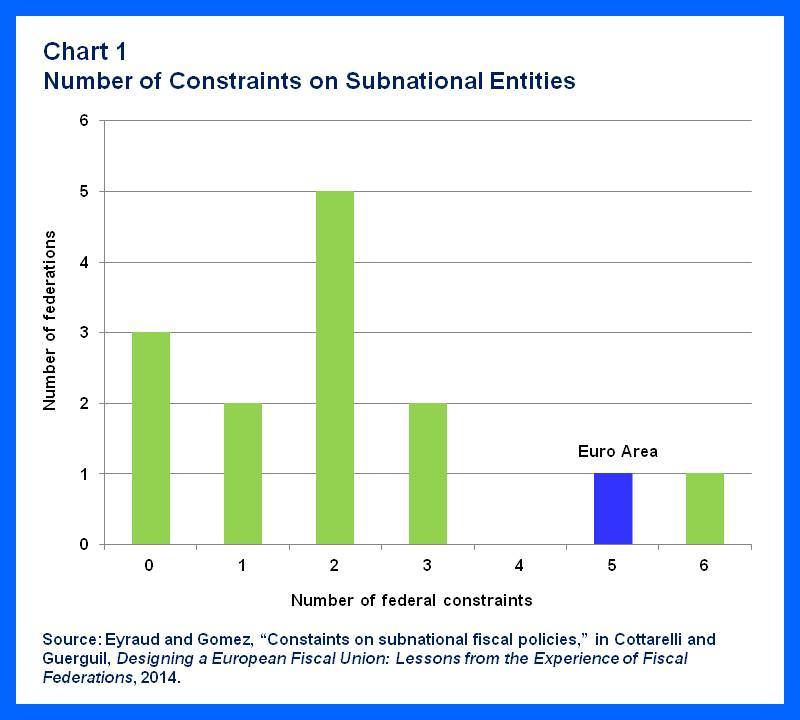
- Even in highly decentralized federations, the large size of the central budget, with its own taxing capacity, allows it to play an important stabilizing role (see Chart 1).
- Conclusion: The European Union has no economically-meaningful center and fiscal risk-sharing is nearly non existent; it remains to be seen whether this arrangement can survive as a permanent EU feature or whether a stronger form of fiscal centralization will be required.
- Fiscal discipline mechanisms
- The European Union is long on institutions but short on shared policy instruments.
- Because it opted for a small central budget, the EU relies much more than existing federations on an extensive set of institutional arrangements to ensure fiscal discipline (see Chart 2).
- This reliance raises significant enforcement, and thus credibility, challenges that will need to be addressed.
- Shared debt practices
- Shared debt is rarely seen in federations.
- Some euro-area proposals, such as common debt issuance and self-standing lending facilities for crisis support, are not a permanent feature of federations, although they have played a role in the early life of federations.
- Influence of subnational financial crises on institutional design
- Subnational financial crises have often, but not always, shaped fiscal responsibility sharing arrangements in federations.
- The role and size of the central government in federations reflects a combination of historical circumstances and social and political preferences.
- Example contrasts:
- The most decentralized federations are often those where states were independent entities before the establishment of the federation—cases that may be more relevant for the European Union.
- A succession of severe and protracted sub-national financial crises led to the introduction of substantial constraints on local budgets in a previously relatively decentralized federation like Brazil.
- Implication: The current crisis in the euro area may influence the future shape of the union beyond the resolution of the financing crisis itself.
Implications and outlook for Europe
- The concrete experiences of federations illuminate decisions and trade-offs the European Union will likely face.
- Given challenging economic and political circumstances in Europe, a prompt, well-articulated response may be impractical, but federation experiences will be informative for future choices.
Source: Fiscal Arrangements in Federations: Four Lessons for Europe, February 25, 2015.