Migrants Bring Economic Benefits for Advanced Economies
IMF Blog, October 24, 2016
Source details
- Canonical URL
- Migrants Bring Economic Benefits for Advanced Economies
Other formats
Bibliographic details
- Authors: Florence Jaumotte, Ksenia Koloskova, Sweta Saxena
- Published: October 24, 2016
Population and demographics
- Authors: Florence Jaumotte, Ksenia Koloskova, Sweta Saxena
- Date: October 24, 2016
- Key facts about migrant populations:
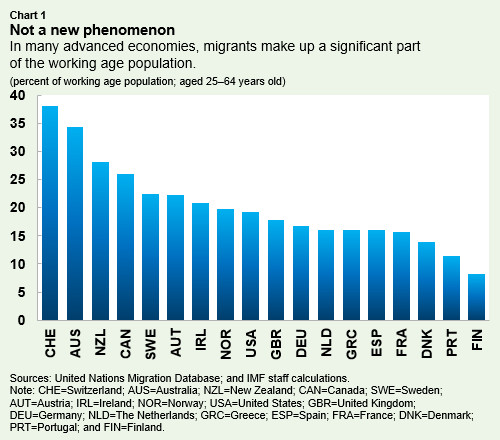
- Migrants constitute 15 to 20 percent of the working-age population in many advanced economies, and around 30 percent in some Anglo-Saxon countries such as Australia and New Zealand.
- Between 1990 and 2015, immigrants accounted for half of the growth in working age population of advanced economies.
- The stock of low-skilled migrants has been the largest (and broadly constant in percent of adult population over time), while the share of high-skilled has been on the rise.
- Anglo-Saxon countries tend to have a higher proportion of high-skilled migrants than continental European and Nordic countries.
- Migrants on average tend to be younger than their adopted country’s native-born population, increasing the share of working age population.
Migration can be a boon — findings on income and productivity
- Overall impact:
- A 1 percentage point increase in the share of migrants in the adult population increases GDP per person in advanced economies by up to 2 percent in the longer term.
- This increase comes primarily from an increase in labor productivity, instead of an increase in the workforce-to-population ratio.
- How migrants raise productivity:
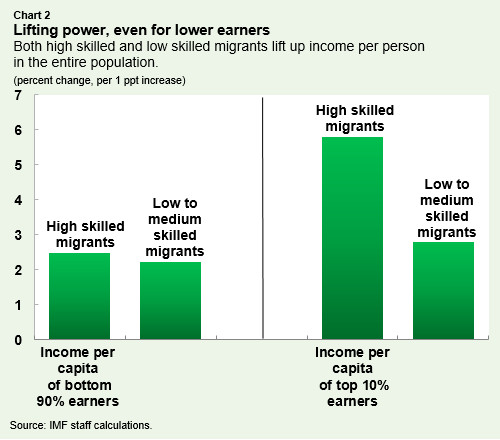
- Both high- and low-skilled migrants improve productivity; gains are not exclusive to high-skilled workers.
- Low-skilled migrants:
- Fill essential occupations for which the native-born population is in short supply, contributing to a more efficient functioning of the economy.
- Take up more manual routine tasks, enabling the native-born population to move to more complex occupations that require language and communication skills.
- Provide housekeeping and childcare services (the “nanny effect”), allowing native-born women to return to work, or work longer hours. Wherever more low-skilled migrants are present, more high-skilled females participate in the labor force.
- Distributional effects:
- An increase in the migrant share benefits the average income per person of both the bottom 90 percent and the top 10 percent of earners.
- High-skilled migration benefits more the average income of top earners.
- The presence of migrants does not seem to increase inequality within the bottom 90 percent of earners.
There is more work to do — integration and policy implications
- Central message:
- Immigration can bring substantial benefits to advanced economies in terms of higher per capita GDP and standards of living, and these gains are broadly shared. The key is addressing short-term challenges and ensuring migrants are integrated into the labor market.
- Policy measures to integrate migrants:
- Language training.
- Job search support.
- Better recognition of the education and work experience of migrants.
- Lower barriers to entrepreneurship.
- Fiscal and social considerations:
- Integrating migrants can add to fiscal cost pressures in the short run, but these policies allow migrants to obtain and keep a job at a relevant skill level, and increasingly contribute to the fiscal accounts.
- Native workers require help to adjust, including by upgrading their skills.
- Policymakers need to avoid possible overburdening of public services such as health care and education to contain possible buildup of social tensions.
Migrants Bring Economic Benefits for Advanced Economies — Florence Jaumotte, Ksenia Koloskova, Sweta Saxena; October 24, 2016.