Roads to Stronger Growth in Low-Income Countries
IMF Blog, January 12, 2017
Source details
- Canonical URL
- Roads to Stronger Growth in Low-Income Countries
Other formats
Bibliographic details
- Authors: Tao Zhang, Vladimir Klyuev
- Published: January 12, 2017
Overview
- Authors: Tao Zhang, Vladimir Klyuev
- Date: January 12, 2017
- Core message: Low-income countries should build more infrastructure—roads, electricity, sanitation, telecommunications, and water delivery—to strengthen growth and meet the 2030 Agenda for Sustainable Development. A chapter in a recent IMF report examines obstacles and policy options.
Challenges to scaling up infrastructure
- Public debt and external financing
- In many low-income countries, public debt levels have risen and external financing conditions have tightened, making loans for infrastructure more difficult and risky.
- During 2015 alone, the ratio of public debt to GDP rose from 34 to 42 percent.
- Capacity and resource constraints
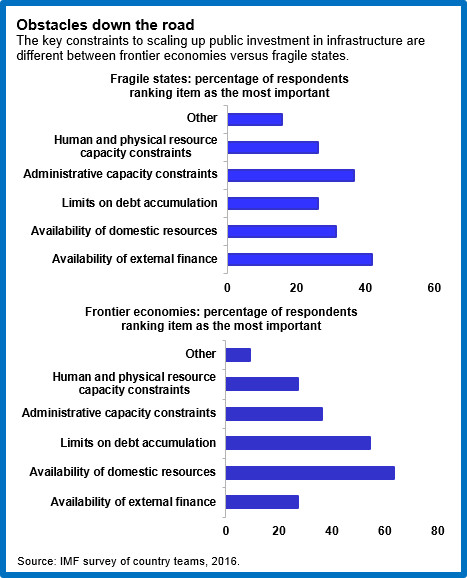
- A survey identifies availability of external financing and administrative capacity constraints as key obstacles in the most vulnerable countries.
- For low-income countries better connected to global capital markets, the sufficiency of domestic financial resources is the most important concern.
Improving public investment efficiency and domestic resource mobilization
- Public investment efficiency
- Value for money in public investment varies considerably among low-income countries and is generally lower than in other states.
- Broad principles (e.g., directing capital expenditure to the most productive projects) are understood but institutional mechanisms—effective cost-benefit analysis and transparent procurement—are often lacking.
- Domestic revenue measures
- More domestic resources from taxes can create space for priority spending on infrastructure.
- Persisting issues: tax revenues remain lower in poorer countries partly due to lower collection efficiency.
- Policy actions to expand fiscal space: improving tax administration; broadening the tax base; closing unjustified loopholes; streamlining expenditures; and, in some cases, raising tax rates.
- Concessional finance and multilateral banks
- Concessional financing will need to continue playing an important role.
- Increasing the capital of multilateral development banks and adjusting how they deploy capital could generate more resources for the poorest countries.
- The rise of new bilateral donors (particularly China) and new institutions (such as the Asian Infrastructure Investment Bank) has brought additional funds for development.
- Many potential donor countries face their own fiscal challenges, limiting prospects for a large increase in multilateral and bilateral donor financing.
- Even scaled up official development assistance is considered insufficient to meet the investment requirements of the Sustainable Development Goals by 2030.
Mobilizing private finance and public-private partnerships
- Evidence and potential
- There is little purely private infrastructure in low-income countries outside mobile telecommunications; the mobile sector demonstrates viability of private models.
- Small-scale applications (e.g., solar micro-grids) provide additional examples.
- Public-private partnerships (PPPs)
- PPPs are relatively frequent in electricity generation.
- Critical requirements: strong institutional framework and sound PPP management to avoid undue fiscal risks.
- Barriers to private investment
- A favorable business environment—stable macroeconomic conditions and predictable policies—is necessary but may not be sufficient.
- Numerous obstacles prevent private investors from connecting to viable projects; low-income countries often lack expertise in structuring projects to deliver acceptable risk-return profiles.
- Large institutional pools of capital (close to $100 trillion in advanced economies) are seeking decent returns but face bottlenecks in accessing viable projects in low-income countries.
- Role of multilateral development banks and project preparation
- Multilateral development banks help structure projects and provide risk mitigation: political risk insurance, credit guarantees, subordinated debt, and other instruments.
- Numerous project preparation facilities assist in structuring viable projects; example cited: the recently established Global Infrastructure Facility with an initial capitalization of $100 million.
- This catalytic approach is promising, although progress has been limited so far.
IMF support and tools
- IMF instruments
- The IMF’s Infrastructure Policy Support Initiative helps countries evaluate macroeconomic and financial implications of alternative investment programs and financing strategies and bolster institutional capacity in managing public investment.
- These tools have been applied in countries including Cambodia, Honduras, the Kyrgyz Republic, and Togo.
- The IMF allocates one-fifth of its support for national capacity building to assistance in the areas of tax policy and administration, which are key to domestic revenue mobilization.
Key statistics and figures
- 2030 (Agenda for Sustainable Development target year)
- During 2015: public debt to GDP rose from 34 to 42 percent
- Close to $100 trillion (large institutional pools of capital in advanced economies)
- Global Infrastructure Facility initial capitalization: $100 million
- IMF national capacity building allocation to tax policy and administration: one-fifth
Source: Roads to Stronger Growth in Low-Income Countries, Tao Zhang, Vladimir Klyuev, January 12, 2017.
Content in this bundle
- World Bank Document
- 低收入国家实现更强劲增长之路; IMF博客; 2017年1月12日
- Making Public Investment More Efficient; IMF Policy Paper, June 11, 2015