A Firming Recovery
IMF Blog, July 24, 2017
Source details
- Canonical URL
- A Firming Recovery
Other formats
Bibliographic details
- Authors: Maurice Obstfeld
- Published: July 24, 2017
Overview
- The recovery in global growth projected in April "is on a firmer footing; there is now no question mark over the world economy’s gain in momentum."
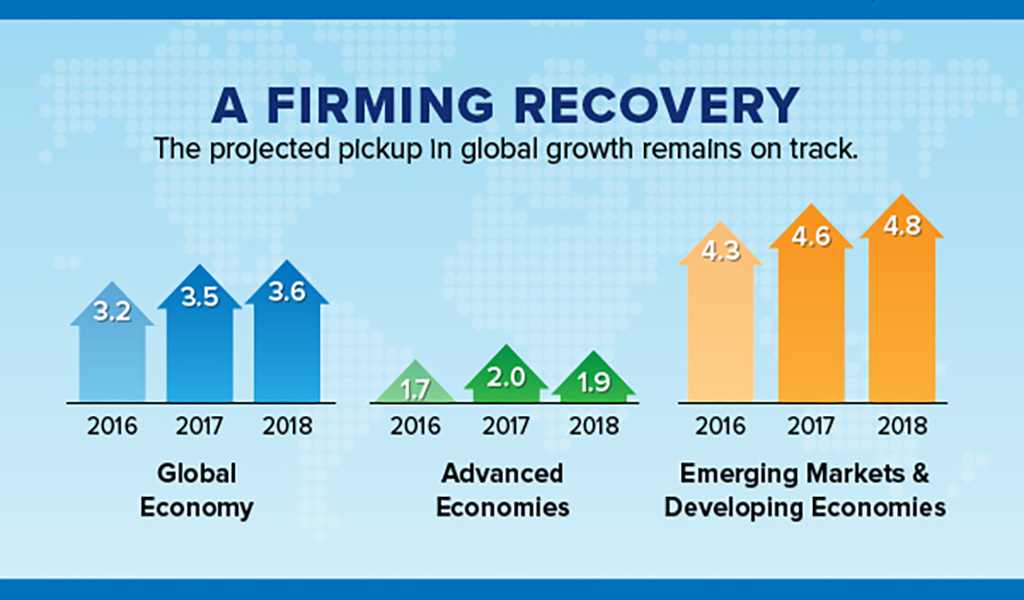
- "As in our April forecast, the World Economic Outlook Update projects 3.5 percent growth in global output for this year and 3.6 percent for next."
- The distribution of growth has shifted: "some economies are up but others are down, offsetting those improvements."
Growth projections and notable country/region developments
- Global:
- World Economic Outlook Update projects "3.5 percent growth in global output for this year and 3.6 percent for next."
- World trade growth has picked up, with volumes projected to grow faster than global output in the next two years.
- Euro area:
- Forecast raised compared with recent projections; performance is "notable compared with the not-too-distant past."
- Japan, China, and emerging and developing Asia:
- Projections raised for Japan and for China, and for emerging and developing Asia more generally.
- Emerging and developing Europe and Mexico:
- Notable improvements observed.
- United States:
- Forecasts for both 2017 and 2018 reduced to "2.1 percent" because near-term U.S. fiscal policy looks less likely to be expansionary than believed in April.
- "This pace is still well above the lacklustre 2016 U.S. outcome of 1.6 percent growth."
- Over the next two years, "U.S. growth should remain above its longer-run potential growth rate."
- United Kingdom:
- Projection for this year is lowered "based on the economy’s tepid performance so far."
- "The ultimate impact of Brexit on the United Kingdom remains unclear."
- Latin America:
- Projections for the region lowered over the next two years; the region "still struggles with sub-par growth."
- Sub-Saharan Africa:
- Growth this year is projected to be higher than last year, but "remains barely above the population growth rate, implying stagnating per capita incomes."
- Commodity exporters and lower-income countries:
- Continued weakness as they "continue to adjust to reduced terms of trade."
Risks (near-term and medium-term)
- Upside risk:
- "Possibility of even stronger growth in continental Europe, as political risks have diminished."
- Downside risks:
- Many emerging and developing economies receiving capital inflows at favorable borrowing rates, possibly leading to "risks of balance of payments reversals later."
- Strains could emerge if advanced economy central banks "show an increasing preference for monetary tightening."
- Core inflation pressures remain low in advanced economies and measures of longer-term inflation expectations show "no indications of upward drift beyond targets."
- Recommendation for central banks: "proceed cautiously based on incoming economic data, reducing the risk of a premature tightening in financial conditions."
- China:
- Supportive policy has promoted recent high growth; IMF upgraded 2017 and 2018 forecasts for China "by 0.1 and 0.2 percentage point, respectively, to 6.7 and 6.4 percent."
- Higher growth comes at the cost of "continuing rapid credit expansion and the resulting financial stability risks."
- Positive note: "China’s recent moves to address nonperforming loans and to coordinate financial oversight therefore are welcome."
- Protectionism and geopolitical risk:
- "The threat of protectionist actions and responses remains salient in the near and medium terms, as do geopolitical risks."
Longer-term outlook and policy recommendations
- Long-term growth:
- "Despite the current improved outlook, longer-term growth forecasts remain subdued compared with historical levels, and tepid longer-term growth also carries risks."
- Advanced economies:
- "Median real incomes have stagnated and inequality has risen over several decades."
- "Even as unemployment is falling, wage growth still remains weak."
- Slow growth risks "exacerbating social tensions that have already pushed some electorates in the direction of more inward-looking economic policies."
- Emerging economies:
- "Despite generally higher inequality than in advanced economies, substantial income gains have accrued even to those low in the income distribution."
- Policy actions while cyclical upswing persists:
- "Suitable structural reforms can raise potential output in all countries, especially if supported by growth-friendly fiscal policies including productive infrastructure investment, provided there is room in the government budget."
- "Investment in people is critical—whether in basic education, job training, or reskilling programs."
- These measures will "increase labor markets’ resilience to economic transformation and raise potential output."
- Policies to help adjust to globalization (as described in the recent report co-authored with the World Bank and World Trade Organization) are "more broadly necessary to meet the challenges of technology and automation."
- Multilateral cooperation:
- "Strengthening multilateral cooperation is another key to prosperity, in a range of areas including trade, financial stability policy, corporate taxation, climate, health, and famine relief."
- Warning: "Where domestic developments have a strong international impact, policies based narrowly on national advantage are at best inefficient and at worst highly damaging to all."
Maurice Obstfeld, July 24, 2017 — A Firming Recovery
Content in this bundle
- 复苏企稳, 作者:莫里·奥伯斯费尔德, 2017 年7 月24 日
- 回復は;底堅い; モーリス・オブストフェルド IMFブログ, 2017年7月24日掲載
- Sebuah Pemulihan yang Menguat, By Maurice Obstfeld, 24 Juli, 2017
- Набирающее силы восстановление, Морис Обстфельд, 23 июля 2017 года