5 Things You Need to Know About the IMF and Gender
IMF Blog, November 22, 2017
Source details
- Canonical URL
- 5 Things You Need to Know About the IMF and Gender
Other formats
Bibliographic details
- Authors: five percent in the US, nine percent in Japan
- Published: November 22, 2017
Overview and context
- Publication date: November 22, 2017.
- The IMF has incorporated gender analysis and policy advice into its country economic assessments.
- To date, the IMF has completed some 30 gender consultations, with a dozen more planned.
- Core finding: Closing gender gaps boosts economic growth, reduces income inequality, and strengthens economic resilience.
Extent of gender inequality (key statistics)
- About 90 percent of countries have at least one legal barrier to women owning property, receiving an inheritance, and opening a bank account.
- In middle-income countries, less than 53 percent of women have bank accounts.
- Raising female labor force participation rates to male levels could boost gross domestic product by:
- five percent in the US,
- nine percent in Japan,
- 27 percent in India.
- A pilot survey in 28 countries found that women represent only two-fifths of total bank account holders and borrowers.
- IMF research shows that widening access to finance, for both men and women, can boost economic growth by two to three percent.
Five areas of IMF engagement (findings and examples)
- Female labor force participation: Strengthening analysis and policy advice.
- IMF-supported programs with Egypt and Jordan include provisions to improve public transport safety for women and provide more child care options to help women seek work.
- In Germany, the IMF recommended the expansion of full-time childcare services and after-school programs.
- Financial inclusion: Data collection on access to and use of financial services.
- Documents required by banks may be a barrier to financial access for women (pilot survey finding).
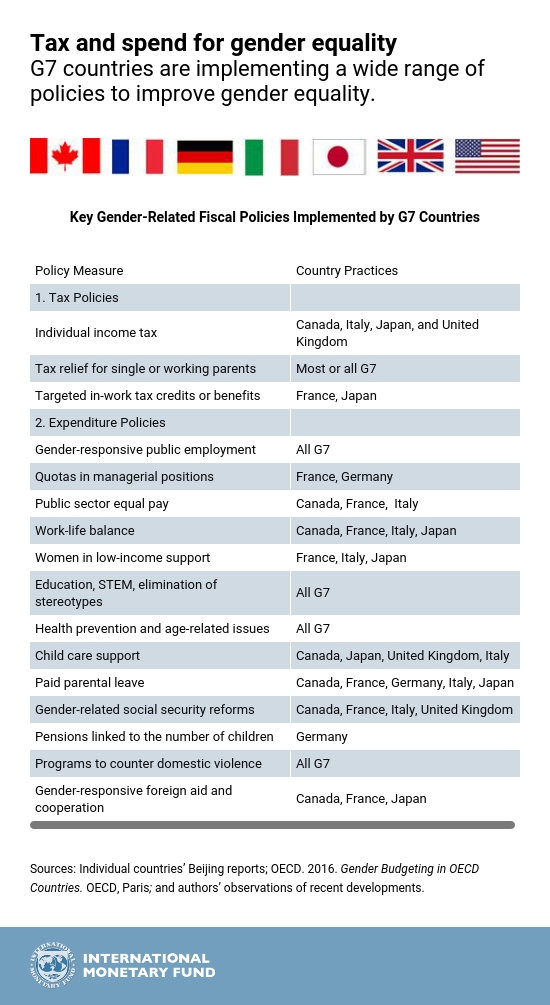
- Gender budgeting: Analyzing the fiscal and budgetary impact.
- The IMF has examined how fiscal policies can promote gender equality and women’s development globally and in the G7.
- Morocco and Afghanistan prioritized budgetary spending in areas with specific targets to improve women’s health care and opportunities for education and paid employment.
- Legal barriers: Study and identify the impact of discriminatory laws.
- An IMF study found that economic development in the Latin America and Caribbean region contributed to increased labor force participation rates, with equal legal rights for women and men also playing a role.
- In Namibia, female labor force participation rose when the country strengthened women’s legal rights, including the right to sign contracts and open a bank account.
- Research and analysis: Conduct further research and publish new studies.
- An IMF paper on women's leadership in finance found that a greater share of women on bank and banking supervision boards could be associated with greater bank stability.
- Banks with a higher share of women were associated with higher capital buffers and lower non-performing loan ratios.
- An IMF paper on the Western Balkans found that women’s participation in the labor force could increase through improvements in the education system, more balanced family leave policies, greater availability of childcare, and lower immigration of male population.
Policy recommendations and implications (implicit in IMF work)
- Integrate gender analysis into macroeconomic assessments and policy advice.
- Remove legal barriers that prevent women from owning property, receiving inheritances, and opening bank accounts.
- Expand access to financial services for women by addressing documentation and procedural barriers.
- Support policies that increase female labor force participation, including child care provision, safer public transport, full-time childcare services, after-school programs, and balanced family leave policies.
- Use gender budgeting to target fiscal spending toward women’s health, education, and paid employment opportunities.
- Encourage gender diversity in financial sector leadership to strengthen bank stability.
Source: IMF blog post “5 Things You Need to Know About the IMF and Gender,” November 22, 2017.
Content in this bundle
- Staff Discussion Note