Euro Area Inflation: Why Low For So Long?
IMF Blog, August 28, 2018
Source details
- Canonical URL
- Euro Area Inflation: Why Low For So Long?
Other formats
Bibliographic details
- Authors: Yasser Abdih, Li Lin, Anne-Charlotte Paret Onorato
- Published: August 28, 2018
Overview and context
- Authors: Yasser Abdih, Li Lin, Anne-Charlotte Paret Onorato
- Date: August 28, 2018
- Context: The euro area economy is in its fifth year of recovery, unemployment is close to its pre-crisis level and the output gaps of most countries have closed. Yet, core inflation continues to be low, notwithstanding temporarily high headline inflation due to higher energy prices.
The puzzle
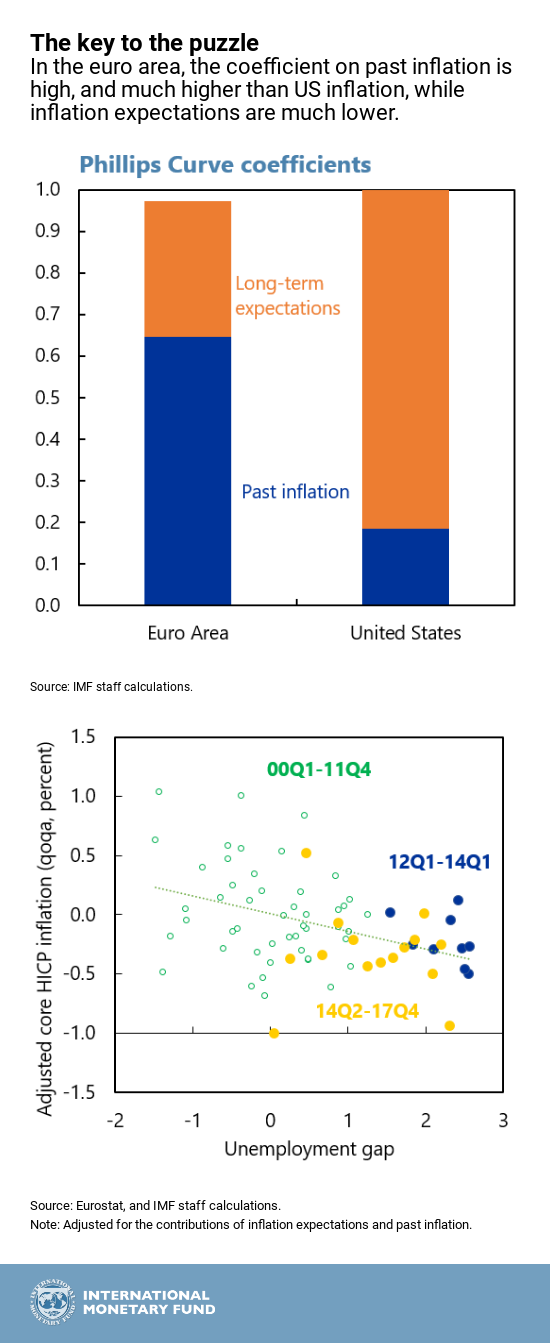
- Apparent breakdown of the Phillips curve: over the past five years, core inflation appears unresponsive to improving labor market conditions.
- Two distinct episodes highlighted:
- 2012 to 2014: “missing disinflation” — inflation stayed at relatively high levels despite high and increasing unemployment.
- 2014 to 2017: “missing inflation” — little inflation pressure despite considerable reductions in labor market slack.
- Alternative explanations discussed in literature: a broken Phillips curve, difficulties in correctly quantifying slack, or low global inflation.
Key findings (model and empirical results)
- A standard Phillips curve specification is used: core inflation depends on inflation expectations, past inflation, and the unemployment gap.
- Stability of relationship:
- The relationship between core inflation and unemployment is stable; inflation continues to react to labor market developments.
- This stability holds when using alternative slack measures (output gap, broader unemployment measures that include underemployed and marginally attached workers).
- Role of inflation persistence:
- Euro area inflation displays strong persistence: the coefficient on past inflation is high (much higher than for US inflation).
- The coefficient on inflation expectations is much lower for the euro area than for the US.
- Implication: after a period of weak demand and low inflation, it takes a much longer period of strong demand to return inflation to the inflation objective — there is a substantial time lag in transmission from labor market improvements to prices.
- Global factors tested and results:
- Global variables included: foreign output gap, foreign inflation, non-oil import prices, oil prices, and the nominal effective exchange rate.
- Empirical result: global factors contribute less to inflation dynamics than domestic factors and were not consistently deflationary in recent years.
- Conclusion on the puzzle: Accounting for high persistence and the implied time lag reconciles observed low core inflation with a conventional Phillips curve — core inflation eventually aligns with labor market developments.
Policy implications and recommendations
- Convergence toward the ECB’s medium-term inflation objective is likely to be gradual due to persistence in the inflation process.
- Risk of premature policy tightening:
- A too early withdrawal of monetary accommodation could be a mistake with long-lived consequences.
- Recommendation for monetary stance:
- Reinforces the case for being “patient, prudent and persistent”.
- Underlines the importance of the ECB’s commitment to keep policy rates at their current, extraordinary low levels—at least through next summer—and as long as necessary.
- Rationale: maintaining accommodation supports the slow process of returning inflation to its objective via stronger demand and well-anchored inflation expectations.
IMF blog post: Euro Area Inflation: Why Low For So Long? (August 28, 2018)
References
- https://www.imf.org/wp-content/uploads/2018/08/eng-august-13-eur1-1.png
- https://www.imf.org/wp-content/uploads/2018/08/eng-august-13-eur2.png
- new study
- https://www.imf.org/wp-content/uploads/2018/08/copy-eng-august-13-eur3-1.png
- The IMF and Europe
- Euro area: Time to tackle the tough challenges
- Euro area Article IV
- Euro area selected issues