Corruption and Your Money
IMF Blog, May 28, 2019
Source details
- Canonical URL
- Corruption and Your Money
Other formats
Bibliographic details
- Authors: The Editors
- Published: May 28, 2019
Overview
- Publication: Corruption and Your Money
- Author: The Editors
- Date: May 28, 2019
- The Fiscal Monitor analysis covers more than 180 countries and examines how corruption affects tax collection, fiscal institutions, and the ability of governments to deliver public services such as schools, roads, and hospitals.
Key findings
- More corrupt countries collect fewer taxes; taxpayers pay bribes to avoid taxes and exploit tax loopholes created in exchange for kickbacks.
- When taxpayers believe their governments are corrupt, they are more likely to evade paying taxes.
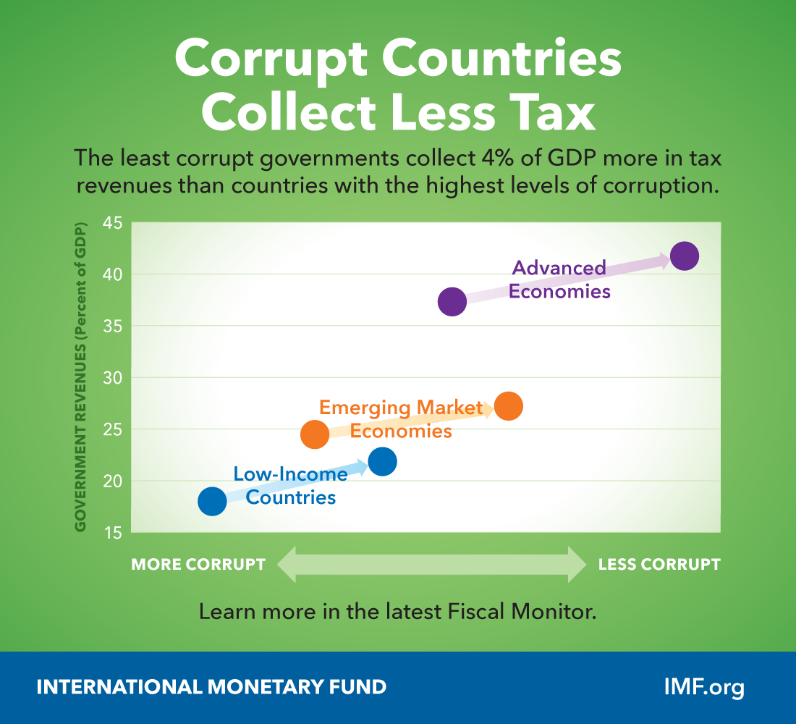
- The least corrupt governments collect 4 percent of GDP more in tax revenues than countries at the same level of economic development with the highest levels of corruption.
- Examples showing large gains from anti-corruption reforms:
- Georgia reduced corruption significantly and tax revenues more than doubled, rising by 13 percentage points of GDP between 2003 and 2008.
- Rwanda’s reforms since the mid-1990s increased tax revenues by 6 percentage points of GDP.
Analysis emphasis
- The Fiscal Monitor highlights the role of fiscal institutions and policies—such as tax administration and procurement practices—in fighting corruption.
- Political will to build strong and transparent institutions is presented as crucial to reducing corruption and improving fiscal outcomes.
Policy lessons and recommendations
- Invest in high levels of transparency and independent external scrutiny to enable effective oversight by audit agencies and the public.
- Examples: Colombia, Costa Rica, and Paraguay use an online platform for citizens to monitor the physical and financial progress of investment projects; Norway applies a high standard of transparency to manage natural resources.
- A free press enhances the benefits of fiscal transparency (example: in Brazil, audit results affected reelection prospects more in areas with local radio stations).
- Reform institutions comprehensively so reforms tackle corruption from all angles; combine tax administration reform with simpler tax laws to reduce officials’ discretion.
- The IMF has developed comprehensive diagnostics on the quality of fiscal institutions, including public investment management, revenue administration, and fiscal transparency.
- Build a professional civil service with transparent, merit-based hiring and pay to reduce opportunities for corruption; leadership must set a clear ethical tone at the top.
- Keep pace with evolving technology and wrongdoing; focus controls on high-risk areas such as procurement, revenue administration, and management of natural resources.
- Example: Electronic procurement systems in Chile and Korea have promoted transparency and improved competition, curtailing corruption.
- Increase international cooperation to reduce cross-border corruption opportunities.
- More than 40 countries have criminalized foreign bribery under the OECD anti-corruption convention.
- Aggressive anti–money laundering efforts and reducing opaque financial centers can limit the ability to hide corrupt proceeds.
Takeaway
- Curbing corruption requires persistent political will, continuously strengthened institutions to promote integrity and accountability, and global cooperation; these actions can yield large fiscal dividends and improve public service delivery.
Corruption and Your Money — The Editors, May 28, 2019.