Central Bank Accountability, Independence, and Transparency
IMF Blog, November 25, 2019
Source details
- Canonical URL
- Central Bank Accountability, Independence, and Transparency
Other formats
Bibliographic details
- Authors: Tobias Adrian, Ashraf Khan
- Published: November 25, 2019
Historical context and evolution
- Bank of England opened for business in August 1694 with a staff of 19.
- The original Royal Charter tasked the Bank to “promote the public Good and Benefit of our People.”
- Independence as a formal concept in modern central banking gained steam in the 1970s.
- The Bank of England was granted operational independence over monetary policy in May 1997, to take effect a year later.
- The text notes that formal independence for many central banks is relatively new and that central banks became pivotal actors in the global financial crisis about a decade before the publication date.
Legal basis and rationale for independence
- Research based on the IMF’s database of central bank legislation shows that most nations’ central bank laws contain “anchors,” in one form or another, for central bank independence.
- Rationale: If politicians manipulate monetary policy to bolster pre-election popularity, prioritization of short-term political gains could invite long-term pain for the economy, in the form of higher inflation or even hyper-inflation.
- Potential consequences of political interference include undermining central banks’ goals—such as stable inflation over time and, in some countries, maximum employment—and creating long-term risks to economic and financial stability.
- Quoted caution: Former Federal Reserve Chair Janet Yellen—“sometimes central banks need to do things that are not immediately popular for the health of the economy. We’ve really seen terrible economic outcomes in countries where central banks have been subject to political pressure.”
Post-crisis challenges and the struggle of central banks
- Since the global financial crisis, many central banks pursued strategies that led to significant expansions of their balance sheets.
- In some cases, governments tasked central banks with new or additional financial stability functions alongside price stability mandates.
- These expanded activities have generated skepticism in some quarters about the necessity or appropriate degree of central bank independence.
- IMF operational engagement: In one-fourth of IMF staff visits to provide technical assistance to central bank staff, the discussions include issues related to central bank independence, in one form or another.
- Most IMF attention has focused on strengthening independence to ensure effective monetary policy and modernizing central bank operations.
Independence, accountability, and transparency (governance framework)
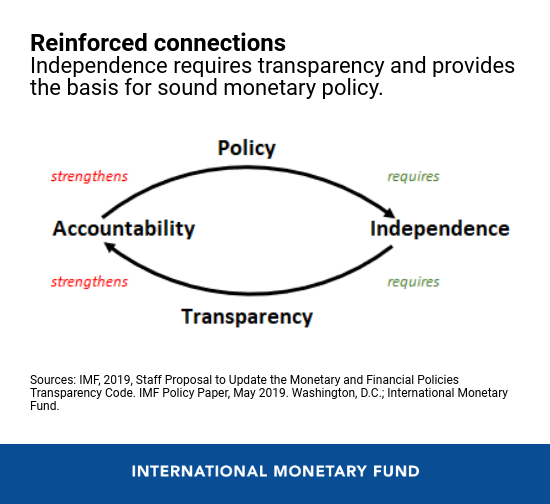
- Core proposition: Independence and accountability are two sides of the same coin; transparency bridges them.
- Transparency is presented as a vital component allowing independent central banks to prove their effectiveness and public accountability.
- Examples of appropriate transparency measures:
- publication of minutes of meetings
- responsiveness to lawmakers’ inquiries
- publication of detailed technical reports
- meetings with Ministers of Finance
- convening press conferences
- Quoted governance perspective: Lesetja Kganyago—“For society to appreciate our roles, we… have got to take society along with us, such that when central banks come under attack, it is not just going to be us defending our independence.”
IMF proposal and policy direction
- The IMF proposed a new Central Bank Transparency Code earlier this year.
- Intended functions of the Code:
- facilitate greater transparency of central banks on governance arrangements, policies, operations, outcomes of operations, and interaction with key stakeholders
- help central banks adapt to their changed environment
- provide a continued raison-d’être for their independence
- make clear that modern central banks are expected to explain and justify their actions and give account of decisions made in the execution of their responsibilities
Risks, governance, and recommendations
- Risks identified:
- poor governance and corruption can harm the economy through short-term disruption and cause institutional decay over the long term
- central banks are not immune to institutional decay and corruption
- Policy and governance recommendations (implied and explicit):
- strengthen legal and operational anchors for central bank independence
- enhance transparency about multifaceted decisions and actions
- improve clear communication with the public
- strengthen governance and accountability mechanisms to preserve long-term independence and rebuild public confidence in central banks as defenders of non-inflationary, job-creating economic policies
Source: Central Bank Accountability, Independence, and Transparency (IMF blog), Tobias Adrian and Ashraf Khan, November 25, 2019