Delivering on Africa’s Dreams
IMF Blog, February 26, 2020
Source details
- Canonical URL
- Delivering on Africa’s Dreams
Other formats
Bibliographic details
- Authors: David Lipton
- Published: February 26, 2020
Education and technology as drivers of change
- Across sub-Saharan Africa, school visits revealed a duality: strong hope and significant resource constraints.
- Education is highlighted as the primary driver of change and there is openness to using technology to overcome resource shortfalls.
- Examples:
- At the Regent Square Municipal School (Sierra Leone) classrooms reflect the government’s Free Quality Education program but face large classes, overburdened and undertrained teachers, and a shortage of educational materials.
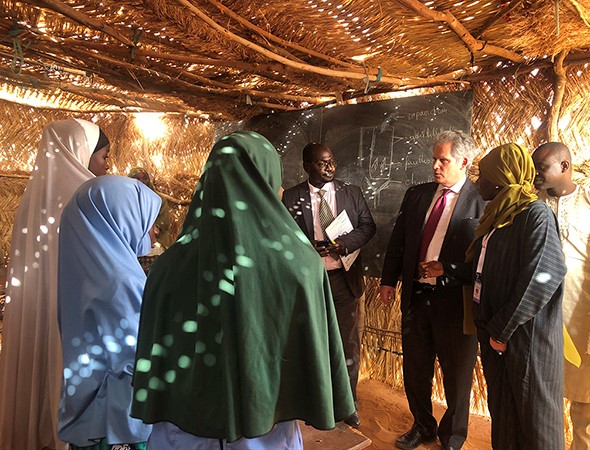
- In Niger, a research center on the edge of the Sahel Desert works on high-tech solutions to tackle malaria and climate change, while nearby students attend school in straw schoolhouses with blackboards but few books.
Sierra Leone: recovery, human capital, and financing
- Historical context and shocks:
- Emerged from a decade of civil war in 2002.
- Received $1.6 billion of debt relief.
- Suffered severe impacts from the 2014 Ebola outbreak amid a collapse of global commodity prices.
- Policy focus:
- Government’s ambitious development program focuses on investing in infrastructure and human capital.
- Technology (digitalization) will be used to evaluate educational progress.
- Minister for Basic and Senior Secondary Education David Moinina Sengeh (also Chief Innovation Officer), an MIT PhD who led artificial intelligence work at IBM, directs the education portfolio.
- Potential economic impact:
- Investing in children and education has the potential to raise GDP by 40 percent in the coming decades and to reduce income inequality.
- Contextual statistics: per capita GDP remains little more than $500; over half the population lives in poverty.
- Financing and governance priorities:
- Key tasks: raise taxes in an evenhanded way, make government spending more effective, and strengthen governance (including tackling corruption).
- The IMF is providing training and support in revenue mobilization and tax management.
- Sierra Leone is creating technological solutions using AI and machine learning to address governance and revenue challenges.
- International assistance trends:
- Post-conflict grant aid in countries like Rwanda and Mozambique amounted to around 8-9 percent of GDP in the decade after their civil conflicts.
- In Sierra Leone today, such assistance has fallen to 2-3 percent of GDP.
Niger: demographic pressures, security, and climate threats
- Growth and resource timeline:
- Niger has experienced strong growth in recent years.
- Crude oil exports are scheduled to begin in 2022.
- Demography and development challenges:
- World’s highest population growth rate: 3.8 percent.
- Fertility: more than 7 children per mother.
- High child mortality.
- Developing the nascent private sector and creating jobs is the top priority.
- Security and climate risks:
- Two existential threats: military conflict and climate change.
- Armed conflict is increasingly encroaching on Niger from terrorist groups across borders with Mali, Burkina Faso and Nigeria, increasing security expenditures and complicating public finances.
- Climate risks: as a predominantly agricultural economy dependent on modest annual rainfall, climate change is an ever-present reality.
- Temperatures in the Sahel are climbing 1.5 times faster than the global average, making rainfall erratic and wet seasons shorter.
- The UN estimates that 80 percent of the Sahel’s farmland has become degraded.
- Strategic implications:
- Armed conflict and climate change have implications for advanced economies concerned about terrorism in North Africa and migration flows, highlighting common interests linking economic development and security.
From aspirations to reality — resource mobilization and collective responsibility
- Core message:
- Achieving the UN Sustainable Development Goals in countries like Niger and Sierra Leone requires mobilizing both domestic and international resources.
- Policy and financing priorities:
- Mobilize domestic resources through equitable tax reforms and improved tax administration.
- Strengthen governance and reduce corruption to make public spending more effective.
- Leverage technology (including AI and machine learning) to improve education outcomes and public-sector performance.
- Sustain and increase international assistance aligned with development needs.
- Rationale:
- Grassroots visits show strong aspirations and the high return that added resources and better policies could yield in turning aspirations into tangible development outcomes.
Source: Delivering on Africa’s Dreams — David Lipton, February 26, 2020.