State-Owned Enterprises in the Time of COVID-19
IMF Blog, May 7, 2020
Source details
- Canonical URL
- State-Owned Enterprises in the Time of COVID-19
Other formats
Bibliographic details
- Authors: the government, some are jointly owned with private investors.
- Published: May 7, 2020
Role of state-owned enterprises during the pandemic
- State-owned enterprises (SOEs) can be public utilities providing essential services (water, electricity, transportation) or public banks providing loans to small businesses.
- Some SOEs are struggling and adding to the burden on government finances, including national oil companies facing a large fall in oil prices and national airlines without enough passengers.
- Governments have asked public banks in Brazil, Canada, Germany, and India to help alleviate the impact of the current pandemic.
Scale and scope
- SOEs’ assets are worth $45 trillion, equivalent to half of global GDP.
- SOEs undertake 55 percent of total infrastructure investment in emerging and developing economies.
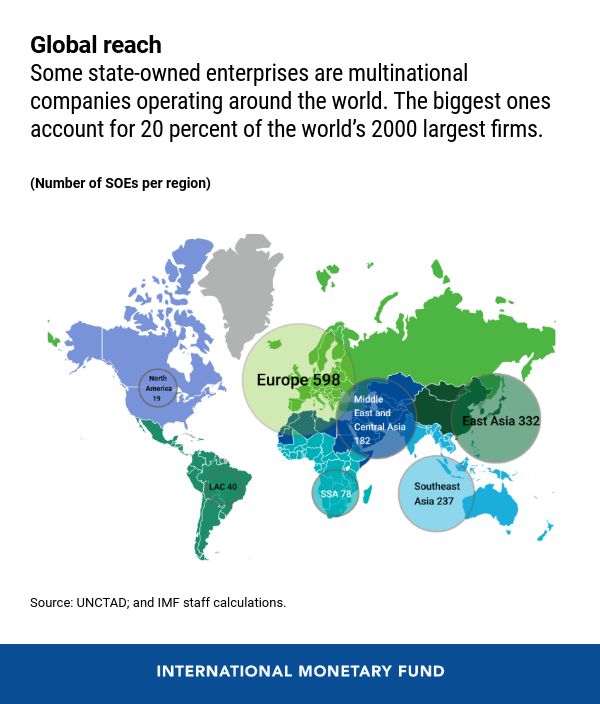
- The share of SOEs among the world’s 2000 largest firms doubled to 20 percent over the last two decades.
- In some countries, like China, Germany, India, and Russia, SOEs number in the thousands.
- SOEs are present in all countries and some are multinationals operating around the world.
Access, mandates, and funding gaps
- SOEs were created to meet goals governments deem socially or economically necessary (provision of water, electricity, transportation) but mandates are often not appropriately funded.
- Consequences of underfunded mandates include insufficient service delivery: more than 2 billion people remain without access to safe water and more than 0.8 billion lack reliable electricity.
- Proper funding is critical in responding to crises so that public banks and utilities can provide subsidized loans, water, and electricity.
Governance, transparency, and fiscal risk
- Many governments lack the capacity to effectively monitor SOEs.
- Poor transparency in public banks’ and enterprises’ activities remains an obstacle to accountability and oversight.
- Hidden debts can build up, with governments having to bail out SOEs, sometimes costing taxpayers more than 10 percent of GDP.
- Empirical performance: drawing from a sample of about 1 million firms in 109 countries, SOEs are less productive than private firms by one-third, on average.
- Governance matters: productivity of SOEs in countries with perceived lower corruption is more than three times higher than those in countries where corruption is seen as severe.
- Internationalization of SOEs raises concerns about unfair advantages (government support, cheap loans, tax benefits) and could fuel protectionist measures.
Policy recommendations (four main recommendations)
- Regularly review the need for and value delivered by an SOE:
- Example: Germany conducts biennial reviews.
- The case for SOEs in competitive sectors (such as manufacturing) is weaker because private firms usually provide goods and services more efficiently.
- Create the right incentives for managers and strengthen government oversight:
- Full transparency in SOE activities is paramount to improve accountability and reduce corruption.
- Including SOEs in the budget and debt targets would create greater incentives for fiscal discipline.
- Examples of practices in place: New Zealand.
- Ensure adequate funding to meet economic and social mandates:
- Example: Sweden.
- Proper funding is critical for crisis response and for promoting development goals.
- Ensure a fair playing field between SOEs and private firms:
- Limiting preferential treatment of SOEs can foster greater productivity and avoid protectionism.
- Examples of limits: Australia and the European Union.
- A potential global way forward is to agree on principles to guide SOEs’ international behavior.
Stakes and conclusion
- Well-governed and financially healthy SOEs can help combat crises such as the pandemic and promote development goals.
- Many SOEs need further reforms; without them, the costs to society and the economy can be large.
Source: State-Owned Enterprises in the Time of COVID-19 (May 7, 2020) — https://www.imf.org/en/blogs/articles/2020/05/07/blog-state-owned-enterprises-in-the-time-of-covid-19
References
- Vitor Gaspar
- Paulo Medas
- John Ralyea
- عربي
- Français,
- 日本語,
- Português
- ,
- Fiscal Monitor
- https://www.imf.org/wp-content/uploads/2020/05/eng-apr-24-fm-chap3-blog-chart2-1.jpg
- https://www.imf.org/wp-content/uploads/2020/05/eng-apr-24-fm-chap3-blog-chart3.jpg
- Fiscal Policies for the Recovery from COVID-19
- Fiscal Policies to Contain the Damage from COVID-19