How Pandemics Leave the Poor Even Farther Behind
IMF Blog, May 11, 2020
Source details
- Canonical URL
- How Pandemics Leave the Poor Even Farther Behind
Other formats
Bibliographic details
- Authors: Davide Furceri, Prakash Loungani, Jonathan D Ostry
- Published: May 11, 2020
Overview and macro context
- The COVID-19 crisis is described as "the greatest economic calamity since the Great Depression."
- In January, the IMF expected global income to grow 3 percent; it is now forecast to fall 3 percent.
- A recent poll of top economists found that the vast majority felt the COVID-19 pandemic will worsen inequality, in part through its disproportionate impact on low-skilled workers.
Events analyzed and horizon
- Five major events analyzed: SARS (2003), H1N1 (2009), MERS (2012), Ebola (2014), and Zika (2016).
- Distributional effects are traced in the five years following each event.
Inequality impacts (net incomes)
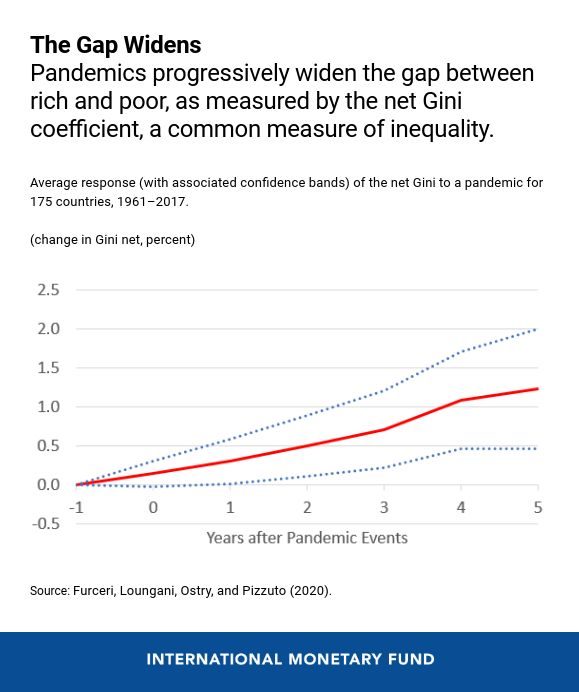
- The Gini coefficient (based on net incomes, i.e., market incomes after taxes and transfers) has increased steadily in the aftermath of these events.
- After five years, the net Gini has gone up by nearly 1.5 percent.
- This increase occurs despite government redistribution efforts to mitigate pandemic effects.
Employment and education (distributional channel)
- Pandemics have disparate impacts on employment by educational attainment (an indicator of skill levels).
- Relative to population, the employment of those with advanced levels of education is scarcely affected.
- The employment of those with only basic levels of education falls sharply, by more than 5 percent at the end of five years.
- Long-lasting effects arise from job loss, lower remittances, and diminished employment prospects.
Policy response and recommendations
- Policies must pay specific attention to preventing long-term damage (or "scarring") to the livelihoods of the least advantaged in society.
- Without strenuous and targeted attempts, inequality is likely to increase; inequality was already "one of the most complex and vexing challenges in the global economy," in the words of the IMF’s Managing Director.
- Concrete policy measures highlighted:
- Access to sick leave, unemployment benefits, and health benefits, especially for poorer segments who lack a savings cushion.
- A "New Deal" in sectors and regions with pervasive informal work and self-employment and scant social protection systems.
- Expanding social assistance systems and introducing new transfers.
- Boosting public work programs to offer job opportunities.
- Providing financing opportunities to sustain employment.
- Progressive tax measures (for example, a "solidarity surcharge") as part of the policy mix.
- Policymakers should use the opportunity to make fundamental changes so that future shocks (including from climate change) encounter stronger risk-sharing and social assistance mechanisms to better protect the most vulnerable.
Source: How Pandemics Leave the Poor Even Farther Behind (IMF blog), Davide Furceri, Prakash Loungani, Jonathan D. Ostry, May 11, 2020.
Content in this bundle
- Staff Paper
- Full Report
References
- عربي
- Français,
- https://www.imf.org/fr/News/Articles/2020/05/06/blog-state-owned-enterprises-in-the-time-of-covid-19
- 日本語,
- Português
- ,
- https://www.imf.org/wp-content/uploads/2020/05/eng-may-5-covid-inequality-1-e1588966727283.jpg
- https://www.imf.org/wp-content/uploads/2020/05/eng-may-5-covid-inequality-2.png
- words
- New Deal