Brave New World: Tracking Trade from Space
IMF Blog, November 2, 2021
Source details
- Canonical URL
- Brave New World: Tracking Trade from Space
Other formats
Bibliographic details
- Authors: Serkan Arslanalp, Robin Koepke, Jasper Verschuur
- Published: November 2, 2021
Overview and context
- Publication: Chart of the Week
- Authors: Serkan Arslanalp, Robin Koepke, Jasper Verschuur
- Date: November 2, 2021
- Theme: Use of satellite-based big data to measure and track trade in real time, filling data gaps for small fragile states and informing policy decisions.
Key findings from IMF staff research
- Satellite data can measure and track trade volumes in real time, providing critical input for policy decisions.
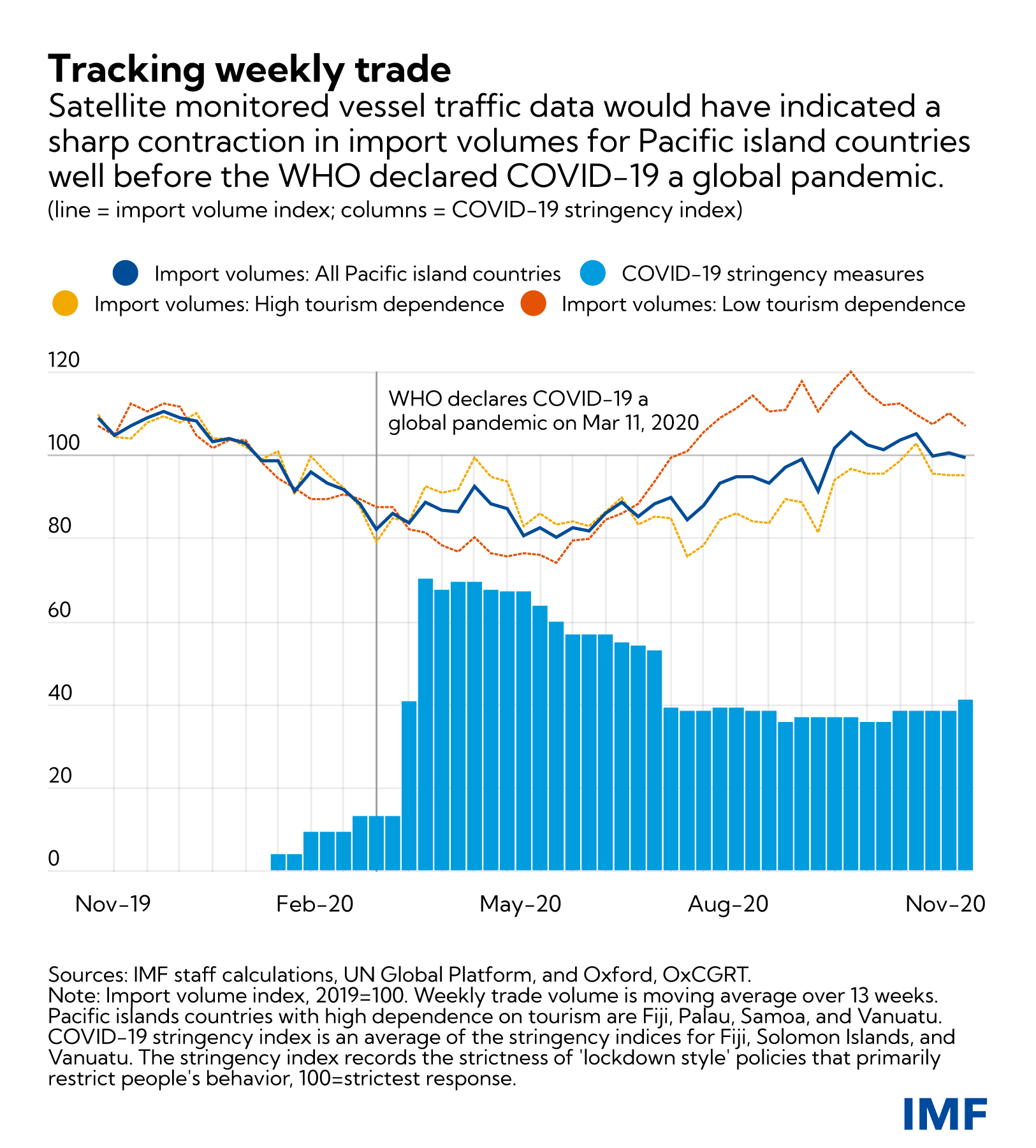
- This method could have highlighted trade and supply-chain disruptions to the Pacific region well before the World Health Organization (WHO) declared a global pandemic in March 2020.
- Pacific island countries insulated themselves from COVID-19 infections by closing borders but were not insulated from economic repercussions, especially in early 2020.
- All countries experienced sharp import contractions in the early stages of the pandemic due to supply disruptions related to port restrictions affecting the regional trade network, including lockdowns in China.
- Later, imports were further depressed by a lockdown-induced demand shock.
- Imports subsequently recovered in countries with low dependence on tourism but remained depressed in tourism-oriented economies.
Methodology highlights
- The new estimation method helps fill gaps in official data and provides early warnings of turning points in economic activity.
- The algorithm overcomes challenges of previous studies in estimating cargo payloads.
- Uses detailed information on shipping liner schedules to validate port calls.
- Applies country-specific information to define port boundaries.
- Uses satellite-based vessel tracking data from the UN Global Platform to construct daily indicators of port and trade activity for the Pacific island countries.
Policy relevance and implications
- Timely information on trade disruptions is particularly important for Pacific island countries given their vulnerability to external shocks, including climate-related natural disasters.
- The approach could be extended to measuring the impact of climate-related shocks, providing critical information to close data gaps and potentially help build resilience to climate change.
- These and other related issues will be discussed in November at the IMF Statistical Forum on Measuring the Economic and Financial Dimensions of Climate Change.
Suggested policy actions (implied by research)
- Incorporate satellite-based trade indicators into real-time monitoring systems for small and fragile states.
- Use validated, schedule-informed algorithms to improve accuracy of vessel and cargo estimates.
- Leverage daily port-activity indicators to provide early warnings for supply-chain disruptions and demand shocks.
- Extend satellite-based monitoring to assess and quantify impacts of climate-related natural disasters on trade and economic activity to inform resilience-building policies.
Source: Brave New World: Tracking Trade from Space (IMF Blog), November 2, 2021