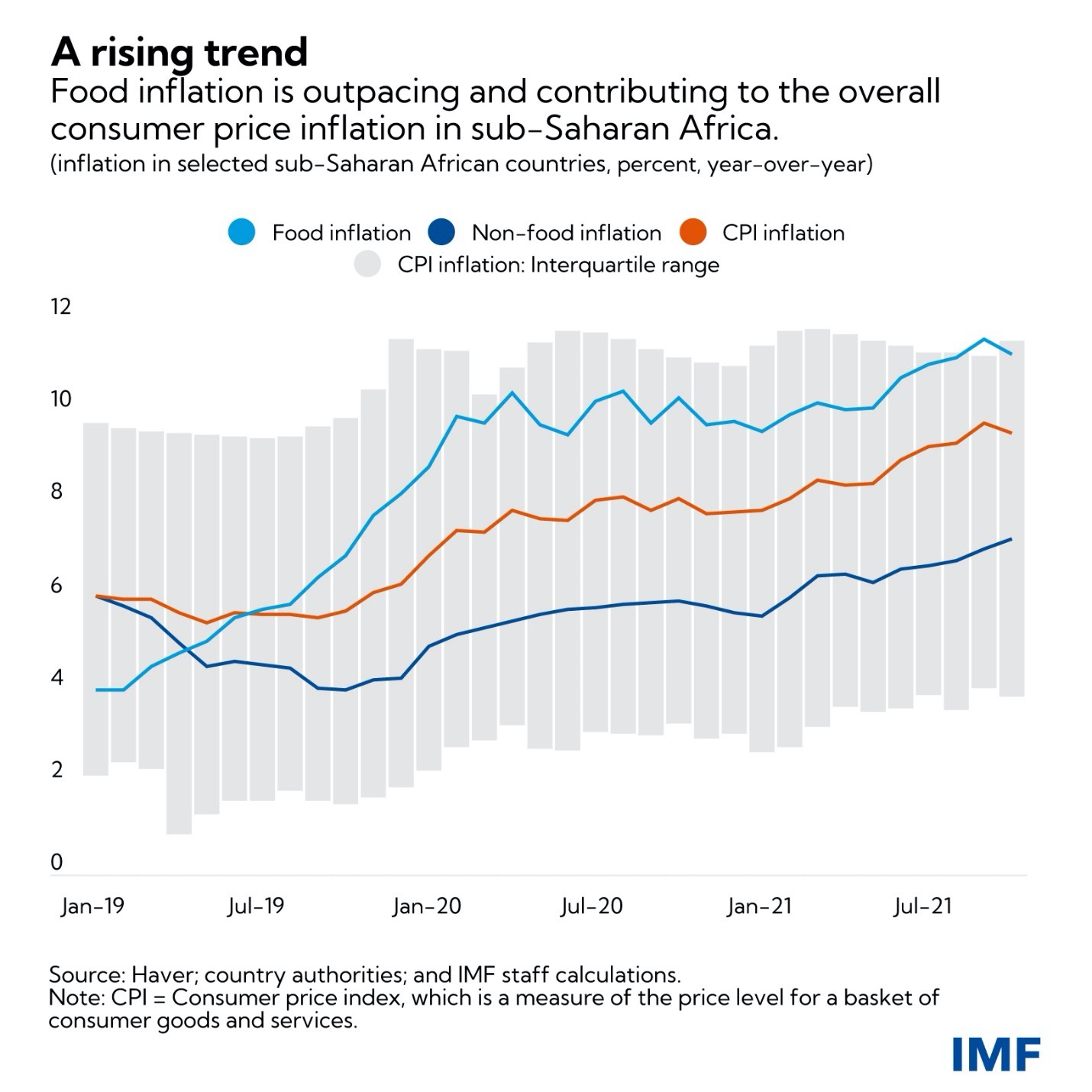
Food Inflation in Sub-Saharan Africa
IMF Blog, December 6, 2021
Source details
- Canonical URL
- Food Inflation in Sub-Saharan Africa
Other formats
Bibliographic details
- Authors: Seung Mo Choi
- Published: December 6, 2021
Overview
- Food accounts for roughly 40 percent of the region’s consumption basket—a measure of goods and services used to measure consumer price index (CPI) inflation.
- Food inflation increased throughout 2019, on average, across 20 countries in the region where monthly food price data are available.
- After remaining stable around 9 percent (year over year) since the beginning of the pandemic, food inflation started to rise again from April this year to some 11 percent in October.
- Overall consumer price inflation in sub-Saharan Africa rose to about 9 percent in October, up from around 6 percent in 2019.
Main drivers of recent food inflation
- Rising oil prices, which raise fertilizer prices and transportation costs.
- Droughts and export restrictions imposed by some major food exporters.
- Stockpiling in some countries.
- Pandemic-related disruptions: containment measures that disrupted production and imports of seeds and fertilizers and caused labor shortages during planting seasons.
- Domestic factors such as weather and exchange rates also play important roles.
Regional variation
- Food inflation exhibits wide variation across the region:
- Chad: food inflation is near zero.
- Angola: food inflation is around 30 percent.
- This diversity suggests domestic factors (weather, exchange rates) can be decisive alongside global drivers.
Outlook and scenarios
- The outlook is highly uncertain.
- Possible moderating scenario:
- Food inflation and CPI inflation could moderate if commodity prices ease and pandemic-induced global supply chain disruptions resolve.
- Persistence scenario:
- High food inflation could persist if inflation expectations become de-anchored or supply chain disruptions continue.
- Near-term expectation:
- Regionwide, average inflation is expected to edge up in 2021 before easing next year depending on commodity prices and the resolution of supply-demand mismatches.
Impacts on food insecurity
- Higher food inflation would worsen the situation for countries already facing food insecurity and shortages with a disproportional impact on poor households.
- The number of undernourished persons in the region is projected to have increased by 20 percent in 2020, encompassing 264 million people.
Policy recommendations and measures
- Fight food insecurity through targeted social assistance and insurance to help populations cope.
- Avoid trade barriers.
- Improve access to:
- Finance
- Seed stocks
- Insecticide
- Fertilizer
- Anti-erosion measures
- Irrigation
Note on revisions
- The figures for number of countries and corresponding inflation rates were changed several hours after initial publication to update earlier data presented.
IMF Blog — Seung Mo Choi, December 6, 2021.