Global Crypto Regulation Should be Comprehensive, Consistent, and Coordinated
IMF Blog, December 9, 2021
Source details
- Canonical URL
- Global Crypto Regulation Should be Comprehensive, Consistent, and Coordinated
Other formats
Bibliographic details
- Authors: Tobias Adrian, Dong He, Aditya Narain
- Published: December 9, 2021
Overview
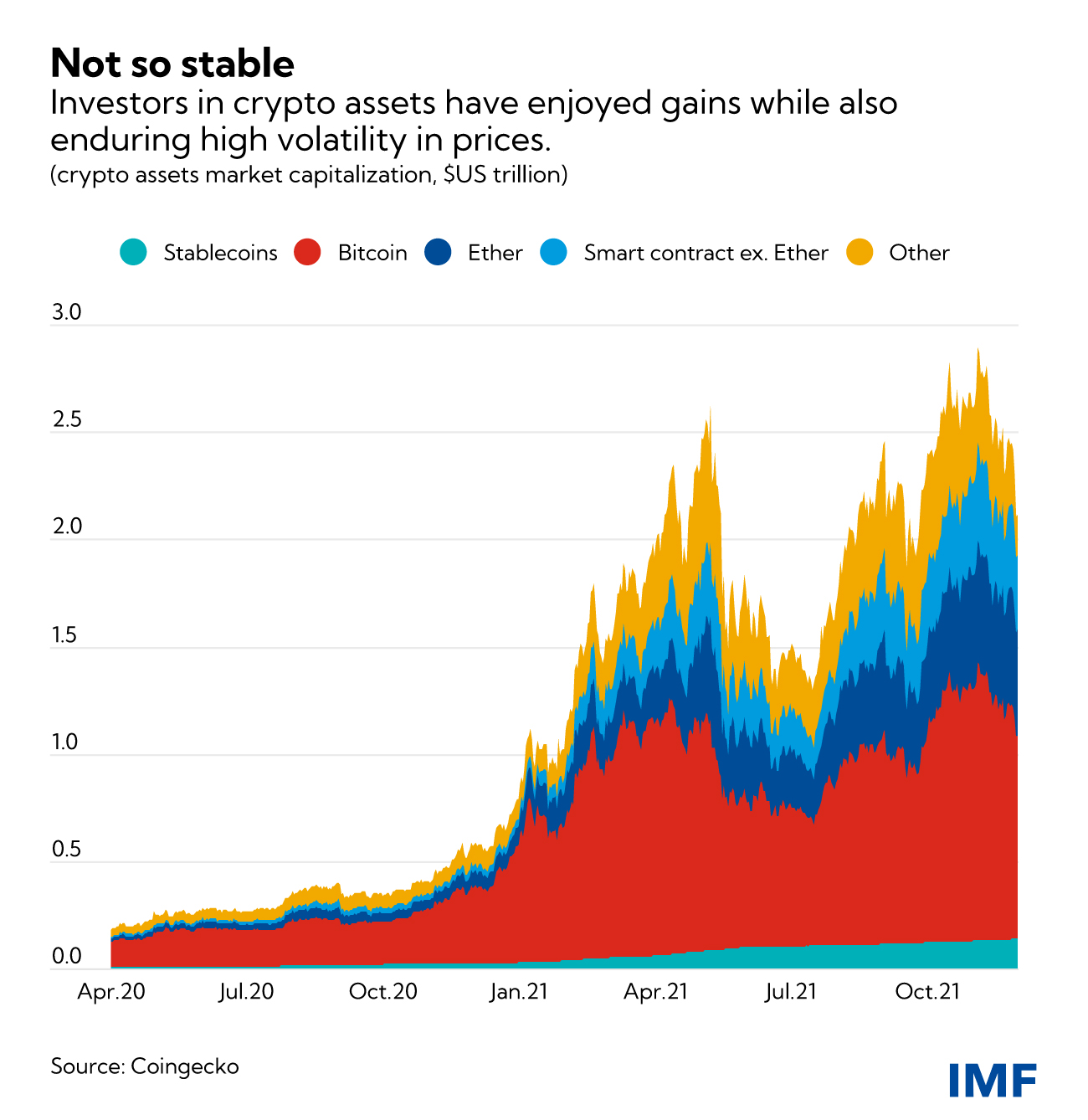
- Crypto assets and associated products and services have grown rapidly in recent years and interlinkages with the regulated financial system are rising.
- The nearly $2.5 trillion market capitalization indicates significant economic value of the underlying technological innovations such as the blockchain, and might also reflect froth in an environment of stretched valuations.
- Early reactions to the Omicron variant included a significant crypto selloff.
- The IMF’s mandate is to safeguard the stability of the international monetary and financial system; crypto assets are changing the system profoundly.
Financial system risks from crypto assets
- Identification, monitoring, and management of risks defy regulators and firms.
- Specific risks highlighted:
- Operational and financial integrity risks from crypto asset exchanges and wallets.
- Investor protection concerns.
- Inadequate reserves and inaccurate disclosure for some stablecoins.
- In emerging markets and developing economies, crypto can accelerate “cryptoization” — when these assets replace domestic currency, and circumvent exchange restrictions and capital account management measures.
- Uncoordinated regulatory measures may facilitate potentially destabilizing capital flows.
- Many crypto service providers operate across borders, complicating supervision and enforcement.
Current standard-setting landscape and gaps
- The Financial Action Task Force has issued guidance for a risk-based approach to mitigating financial integrity risks from virtual assets and their service providers.
- Other standard-setting bodies have issued varying levels of guidance, ranging from broad principles to rules for mitigating exposure risks of regulated entities and setting up information exchange networks.
- These efforts are useful but not sufficiently coordinated towards a global framework for managing risks to financial and market integrity, financial stability, and consumer and investor protection.
Making regulation work at the global level — recommended framework elements
- The Financial Stability Board, in its coordinating role, should develop a global framework comprising standards for regulation of crypto assets to provide a comprehensive and coordinated approach.
- The global regulatory framework should provide a level playing field along the activity and risk spectrum and include the following elements:
- Crypto-asset service providers that deliver critical functions should be licensed or authorized.
- Critical functions include storage, transfer, settlement, and custody of reserves and assets, among others, similar to existing rules for financial service providers.
- Licensing and authorization criteria should be clearly articulated, the responsible authorities clearly designated, and coordination mechanisms among them well defined.
- Requirements should be tailored to the main use cases of crypto assets and stablecoins.
- Services and products for investments should have requirements similar to those of securities brokers and dealers, overseen by the securities regulator.
- Services and products for payments should have requirements similar to those of bank deposits, overseen by the central bank or the payments oversight authority.
- All overseers—from central banks to securities and banking regulators—need to coordinate to address the various risks arising from different and changing uses.
- Authorities should provide clear requirements on regulated financial institutions concerning their exposure to and engagement with crypto.
- Banking, securities, insurance, and pension regulators should stipulate the capital and liquidity requirements and limits on exposure to different types of these assets, and require investor suitability and risk assessments.
- If regulated entities provide custody services, requirements should be clarified to address the risks arising from those functions.
Emerging markets, capital flow management, and cross-border cooperation
- Some emerging markets and developing economies face more immediate and acute risks of currency substitution through crypto assets (“cryptoization”).
- Capital flow management measures will need to be fine-tuned because applying established regulatory tools to manage capital flows may be more challenging when value is transmitted through new instruments, new channels and new service providers that are not regulated entities.
- There is an urgent need for cross-border collaboration and cooperation to address technological, legal, regulatory, and supervisory challenges.
- Setting up a comprehensive, consistent, and coordinated regulatory approach to crypto is a daunting task but necessary to maintain financial stability while benefiting from technological innovations.
IMF role and next steps
- The IMF has developed a strategy to continue to deliver on its mandate in the digital age.
- The Fund will work closely with the Financial Stability Board and other members of the international regulatory community to develop an effective regulatory approach to crypto assets.
Source: IMF blog post "Global Crypto Regulation Should be Comprehensive, Consistent, and Coordinated" (December 9, 2021).