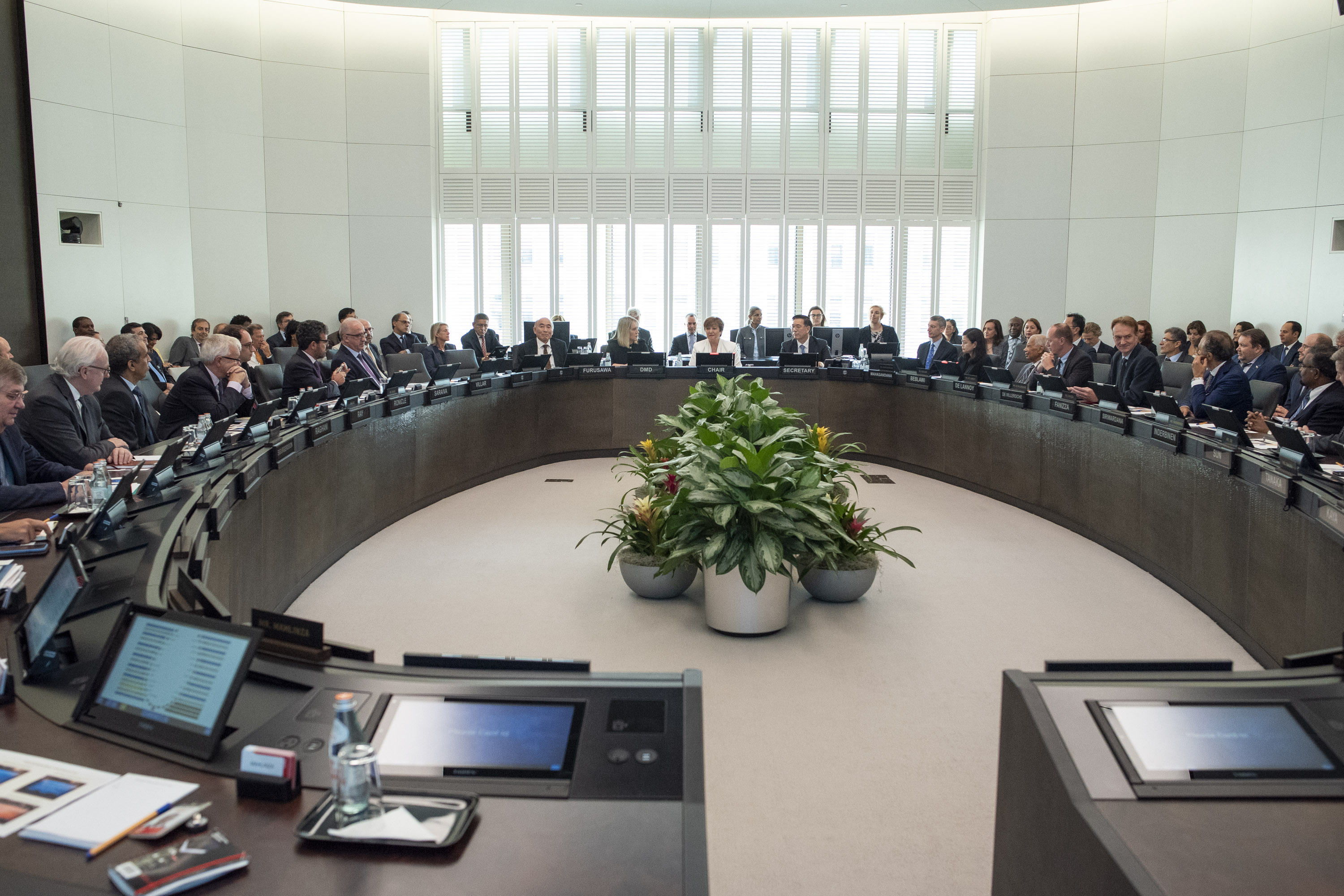
IMF Executive Board Concludes 2017 Article IV Consultation with Zambia
IMF News, October 10, 2017
Source details
- Canonical URL
- IMF Executive Board Concludes 2017 Article IV Consultation with Zambia
Other formats
Bibliographic details
- Published: October 10, 2017
Near-term economic outlook and recent developments
- Economy improved in recent months driven by good rains and rising world copper price.
- Economy was in near-crisis from Q4 2015 through most of 2016 due to exogenous shocks and lax fiscal policy.
- Copper price shock and poor rainfall reduced export earnings, government revenues, and electricity generation; severe power rationing occurred.
- Kwacha depreciation fueled inflation from an annual rate of 7 percent in mid-2015 to nearly 23 percent in February 2016.
- Tight monetary policy stabilized the exchange rate and slowed inflation to 6.3 percent in August 2017, but contributed to:
- a sharp rise in nonperforming loans,
- a plunge in the growth of credit to the private sector.
- Stress tests indicate banks are resilient to credit and liquidity pressures, but financial system faces considerable risks from high dependence on copper exports, rising public debt, and funding pressures.
Fiscal imbalances and public debt
- Fiscal deficits:
- Cash-basis fiscal deficit reached 9.3 percent of GDP in 2015, twice the budgeted level.
- Commitment-basis deficit exceeded 12 percent of GDP in 2015, remained about 9 percent of GDP in 2016.
- Commitment-basis deficit projected to decline significantly in 2017; cash deficit will remain elevated as the government clears arrears.
- Public and publicly guaranteed debt:
- Rose from 36 percent of GDP at end-2014 to 60 percent at end-2016, driven largely by external borrowing and exchange rate depreciation.
- Increased foreign investor participation in government securities eased financing but raised vulnerability to market sentiment and capital flow reversals.
- Executive Directors noted that public debt, especially external debt, has increased at a pace that puts Zambia at high risk of debt distress.
Medium-term outlook and risks
- Real GDP growth trajectory:
- 7.6 percent in 2012 down to 2.9 percent in 2015; growth has picked up subsequently.
- Growth projected to reach 4 percent in 2017.
- Achieving sustained high and inclusive growth requires stable macroeconomic environment and reforms to:
- increase productivity,
- enhance competitiveness,
- strengthen human capital,
- support financial inclusion for SMEs.
- Domestic risks:
- Delayed fiscal adjustment crowding out private credit and entrenching unsustainable debt.
- Unfavorable weather affecting hydro power and agriculture.
- External risks:
- Tighter global financial conditions.
- Volatility in world copper price.
Executive Board assessment and policy recommendations
- Directors welcomed improved outlook but highlighted significant domestic and external risks.
- Advised authorities to use current favorable conditions to implement decisive and prudent macroeconomic policies and reforms to:
- place public finances and debt on a sustainable path,
- build international reserves,
- increase resilience to shocks,
- achieve higher and inclusive growth.
- Commended measures to phase-out regressive fuel and electricity subsidies and to scale up social protection spending.
- Fiscal consolidation recommendations:
- Increase domestic revenues by addressing widespread exemptions and broadening the VAT and income tax bases.
- Contain recurrent spending, improve commitment controls, phase out subsidies, and strengthen public financial management.
- Debt management recommendations:
- Slow on contracting new debt, especially non-concessional loans.
- Strengthen debt management capacity.
- Improve project appraisal and selection processes.
- Monetary and financial sector recommendations:
- Greater reliance on interest rates and market mechanisms to enhance transparency and effectiveness of monetary policy.
- Credible fiscal consolidation necessary to sustain monetary policy stance.
- Safeguard financial stability by implementing FSAP recommendations, strengthen supervision capacity, and improve crisis preparedness.
- Bank of Zambia (BoZ) plans welcomed: complete on-site inspection of all banks within 12–18 months; act on weaknesses identified.
- Accelerate revamping the BoZ Act to provide more operational autonomy while enhancing transparency and accountability.
- Structural recommendations:
- Address policy uncertainties clouding the investment climate, including clarifying roles of the state and private sector in the energy and agriculture sectors.
- Emphasize macroeconomic stability, policy consistency, and investment in human capital to address high poverty and income inequality.
Key statistics and projections (selected, as presented)
- Inflation and exchange:
- Inflation: 7 percent (mid-2015), nearly 23 percent (February 2016), 6.3 percent (August 2017).
- Growth:
- GDP growth at constant prices: 4.7 (2014), 2.9 (2015), 3.4 (2016), 4.0 (2017), 4.5 (2018), 4.3 (2020).
- Mining growth: -2.3 (2014), 0.2 (2015), 7.0 (2016), 5.0 (2017), 6.0 (2018).
- Non-mining growth: 5.6 (2014), 3.2 (2015), 3.0 (2016), 3.6 (2017), 4.4 (2018).
- GDP at market prices (millions of kwacha): 167,052 (2014), 183,381 (2015), 216,826 (2016), 243,284 (2017), 274,845 (2018), 310,305 (2019), 349,546 (2020), 394,301 (2021), 444,362 (2022).
- GDP at market prices (USD): 27,151 (2014), 21,243 (2015), 21,012 (2016), 25,576 (2017), 27,328 (2018), 28,242 (2019), 29,521 (2020), 31,267 (2021), 33,345 (2022).
- Prices:
- GDP deflator: 5.4 (2014), 6.7 (2015), 14.3 (2016), 7.9 (2017), 8.1 (2018), 7.8 (2019), 8.0 (2020).
- Consumer prices (average): 10.1 (2014), 17.9 (2015), 6.8 (2016), 7.4 (2017).
- Consumer prices (end of period): 21.1 (2015), 7.5 (2016), 5.8 (2017).
- Money and credit:
- Domestic credit to the private sector (percent change): 26.4 (2014), 29.3 (2015), -9.4 (2016), 13.0 (2017), 12.9 (2018), 14.4 (2019), 14.7 (2020), 14.2 (2021), 14.8 (2022).
- Reserve money (end of period): 31.1 (2014), 22.2 (2015), 12.8 (2016), 5.9 (2017), 23.4 (2018), 21.3 (2019), 16.1 (2020), 15.1 (2021), 15.5 (2022).
- Broad Money (M3): 12.6 (2014), 35.2 (2015), -5.7 (2016), 14.0 (2017), 27.0 (2018), 20.6 (2019), 15.4 (2020), 15.6 (2021).
- Credit to the private sector (percent of GDP): 13.4 (2014), 15.7 (2015), 12.1 (2016), 12.3 (2017), 12.5 (2018), 12.7 (2019).
- National accounts (percent of GDP):
- Gross investment: 33.6 (2014), 42.1 (2015), 41.7 (2016), 41.9 (2017), 43.6 (2018), 42.7 (2019), 41.1 (2020), 39.2 (2021), 38.2 (2022).
- Government investment: 4.8 (2014), 3.8 (2015), 5.3 (2016), 7.2 (2017), 7.3 (2018).
- Private investment: 28.7 (2014), 36.1 (2015), 38.0 (2016), 36.6 (2017), 36.4 (2018), 35.4 (2019), 33.9 (2020), 32.5 (2021), 32.2 (2022).
- National savings: 35.7 (2014), 37.3 (2015), 38.3 (2016), 40.8 (2017), 41.2 (2018), 39.0 (2019), 37.8 (2020).
- External and fiscal balances:
- External current account balance: 2.1 (2014), -4.4 (2015), -3.6 (2016), -2.8 (2017), -1.5 (2018), 0.0 (2019), -0.2 (2020).
- Central government revenue: 18.9 (2014), 18.8 (2015), 18.2 (2016), 17.3 (2017), 18.4 (2018), 19.4 (2019), 19.6 (2020).
- Central government expenditure: 24.3 (2014), 27.6 (2015), 23.8 (2016), 25.3 (2017), 26.2 (2018), 25.6 (2019), 25.5 (2020), 24.7 (2021), 23.9 (2022).
- Net lending/borrowing (cash basis): -9.3 (2015), -5.8 (2016), -8.0 (2017), -7.8 (2018), -7.2 (2019), -6.5 (2020), -5.3 (2021), -4.3 (2022).
- Net lending/borrowing (commitment basis): -9.8 (2015), -12.1 (2016), -8.6 (2017), -5.6 (2018), -6.8 (2019), -5.5 (2020), -5.1 (2021).
- Public debt (percent of GDP, end-period):
- Total central government debt, gross: 35.6 (2014), 61.4 (2015), 60.5 (2016), 55.6 (2017), 60.0 (2018), 62.4 (2019), 63.3 (2020), 64.0 (2021), 63.1 (2022).
- External: 43.1 (2014), 36.5 (2015), 32.9 (2016), 40.4 (2017), 42.4 (2018), 42.6 (2019), 41.4 (2020).
- Domestic (including arrears): 24.0 (2014), 22.7 (2015), 22.0 (2016), 21.4 (2017), 21.7 (2018).
- PV of Public External Debt: 46.2 (2014), 37.0 (2015), 34.5 (2016), 39.1 (2017), 44.3 (2018), 43.3 (2019).
IMF Executive Board Concludes 2017 Article IV Consultation with Zambia, October 10, 2017.