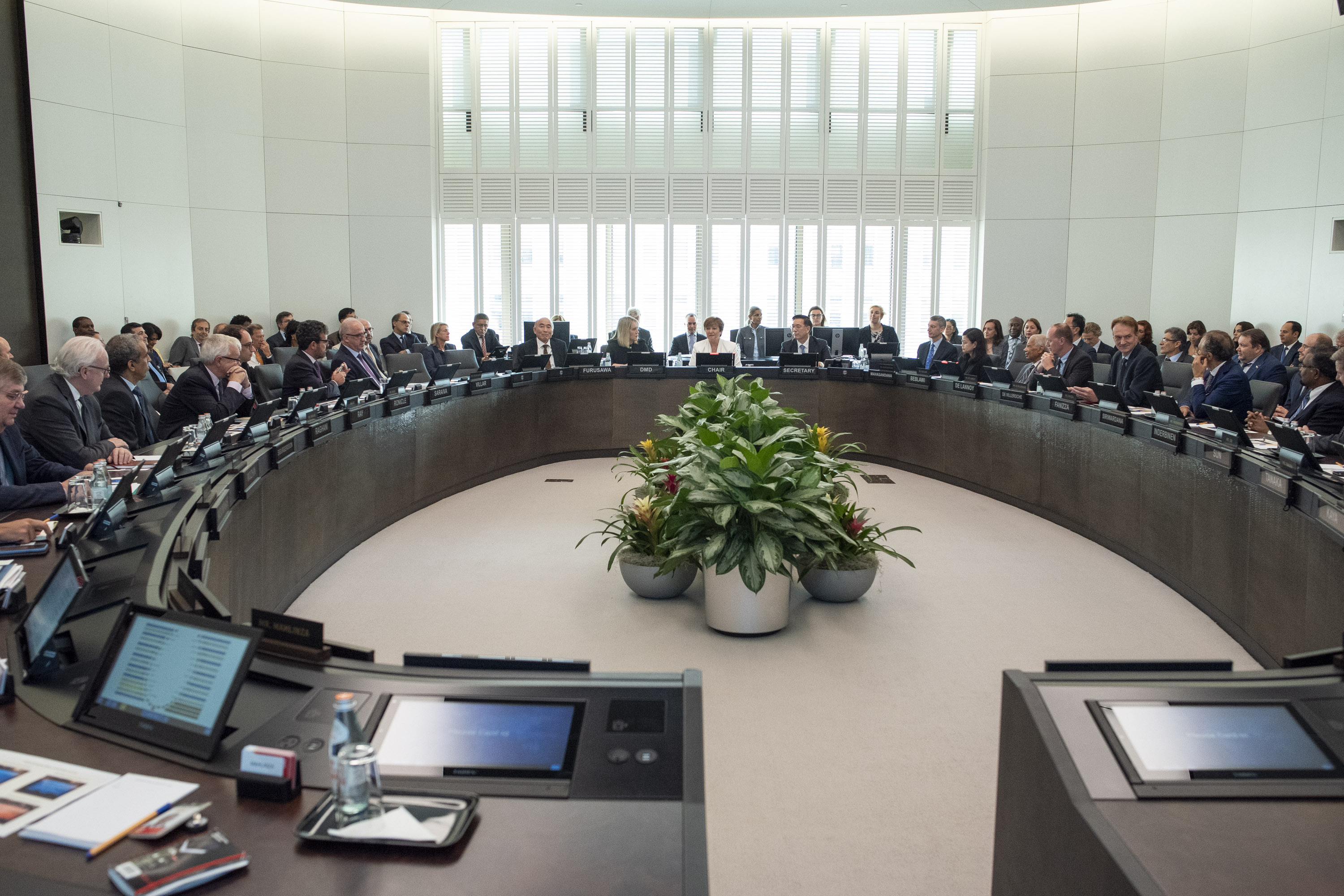
IMF Executive Board Concludes 2019 Article IV Consultation with the Republic of North Macedonia
IMF News, January 27, 2020
Source details
- Canonical URL
- IMF Executive Board Concludes 2019 Article IV Consultation with the Republic of North Macedonia
Other formats
Bibliographic details
- Published: January 27, 2020
Economic performance and outlook
- Real GDP growth:
- Estimated at 3.2 percent in 2019.
- Projected at 3.4 percent in 2020.
- Drivers of 2019 growth:
- Buoyant private consumption.
- Rebound in investment (gross investment growth 7.4 percent in 2019).
- High export growth despite slowdown in key trading partners.
- Solid domestic demand boosted imports.
- Sizeable inflows from remittances helped keep the current account deficit modest.
- Inflation and labor market:
- Inflation is low and mainly driven by euro area inflation and food and energy prices.
- Unemployment rate (annual average): 17.9 in 2019; projected 16.8 in 2020.
- Domestic demand and components:
- Real domestic demand growth: 4.2 percent in 2019; projected 3.7 percent in 2020.
- Consumption growth: 3.1 percent in 2019.
- Net exports contributed -5.8 percentage points to growth in 2019.
Fiscal outlook and recommendations
- Fiscal stance and public debt:
- Overall fiscal deficit expected to have remained below 2 percent of GDP in 2019.
- Public debt broadly stable: General government gross debt 40.4 percent of GDP in 2019.
- Public sector gross debt 49.1 percent of GDP in 2019.
- Investment and capital spending:
- Capital spending increased markedly from 2018 but remains below budgeted amounts.
- Authorities should increase essential capital expenditure to narrow the investment gap.
- Strengthen public investment management framework: better prioritization and address execution bottlenecks.
- Recommended consolidation:
- A cumulative consolidation of 1½ percent of GDP over 2020–22, compared to staff’s baseline projections, would achieve primary budget balance.
- Consolidation measures should include:
- Steadfast implementation of already approved reforms to pensions and personal income tax.
- Enhanced revenue administration.
- Rationalization of agricultural subsidies.
- Authorities should wait to approve new PPPs until a strengthened framework is in place.
- Fiscal risks:
- Rebuilding fiscal space is essential to strengthen the economy’s ability to cope with future shocks.
Monetary policy and external position
- Monetary policy stance:
- The National Bank of the Republic of North Macedonia (NBRNM) has continued to accumulate international reserves and further cut its policy rate in January 2020, keeping monetary policy accommodative.
- The monetary policy stance is judged appropriate.
- Recommendation: continue building buffers against possible domestic or external shocks; be ready to tighten monetary policy if the external environment worsens.
- External sector indicators (percent of GDP):
- Current account balance: -0.5 in 2014; -2.0 in 2015; -2.9 in 2016; -1.0 in 2017; (figure for 2018 appears missing); (2019 value not explicitly listed in table as single line).
- Exports of goods and services: 63.0 percent of GDP in 2019.
- Imports of goods and services: 75.8 percent of GDP in 2019.
- Private transfers: 14.8 percent of GDP in 2018.
- External debt: 74.0 percent of GDP in 2019.
- Reserve coverage:
- Reserve accumulation has been pursued within the de facto exchange rate peg; reserve coverage is described as broadly adequate.
Financial sector stability
- Banking system soundness:
- Banking system is well capitalized and liquid.
- Credit growth is solid: Private Sector Credit growth 6.7 percent in 2019; projected 6.3 percent in 2020.
- Non-performing loans remain relatively low.
- Financial sector recommendations:
- Increase deposit denarization.
- Calibrate measures to curb foreign currency lending to households as needed.
- Closer monitoring of household lending, including collecting granular household data.
- Strengthen macroprudential mandate of the NBRNM and improve systemic risk identification.
- Further progress on the financial safety net:
- Introduce a comprehensive bank resolution framework.
- Buttress the deposit guarantee scheme.
- Continue implementing 2018 FSAP recommendations: enhance supervisory and regulatory framework, improve banks’ liquidity risk reporting, and increase supervisory intensity for domestic systemically important banks.
Structural reforms, labor market, and competitiveness
- Reform priorities to accelerate convergence and raise incomes:
- Continue reforms to improve public administration, rule of law, and control of corruption.
- Build physical capital to address infrastructure gaps.
- Boost human capital to address skills shortages and mismatches through vocational education and training and more use of skill-enhancing active labor market policies.
- Tackle informality to improve the business climate, protect workers, and generate potential large revenue gains.
- Strengthen revenue administration efficiency and compliance; raise public trust in institutions to improve tax morale.
- Minimum wage considerations:
- Net minimum wage has been raised by 44 percent cumulatively since 2017.
- Minimum wage estimated to reach 53 percent of the average wage in 2020.
- Concern: productivity growth has been low; large increases in the minimum wage may not effectively reduce overall poverty and may have adverse effects on formal employment and competitiveness.
Executive Board assessment and scenarios
- Overall assessment:
- After a protracted political crisis, the economy has entered a period of solid growth and stability.
- Authorities have advanced institutional and governance reforms and efforts to make public finances more sustainable and equitable, gaining substantial policy credibility.
- 2020 prospects and risks:
- Growth expected to accelerate in 2020 driven by lower taxes and higher pensions and wages (including public sector and minimum wages), providing a one-off stimulus to consumption.
- Export and investment growth expected to remain robust but slow somewhat reflecting weak growth in trading partners.
- Downside risks:
- Worsening global trade tensions.
- Delays in investment plans due to uncertainty during the election period.
- Medium-term priority:
- Use the period of solid growth to rebuild fiscal space and maintain an unwavering commitment to the ambitious structural reform agenda to durably raise income levels.
IMF Executive Board press release, January 27, 2020.