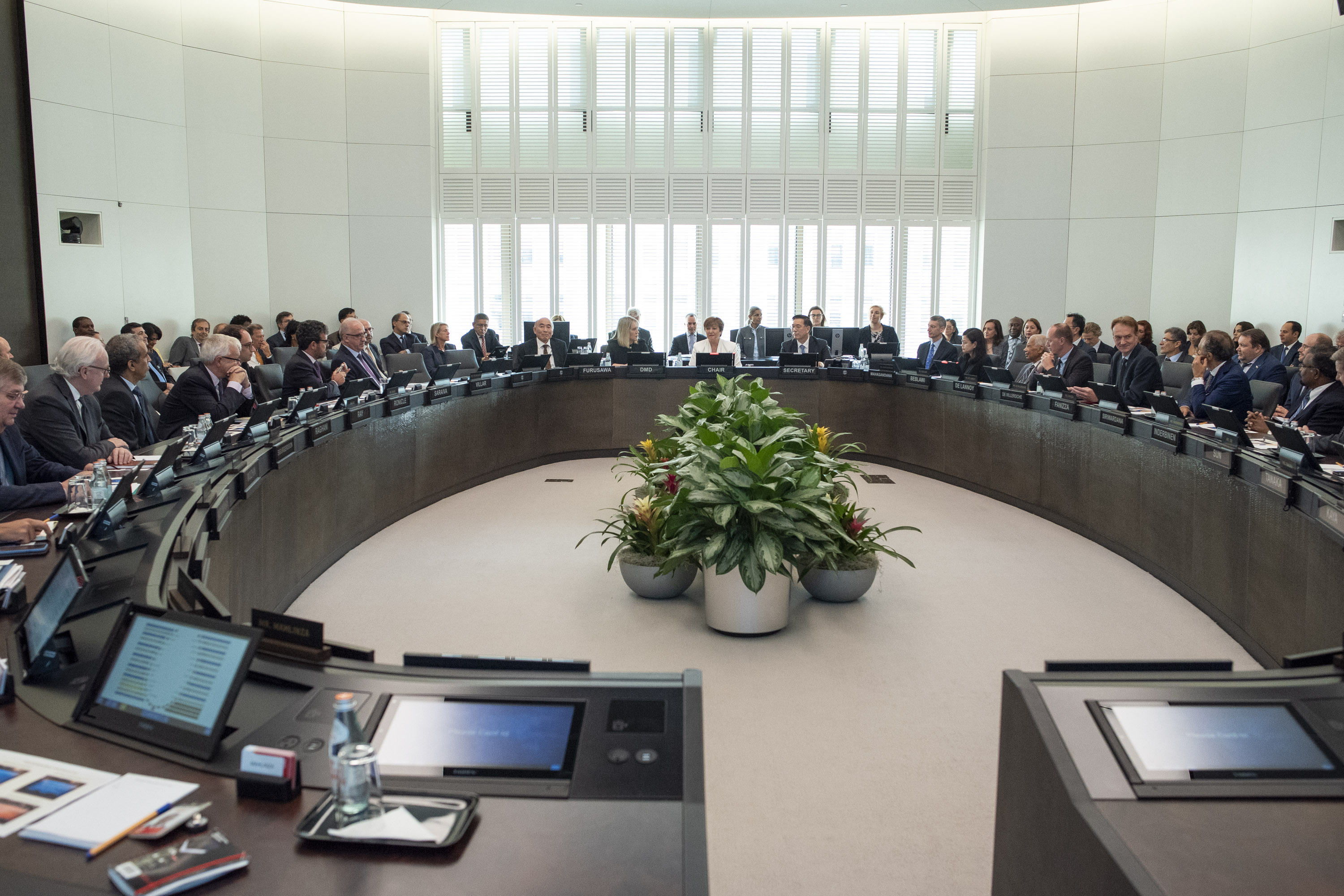
IMF Executive Board Concludes 2023 Article IV Consultation with Ghana and Completes First Review under the Extended Credit Facility Arrangement
IMF News, January 19, 2024
Source details
- Canonical URL
- IMF Executive Board Concludes 2023 Article IV Consultation with Ghana and Completes First Review under the Extended Credit Facility Arrangement
Other formats
Bibliographic details
- Published: January 19, 2024
Action taken and financing
- The Executive Board completed the 2023 Article IV consultation and the first review of Ghana’s 36-month Extended Credit Facility (ECF) arrangement.
- Approval of the first review enables the immediate disbursement of SDR 451.4 million (about US$600 million).
- The completion of the first ECF review brings Ghana’s total disbursements under the arrangement to about US$1.2 billion.
- The original ECF arrangement size: $3 billion, 36-month ECF Arrangement, approved on May, 17, 2023.
Program implementation and near-term macro outcomes
- Ghana’s performance under the program has been strong: all quantitative performance criteria for the first review and almost all indicative targets and structural benchmarks were met.
- Authorities’ reforms and program measures have produced emerging signs of stabilization:
- Growth in 2023 has proven resilient.
- Inflation has declined.
- Fiscal and external positions have improved.
- International reserves are being rebuilt.
- Domestic debt restructuring was completed over the summer.
- On January 12, 2024, the authorities reached an agreement with the Official Creditor Committee (OCC) under the G20’s Common Framework on a debt treatment aligned with Fund program parameters, providing financing assurances necessary for the Executive Board review.
Fiscal policy, revenues, and social protection
- Ghana is on track to lower the fiscal primary deficit on a commitment basis by about 4 percentage points of GDP in 2023.
- Spending has remained within program limits.
- Authorities significantly expanded social protection programs to help mitigate the crisis impact on the most vulnerable.
- Ghana met its non-oil revenue mobilization target.
- Ambitious structural fiscal reforms underway aim to:
- Bolster domestic revenues.
- Improve spending efficiency.
- Strengthen public financial and debt management.
- Preserve financial sector stability.
- Enhance governance and transparency.
- Create an environment more conducive to private sector investment.
Debt restructuring and debt management
- Domestic debt restructuring: completed.
- Agreement with the Official Creditor Committee (OCC) on January 12, 2024, for official bilateral debt treatment consistent with program parameters.
- Directors emphasized:
- Importance of finalizing comprehensive debt restructuring timely.
- Completing negotiations with external commercial creditors.
- Enhancing debt management.
Monetary policy and financial sector stability
- Authorities took decisive steps to rein in inflation and rebuild foreign reserve buffers.
- Policy guidance emphasized:
- Maintaining an appropriately tight monetary stance.
- Enhancing exchange rate flexibility.
- Improving FX market functioning and adopting an FX intervention framework to help unwind multiple currency practices.
- Strengthening the Bank of Ghana’s independence.
- Bank of Ghana deployed regulatory and supervisory tools to mitigate the domestic debt restructuring impact on financial institutions.
- Strategy welcomed to rapidly rebuild financial buffers by drawing on new resources from the private sector, government, and multilaterals.
- Importance stressed on:
- Full implementation of bank recapitalization plans, including operationalization of Ghana’s Financial Stability Fund.
- Addressing legacy issues in the financial sector.
- Further upgrading the AML/CFT framework.
Structural reforms and growth agenda
- Reforms to create an environment more conducive to private investment are needed to raise private sector led growth and underpin sustainable job creation.
- Priority to promote a green recovery given Ghana’s exposure to climate shocks by advancing adaptation and mitigation agendas.
- Continued capacity development support for authorities’ reform efforts emphasized.
Executive Board assessment and guidance
- Directors agreed with the thrust of the staff appraisal and welcomed strong program implementation and positive results (resilient growth, declining inflation, improving fiscal and external positions, rebuilding reserves).
- Directors warned of significant downside risks and stressed the need for continued strong program ownership and steadfast implementation of macroeconomic policy adjustment and reforms.
- Directors urged further advancement of structural fiscal reforms, improved tax administration, stronger expenditure control and arrears management, enhanced fiscal rules and institutions, and improved SOE management (including in energy and cocoa sectors).
Key macroeconomic figures and projections (annual percentage change or percent of GDP unless otherwise indicated)
- National accounts and prices (annual percentage change):
- GDP at constant prices: 2022 actual 3.1; 2023 2.3; 2024 proj. 2.8; 2025 proj. 4.4; 2026 proj. 4.9; 2027 proj. 5.0.
- Non-extractive GDP: 2023 2.4; 2024 2.5; 2025 4.8.
- Extractive GDP: 2022 8.1; 2023 0.4; 2024 6.2; 2025 4.2; 2026 5.9.
- Real GDP per capita: 2022 0.9; 2023 -0.3; 2024 0.2; 2025 1.8.
- GDP deflator: 2022 28.2; 2023 36.3; 2024 20.2; 2025 10.9; 2026 7.5.
- Consumer price index (end of period): 2022 54.1; 2023 27.6; 2024 15.0; 2025 8.0.
- Consumer price index (annual average): 2022 31.9; 2023 40.2; 2024 22.3; 2025 11.5.
- Central government budget (percent of GDP):
- Revenue: 2022 15.8; 2023 15.7; 2024 16.7; 2025 17.3; 2026 18.2; 2027 18.1; 2028 18.0.
- Expenditure (commitment basis): 2022 27.7; 2023 20.4; 2024 21.7; 2025 21.6; 2026 21.8; 2027 21.2; 2028 21.1.
- Overall balance (commitment basis): 2022 -11.8; 2023 -4.6; 2024 -5.0; 2025 -4.3; 2026 -3.6; 2027 -3.1; 2028 -3.0.
- Primary balance (commitment basis): 2022 -4.4; 2023 -0.5; 2024 0.5; 2025 1.5.
- Non-oil primary balance (commitment basis): 2022 -6.3; 2023 -1.8; 2024 -0.8; 2025 0.0; 2026 0.1.
- Public debt (gross): 2022 93.3; 2023 86.1; 2024 83.6; 2025 80.9; 2026 77.9; 2027 74.9; 2028 72.0.
- Domestic debt: 2022 50.0; 2023 37.0; 2024 33.7; 2025 31.8; 2026 29.4; 2027 27.8; 2028 26.4.
- External debt: 2022 43.3; 2023 49.1; 2024 49.9; 2025 48.6; 2026 47.1; 2027 45.6.
- Money and credit:
- Credit to the private sector: 2022 12.6; 2023 22.0; 2024 13.0.
- Broad money (M2+): 2022 32.9; 2023 22.8; 2024 17.4; 2025 16.9; 2026 16.0.
- Velocity (GDP/M2+, end of period): 2022 3.4; 2023 3.8; 2024 4.0; 2025 3.9; 2026 3.7.
- Base money: 2022 57.3; 2023 6.0; 2024 12.1; 2025 13.6; 2026 13.8.
- Policy rate (end of period): 2022 27.0; 2023 ….
- External sector (US$ million, unless otherwise indicated):
- Current account balance (percent of GDP): 2022 -2.1; 2023 -1.7; 2024 -1.9; 2025 -2.2; 2026 -2.4.
- BOP financing gap: 2022 4,216; 2023 3,312; 2024 3,910; 2025 3,321; 2026 1,410; 2027 937.
- IMF: 2022 1,200; 2023 720; 2024 360; 2025 0.
- World Bank: 2022 330; 2023 620; 2024 350; 2025 250.
- AfDB: 2022 59; 2023 44.
- Residual gap: 2022 2,627; 2023 1,928; 2024 2,840; 2025 2,711.
- Gross international reserves (program): 2022 1,441; 2023 2,388; 2024 3,852; 2025 5,501; 2026 7,677; 2027 9,250; 2028 10,874.
- in months of prospective imports: 2022 0.7; 2023 1.1; 2024 1.7; 2025 3.0; 2026 3.5.
- Gross international reserves: 2022 6,238.
- Memorandum:
- Nominal GDP (millions of GHc): 2022 610,222; 2023 850,656; 2024 1,050,978; 2025 1,216,854; 2026 1,372,186; 2027 1,548,313; 2028 1,746,882.
- Notes:
- Program approval interest expenditure projections corresponded to a pre-domestic and external debt restructuring scenario. Updated projections correspond to a post-domestic debt restructuring and pre-external debt restructuring scenario.
- BOP financing gap: Additional financing needed to gradually bring reserves to at least 3 months of imports by 2026.
- Gross international reserves (program) excludes oil funds, encumbered assets, and pledged assets.
- Gross international reserves (listed separately) includes oil funds, encumbered assets, and pledged assets.
Source: IMF Executive Board Concludes 2023 Article IV Consultation with Ghana and Completes First Review under the Extended Credit Facility Arrangement.