
EXECUTIVE SUMMARY OF THE PRSP This document is Burkina Faso’s first Poverty Reduction Strategy Paper. It was prepared in the context of the introduction of the enhanced Heavily Indebted Poor Countries (HIPC) Initiative. The paper describes the strategy, which the Government plans to implement during the next four years in order to wage a more effective fight against poverty. It was prepared via a participatory process in consultation with representatives of the private sector, civil society, and donors, thus benefiting from the experience the country has acquired in this field over the past decade. The document comprises five parts. The first part describes the predominant characteristics of poverty in Burkina Faso and endeavors to identify the major causes. The second part presents the country’s development objectives and priorities. The third part describes the Government’s poverty reduction strategy. The fourth part indicates the cost of complementary priority actions, which the Government has identified for the purpose of accelerating poverty reduction. The fifth and final part describes the monitoring and evaluation arrangements. (1) Characteristics and causes of poverty in Burkina Faso The analysis of poverty is based on the results of two surveys of household living conditions conducted in 1994 and 1998 and on qualitative studies of the perceptions of the poor regarding the causes of poverty. The survey findings indicate that poverty is a widespread phenomenon in Burkina Faso, and that 45.3 percent - nearly one-half - of the population lives below the absolute poverty line of approximately CFAF 72,690 per year. Poverty is particularly prevalent in rural areas, although its incidence in urban areas increased by nearly five points from 1994 to 1998, reaching 16 percent in 1998. The participatory surveys of the perceptions of the poor regarding poverty reveal that the situation differs depending on where the respondents live. The key factors for the urban poor are, in order of importance, climate-related hazards, low purchasing power, old age, and large family size. Poor people in rural areas, however, attribute their situation mainly to laziness or lack of initiative, persistent failure, physical handicaps, and social decay. The regional analysis of poverty shows that the poverty map in Burkina Faso changed between 1994 and 1998. Although the incidence of poverty decreased significantly (by nearly eight points) in the southern, southeastern, and northern agro-climatic regions, the south-central region experienced an increase of four points. The Probit analysis of the probability of becoming poor reveals a troubling situation, in that the probability is highest in poor regions.
The analysis of poverty among socioeconomic groups (based on source of income) shows that the incidence of poverty is increasing for all groups except cash crop farmers and inactive persons. It is highest among food crop farmers, who account for most of the population living in poverty. The analysis of the causes of poverty shows that inappropriate public policies and inhospitable climatic conditions are largely responsible for this situation.
(2) Vision and long-term development objectives In the light of these observations, the Government reaffirms its commitment to pursue the objectives established in the Letter of Intent for Sustainable Human Development, which sets out its vision for the country’s development. This vision is based on the concept of human security, which entails guaranteeing that every Burkinabe national will enjoy economic security (access to training and employment), health security, food security, environmental security, and individual and political security. The key quantitative objectives the Government will pursue in the years ahead are the product of this vision. They include (i) increasing annual per capita gross domestic product (GDP) by at least three percent from 2000 to 2002 and from four to five percent starting in 2003; (ii) reducing the incidence of poverty from 45 percent to 30 percent by the year 2015; and (iii) increasing life expectancy by at least ten years. (3) Poverty reduction strategy The new poverty reduction strategy for Burkina Faso is in line with the existing Letter of Intent for Sustainable Human Development and is based on seven major principles that will underpin the Government’s actions in the future:
Acceleration of growth is a prerequisite for reducing poverty. The Government will therefore implement major structural reforms in order to more fully open up the economy to the outside, lower production costs while improving factor productivity, encourage initiative, and support activities to generate income and create jobs, particularly in rural areas. However, the Government recognizes that faster growth alone will not reduce the incidence of poverty. It will therefore adopt policies directly targeting the poor by helping them access essential social services (basic education, health, clean water, and sanitation) and offering them expanded employment opportunities. To this end, it will accelerate the required institutional reforms and will continue its efforts to enhance the effectiveness of public expenditure. Reforms to increase the ability of the poor to participate in growth will focus on creating conditions necessary to facilitate the accelerated growth of the agricultural sector. Finally, the Government considers good governance a key component of its poverty reduction strategy. It will therefore accelerate reforms to strengthen democratic forums and promote the efficient management and transparency of government finance. In order to combat poverty it is essential to establish priorities. The Government has therefore decided to designate the social sectors (basic education, health, drinking water, and sanitation) and rural development (agriculture, livestock breeding, agricultural water works, rural roads) as priority sectors, which will receive increased attention as the poverty reduction strategy is implemented. Programs for these sectors will be implemented via new modalities involving NGOs and local communities when such modalities are more effective than government structures. (4) Cost and financing of complementary priority actions The availability of resources under the HIPC Initiative will enable the Government to strengthen its efforts on behalf of priority sectors. The approximate overall cost of implementing planned complementary actions and thereby accelerating poverty reduction is CFAF 15 billion during 2000 and CFAF 32 billion-CFAF 34 billion in subsequent years. These amounts exceed the estimated resources expected from the HIPC Initiative. The additional financing needed in 2000 is CFAF 2.6 billion, and varies from CFAF 6 billion-CFAF 7.6 billion in future years. The development objectives, which the Government has established, can be achieved if all the priority actions identified in the priority action plan to combat poverty are carried out. The Government is therefore counting on the willingness of its development partners to provide the additional resources. The macroeconomic framework incorporating these additional expenditures will remain stable even though the primary balance will be adversely affected (although it will remain positive, i.e., will show a surplus). (5) Arrangements for monitoring the poverty reduction strategy The success of the strategy will depend on how effectively it is monitored. The Government therefore plans to establish dedicated monitoring arrangements which will rely, in particular, on improving statistics-gathering, and on clearly defined monitoring indicators, the identification of ad hoc administrative structures, and, finally, participation by beneficiaries, civil society, and the private sector in the evaluation of outcomes. It will use the results of the conditionality reform exercise currently under way to refine indicators showing the impact of public policy and will involve its development partners in implementing and monitoring the poverty reduction strategy. |
ABBREVIATIONS AND ACRONYMS
|
|
Macroeconomic performance in Burkina Faso was impressive during the 1990s. Real GDP grew at an average rate of 5 percent during 1994-99 compared with 3 percent during 1980-93. Despite a significant deterioration in the terms of trade between 1997 and 1999, the growth rate held steady at 5.6 percent on average. The increase in the gross domestic product (GDP) was achieved through the adoption and implementation of stabilization and structural adjustment programs – supported by the Burkina Faso’s entire development partners – aimed at improving public expenditure management, liberalizing the national economy, and benefiting from a more openness to external trade. Despite important economic achievement, Burkina Faso’s population has remained extremely poor, as demonstrated by the findings of two priority surveys conducted by the Government in 1994 and 1998. Based on the current poverty line – approximately CFAF 72,690 in 1998 compared with CFAF 41,099 in 1994 – the proportion of poor inhabitants rose slightly, from 44.5 percent to 45.3 percent. Although the number of poor declined slightly in rural areas, it is on the rise in urban areas. Annual per capita GDP is US$220, lower than in most of Burkina Faso’s neighbors (US$250 in Mali, US$ 330 in Togo, US$380 in Benin, US$390 in Ghana and US$700 in Côte d’Ivoire). Burkina Faso’s Human Development Index is one of the lowest in the World (HDI = 0.304 in 1997). Although much has been done to promote essential basic social services (basic education, basic health services, including reproductive health, drinking water, nutrition, hygiene, and sanitation), Burkina Faso still suffers from a huge gap in social services. This may be attributed to the rapid rate of population growth (2.8 percent annually) and low labor productivity, particularly in the agricultural sector, which employs 80 percent of the working population. Moreover, the school enrollment ratio, though definitely on the rise, is one of the lowest in the subregion (the gross enrollment ratio was 41 percent in 1998-99, in which girls accounted for approximately 35 percent). With regard to health, morbidity and mortality (particularly among infants and mothers) are very high, a result of infectious and parasitic diseases and the rapid spread of HIV infection. Water supply has improved considerably, although it remains insufficient to cover the entire urban and rural demand. The nutritional status is unsatisfactory. Nutritional requirements are not still being adequately met: In 1996 the figure was 2300 kcal, compared to 2500 kcal required. As to the status of women in Burkina Faso, they are still subject to reactionary prejudices and practices and have not been adequately incorporated into the public life of the country. The gap in social services, the extreme poverty, and vulnerability of Burkina Faso’s population to a wide variety of crises, constitute a major handicap impeding efforts to bring about sustainable development. Against this background, the Government has decided to prepare this Poverty Reduction Strategy Paper (PRSP) in cooperation with the various stakeholders – the Government, the private sector, civil society, and the country’s development partners. The Government’s primary objective in the PRSP is to put forward a development strategy that will focus on enhancing the impact of public policies and on the need to increase the purchasing power of the disadvantaged population and to provide them with an environment more conducive to their social development. A new paradigm, therefore, has to be adopted to guide macroeconomic policy: a paradigm focusing on the pursuit of quality economic growth, i.e. sustainable growth in the face of external shocks (such as a sudden drop in cotton or gold prices), and stronger because it is fueled by a broader economic base. Various fiscal and sector policy instruments will also be needed to enable the population to play a more active role in their development and to reduce inequities. Although economic growth is certainly a necessary condition to raise the level of income and improve the well being of the population, growth alone is not enough to combat poverty and inequity. For an economic policy to be sound and effective for the majority of the population, it must place equity at the forefront of its objectives. A number of recent government studies1 have identified the main obstacles to a balanced growth: (i) weak human capital, which contributes to low labor productivity and very high unemployment; (ii) inadequate infrastructure for economic development, which explains the high cost of production factors and the narrow scope of the modern sector of the economy; (iii) insufficient national capacity, which aggravates governance problems; and (iv) the limited external openness of the economy (despite the success of Burkina Faso’s stabilization and adjustment programs), which limits opportunities for growth and job creation. Burkina Faso would like to benefit from the regional integration process under way in the West African Economic and Monetary Union (WAEMU) in order to transform its landlocked status – currently a handicap – into an asset and position itself at the crossroads of the economies of the sub-region. Swift implementation of an ambitious program of complementary structural reforms to eliminate the four key obstacles outlined above would soon enable Burkina Faso to achieve growth rates permitting a significant alleviation in the incidence of poverty. Given the current low level of competitiveness of the national economy, the West African economic integration process will undoubtedly entail some economic and social costs. Even so, the Government is confident that it can work with other members of the Union both to minimize the costs and to take full advantage of the opportunities that a much broader regional market will offer. The PRSP is a framework document setting out the development priorities established by the Government. It is not intended to replace sectoral strategies, which already exist or are currently being developed within each ministry – all of which must be aligned with government priorities. The purpose of the PRSP is therefore to influence the sectoral objectives of each ministry and the choice of monitoring indicators for the programs and action plans to be financed. However, the PRSP also reflects the essential choices established for the priority sectors. The PRSP preparation process is therefore an iterative process. The Government plans to update it annually to take into account the lessons learned from the implementation of the public policies adopted in the document, the findings of complementary studies carried out by various institutions to gain a better grasp of the poverty phenomenon, and the amount of resources available. The major challenge facing Burkina Faso is to reduce the level of poverty of its population, their vulnerability in the face of a wide variety of crises, and inequalities among different regions and socioeconomic groups. To accomplish this goal, the Poverty Reduction Strategy Paper will endeavor to reconcile the requirements of structural reform and economic recovery with the objective of increasing the income of the poor and transferring more resources to the poorest members of society. Recognizing the limited amount of resources available, and wishing to take a realistic approach to its problems, the Government has established development priorities to guide its poverty reduction efforts. It will therefore focus initially on reducing the gap in social services, improving food security, and ensuring that the poor have access to drinking water. In order to reduce considerably the incidence of poverty, a stronger economic growth is required in the years ahead. Accelerated growth should:
Efforts to achieve the goals of the strategy paper will focus on a set of programs organized under four strategic objectives, for which quantified priority actions are planned: Objective 1: Accelerate growth based on equity
Objective 2: Guarantee that the poor have access to basic social services
Objective 3: Expand opportunities for employment and income-generating activities for the poor
Objective 4: Promote good governance
1.4.1 Broad-based consultations to prepare the PRSP Building on the work carried out by the Government since the adoption of the Letter of Intent for Sustainable Human Development (LISHD) in 1995 and on the outcome of broad-based consultations in each sector of activity, the PRSP preparation process, officially launched in November 1999, was conducted on four levels of dialogue: 1.4.2 Within the central Government: This dialogue began with a briefing for the Government on the process as a whole. All the ministries were made aware of the importance of the new undertaking and of the need to make poverty reduction the focus of all development strategies, and were asked to contribute their ideas. An interministerial committee was then formed comprising the directors of research and planning. Its first task was to become thoroughly familiar with and to endorse the preliminary findings of the household living conditions survey. The committee – which was organized in four thematic groups (improving the economic environment of the poor, human resources development, natural resources management, and improved governance and aid coordination) – was then asked to discuss the components of the strategy. Operating under the supervision of the Ministry of Economy and Finance, the committee worked to improve the PRSP on an almost continual basis. The basic documents prepared by the interministerial committee were then discussed in technical meetings within the Government. 1.4.3 With institutions representing the people: Before the PRSP was officially transmitted to the international financial institutions, the Ministry of Economy and Finance presented it to both chambers of the parliament of Burkina Faso (the National Assembly and the House of Representatives) and the economic committee of the Economic and Social Council (ESC). With quasi-unanimity, the representatives of the population and of civil society belonging to these institutions approved the Government’s suggested choices and the highly selective and realistic approach underlying these choices. 1.4.4 With the country’s development partners: Two meetings have already taken place. The first one, held on February 15, 2000, enabled members of the Government to exchange ideas and information on the PRSP preparation process with Burkina Faso’s external partners. The second meeting held on February 28, 2000, provided an opportunity to hear the views of certain partners regarding an initial outline of the framework document. Additional technical meetings were then held to finalize the document. These meetings demonstrated that the Government’s approach to the preparation of the PRSP mirrored the approach taken in discussions with donors in the context of an important reformulated conditionality test initiative under way in Burkina Faso. Recognizing that the purpose of all development efforts is to improve the well being of the population, especially the poorest members of society, the Government – with the support of its development partners – began to test a new approach to conditionality in 1997. The objectives of this original exercise are to strengthen the Government’s commitment to the reforms and establish performance indicators acceptable to all donors for measuring both progresses in the implementation of public policy and their actual impact on the well being of the population. 1.4.5 With civil society and other stakeholders in the field: Two regional workshops were organized, in Ouahigouya (in the northern part of the country) and Bobo-Dioulasso (in the west), on February 23 and March 3, 2000, respectively. The aim of the workshops was to inform representatives of civil society, decentralized governments, the private sector, and producers’ groups of the results of the second priority survey (EP II) and to elicit their advice and suggestions for improving the basic document prepared by the interministerial committee. Many association officials representing a broad sample of Burkina Faso’s society thus were able to indicate their priorities for combating poverty and contribute meaningfully to the search for solutions. The members of the interministerial committee preparing the PRSP were receptive to the proposals offered and prepared summaries that were used to draft the document. This PRSP is therefore a synthesis of all the ideas and contributions gathered throughout the country, not only during the five-month drafting period (November 1999-April 2000), but also at the meetings and forums on various topics convened over the past few years. The document reflects the current consensus in Burkina Faso regarding the Government’s approach to the problem. It reiterates the Government’s vision and its priorities for the poverty reduction effort. This new strategy will influence the process now under way to consolidate democratic reforms, and the shared commitment to democratic values will have a positive impact on performance in the priority social sectors. Democracy should lead to greater well being for the poorest segments of society so that they will remain committed to the democratic process. |
|
| Contents |
BACKROUND AND CAUSES 2.1.1 Definitions and Approach Equity and poverty are multidimensional concepts. They include many things beyond an individual’s monetary income, including the ability to play an active role in the community or to take control of his own life. Accordingly, no single indicator can address all the issues at hand. Factors unrelated to income, including the level of education, health and nutrition, housing, access to drinking water and land – all of which have a direct impact on poverty in Burkina Faso – must also be considered. 2.1.2 How the poor themselves perceive poverty The results of the participatory surveys conducted in 1998 on perceptions of the dimensions of well being, poverty and the accessibility of basic social services in urban and rural areas showed that at the individual level, poverty – particularly economic poverty – is defined as the inability to satisfy basic needs such as food, clothing, and housing. From a collective perspective, an inhospitable natural environment, famine, and epidemics characterize economic poverty. The lack of a safe environment (public safety) and of social infrastructure (schools, markets, dispensaries, etc.), the isolation of some regions, and poor transport facilities underscore the population’s perception of collective poverty. The population has a clear perception of the causes of poverty. How the main factors are ranked depends on where the inhabitants live. In urban areas, ten determinants of poverty were singled out, as follows, in decreasing order of importance: climate-related hazards, low purchasing power, old age, large family size, laziness or lack of initiative, mediocre governance, physical handicaps, theft, death of a spouse, and chronic poverty. In rural areas, the ten key factors, in decreasing order of importance, were laziness or lack of initiative, permanent failure, physical handicaps, social decay, chronic poverty, low purchasing power, social and cultural barriers, absence of NGOs or project assistance, large family size, and planning problems. Inasmuch as the perceptions of households determine how they conduct their lives, these perceptions should be taken into account when defining a poverty reduction strategy. It can be noted that low purchasing power, the burden of having a large family, and a lack of initiative were cited as causing poverty in urban and rural areas alike. The results of the most recent (1998) survey of household living conditions indicate that the absolute poverty line is approximately CFAF 72,690 per adult per year, compared with CFAF 41,099 in 1994. The poverty line expressed in terms of caloric intake remained constant, at 2300/person/day. Accordingly, the proportion of the population of Burkina Faso living below the poverty line is 45.3 percent, slightly higher than in 1994 (44.5 percent). The incidence of poverty in urban areas rose by nearly five points during that period, reaching 16 percent in 1998. In rural areas, however, the incidence of poverty remained stable. Despite the significant increase in urban poverty – from 3.8 percent in 1994 to 6.1 percent in 1998 – its share in the total picture is low. Thus, poverty is still essentially a rural phenomenon, accounting for 94 percent of the national figure in 1998. The depth of poverty remained at 14 percent, suggesting that a substantial majority of the poor are close to the poverty line. |
Table 1: Poverty Indices Based on Place of Residence (in percent) |
|||||||||||||||||||||||||||||||||||||
|
|||||||||||||||||||||||||||||||||||||
| Source: Analysis of Poverty in Burkina Faso, INSD, 1999 | |||||||||||||||||||||||||||||||||||||
2.2.1 Household Consumption The results of Priority Survey II indicate that the average annual spending per household is CFAF 751,361, or CFAF 62,613 per month. The breakdown shows that the money is spent mainly on foodstuffs (52.2 percent). Lodging, water, electricity, and other consumables come second with 20.2 percent of total spending in urban areas and 12.1 percent in rural regions. Compared with the situation in 1994, foodstuffs are the main expenditure items with an increasing share. In poor households, cereal products accounted for 40.6 percent of foodstuffs. In urban households, the major non-foodstuff spending included rent (19.5 percent), health care (14.3 percent), gasoline and lubricants (11.6 percent), and transfers (9.7 percent). Without taking into account rent, wood was the most important expenditure item (15.1 percent) in poor households. More was spent on them than for health care (14.1 percent) and education (6.3 percent). In addition, individual spending in poor households was less than half more important than that of other households. |
2.3.1 Analysis based on agro-climatic regions Data analysis of the Priority Survey I was based on agro-climatic regions as a representative unit. The same regions have been maintained in order to insure methodological coherence of poverty analysis in Burkina Faso. From the geographical perspective, the poverty map has changed, the result of a significant decrease in the incidence of poverty in the southern, southeastern, and northern agro-climatic regions for about 8 points and a major increase in the south central region and, to a lesser extent, in the west. These regional disparities may be attributed to significant variations in the availability of natural resources (water, fertile land, and the environment). Moreover, in certain zones -especially in the north central, south-central, and southeastern regions, poverty is a particularly critical issue, owing to severe population pressures and a very inhospitable ecosystem. |
Map 1: Poverty incidence rate in Burkina Faso, by Agro-climatic Regions (in percent) |
Rates for 1994 in small fonts, rates for 1998 in bigger fonts |
 |
Table 2: Incidence and Share by Agro-climatic Region |
||||||||||||||||||||||||||||||||||||||||||||||||||||||||||||||||||||||
|
||||||||||||||||||||||||||||||||||||||||||||||||||||||||||||||||||||||
| Source : Poverty Analysis in Burkina Faso, INSD, 1999 | ||||||||||||||||||||||||||||||||||||||||||||||||||||||||||||||||||||||
2.3.2 Analysis by Administrative Planning Regions The Priority Survey II of 1998 was based on the ten planning regions of the Ministry of Economy and Finance for the production and representativity of data. Each region regroups a number of provinces with common characteristics. Result analysis shows that the poorest regions, by decreasing importance, are the North, the North Central, the East Central, the Northwest and the East (See the Maps). In general, poorest regions have high probability to be poor. However, it can be noted that economic regions with relatively low incidence of poverty may have high probability of being poor (case of the East). |
Map 2: Poverty incidence rate in Burkina Faso, by Region (in percent) |
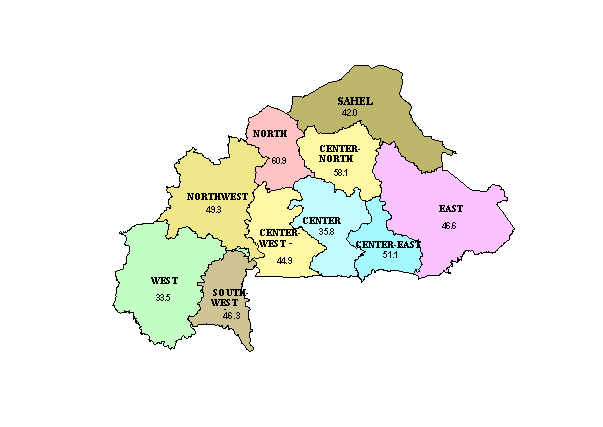 |
Map 3: Probability of being poor in Burkina Faso, by geographic area (in percent) |
(Calculations based on the Probit analysis method and results of the EP II) |
 |
2.3.3 Socioeconomic groups and poverty When considering poverty among different socioeconomic groups – that is, by focusing on the main sources of household income – the figures show that in 1994 the incidence of poverty was highest among food crop farmers (51.5 percent), cash crop farmers (50.1 percent), and inactive or unemployed persons (41.5 percent). In 1998 the figures increased in all groups, with the exception of cash crop farmers and inactive persons, who experienced a significant decrease in poverty. Although the proportion of food crop farmers among the poor population decreased slightly, they still account for the majority of the poor in Burkina Faso: more than three out of four poor persons are food crop farmers. If poverty is to be reduced in Burkina Faso, it is essential to improve the living conditions and income of these farmers. The incidence of poverty among cash crop farmers fell substantially, from 50.1 percent to 42.4 percent, but since the number of households growing cash crops increased during the period studied, they accounted for a higher proportion of the poor. |
Figure 1: Inequity in Burkina Faso: proportion of income held by the wealthiest households |
 |
Table 3: Poverty Trend by Socioeconomic Groups |
||||||||||||||||||||||||||||||||||||||||||||||||||
|
||||||||||||||||||||||||||||||||||||||||||||||||||
| Source : Poverty Analysis in Burkina Faso, INSD, 1999 | ||||||||||||||||||||||||||||||||||||||||||||||||||
2.3.4 Farmers and Livestock Breeders’ Vulnerability and Food Security Production activities in the rural sector are the main source of employment and income for approximately 80 percent of the population of Burkina Faso. Agriculture and livestock are the primary sectors driving the growth of the national economy, accounting for nearly 35 percent of GDP and 60 percent of exports. There are about 1,300,000 farms, 87 percent of which focus on subsistence farming and/or extensive livestock breeding, and productivity is low. Small farmers have difficulty securing loans and gaining access to markets and agricultural support services. Agricultural performance was inconsistent during the 1980s; however, the agricultural sector grew by an average of 4 percent annually, outstripping population growth. Growth was weak during the first half of the 1990s (about 2 percent), but after the CFAF devaluation it increased by more than 6 percent between 1995 and 1997, mainly as a result of the boom in cotton production. Low productivity in the agricultural and livestock sectors places considerable pressure on Burkina Faso’s already fragile natural resources, particularly in the densely populated zones of the central plateau. Short fallow periods, inadequate use of fertilizers, overgrazing, and woodfuel harvesting contribute directly to deforestation and the disappearance of the vegetation cover. To sum up, climatic conditions, the country’s land-locked status, and low agricultural productivity, along with degradation of the soil and water resources, are major constraints to economic growth and contribute to massive poverty and severe food insecurity among rural inhabitants. Income from farming and livestock raising is therefore highly dependent on the amount of rainfall, which varies considerably from year to year, causing rural families to suffer from food insecurity. The incidence of poverty in rural areas remained stable between 1994 and 1998, increasing by two points among food crop farmers and decreasing by eight points among cash crop farmers. The breakdown of the figures by socioeconomic group shows that the incidence of poverty among food crop producers rose from 51.5 percent in 1994 to 53.4 percent in 1998. The depth of poverty, which measures the revenue gap between the income of the average poor and the poverty line, remained stable, at 16.3 percent for the same social group. A comparative analysis of the various socioeconomic groups indicates that poor farmers were the farthest removed from the poverty line, both in 1994 and in 1998. They also have very limited access to social services (such as education and health), earn very modest incomes, and their productive capacity is low. Food crop farmers account for a very high percentage of the poor: the figure was 78.9 percent in 1994 and 77.1 percent in 1998. The average family size among the poor in this group is 7.6 persons. |
|
2.4.1 Education and poverty Throughout the past decade Burkina Faso has pursued a satisfactory resource-allocation policy that reflects the priority assigned to basic education. Thus, between 1990 and 1999 primary enrollment rose from 30 percent to 41 percent (34 percent for girls). The number of new admissions in the first year of primary education doubled in the same period. Educational opportunities have been greater for urban children and particularly for those in rural areas, where 70 percent of all new classrooms have been built over recent years. The disparities between provinces are becoming less in that the proportion of provinces failing to reach the national average enrollment rate has fallen from 73 percent to 58 percent. These recent advances have been accomplished thanks to the implementation of two strategies: (i) Additional funds have been allocated to basic education to support its development; the share of the education sector budget assigned to basic education increased from 45 percent to nearly 60 percent between 1990 and 1999; the availability of schools has also increased thanks to the construction of about 800 classrooms on average per year; (ii) Several steps have been taken to substantially reduce unit costs per student in order to facilitate the expansion of basic education. These include: (a) concentration on hiring assistant teachers, which has made it possible to reduce average salary costs for primary teachers from 8.2 to 6.2 times the country’s per capita GDP; (b) the introduction of dual-stream teaching, which has facilitated the inclusion of 40 percent of students in urban areas, thereby serving to contain urban demographic pressure; and (c) recourse to multigrade classes which have enabled 25 percent of rural children living in localities with very low population density to attend school. Burkina Faso has also made appreciable efforts to address demand-side education constraints. To this end, the proportion of schools with drinking water and sanitary facilities has reached 47 percent and 45 percent respectively. The number of literacy centers has more than doubled since 1990 and the literacy programs available to only 90 villages in 1990 today cover 4,500. To further stimulate school attendance on the part of low-income groups, the Government has set up a system for providing sets of textbooks for use free of charge and has encouraged greater parent participation in the running of the schools. To lower the opportunity costs for poor households and promote school attendance by girls, a considerable effort has been made to build schools not far from the villages, financial and material resources have been made available to mothers’ associations (Associations des mères d’élèves) for income-generating activities, and school lunch programs have been developed in rural areas. In parallel to these efforts, Burkina Faso has also taken steps to improve the quality of education (a) by regularly distributing sufficient textbooks to allow, on average, for one set of books to be shared by two students in the basic subjects; (b) by upgrading teachers’ skills, particularly in rural areas; and (c) by introducing bilingual education on an experimental basis. Taken altogether, these improvements have made it possible to reduce the disparities in school attendance between urban and rural areas and between regions, and also between boys and girls. Despite these efforts some significant problems still persist:
The cost of producing a primary graduate is twice what it ought to be; dropout rates are high in the north (10.9 percent) and lower in the southwest (3.5 percent); the gender difference expressed in dropout rates varies between regions: for boys it is 12.5 percent and for girls 7.1 percent in the north and in the west the rates are, respectively, 8.1 percent and 3.7 percent; in the other regions the dropout rate for girls is either higher than the dropout rate for boys, or largely the same; and the AIDS pandemic could erode the gains already achieved. Not only does the falling life expectancy due to AIDS limit the returns on investments in education, but it also threatens the effectiveness of the system due to the increased rates of teacher and student absenteeism, the need to replace sick teachers, and the growing number of AIDS orphans, thereby complicating management of the education system. |
Table 4: Education Indicators |
||||||||||||||||||||||||||||||||||||||||||||||||||||||||||||||||||||||||||||||||||||||||||||||||||||||||||||||||||||||||||||||
|
||||||||||||||||||||||||||||||||||||||||||||||||||||||||||||||||||||||||||||||||||||||||||||||||||||||||||||||||||||||||||||||
| Source : Poverty Analysis Report – INSD-EP II – 1998 | ||||||||||||||||||||||||||||||||||||||||||||||||||||||||||||||||||||||||||||||||||||||||||||||||||||||||||||||||||||||||||||||
2.4.2 Health and Poverty Propelled by very high fertility (the fertility rate is 6.8 births per woman), Burkina Faso’s population is growing at a rapid rate of 2.8 percent annually. The health indicators place Burkina Faso among the most disadvantaged countries in Sub-Saharan Africa (Table 5). Life expectancy at birth is 54 years, child mortality is 219 per thousand and maternal mortality is 484 per 100,000 births. More than one third of all children suffer from malnutrition. Burkina Faso is also one of the countries in West Africa more severely affected by the AIDS epidemic. HIV seroprevalence is 7 percent among the general population and reaches 13 percent among truckers. Nearly 64 percent of the prostitutes in Ouagadougou and 43 percent of those in Bobo-Dioulasso are estimated to be seropositive. The evolution of the health indicators over time is also particularly disturbing. Between 1993 and 1999 certain indicators posted no noteworthy improvement while others deteriorated (mortality among children under five years), as shown in Table 6. |
Table 5: Health Indicators in Burkina Faso Compared with Sub-Saharan Africa 2 |
||||||||||||||||||||||||||||||||||||||||||||||||||||||||||||||||||||||||||||||||||||||||||||||||
|
||||||||||||||||||||||||||||||||||||||||||||||||||||||||||||||||||||||||||||||||||||||||||||||||
Table 6: Burkina Faso Health Indicators 1993-1999 |
|||||||||||||||||||||||||||||||||||||||
|
|||||||||||||||||||||||||||||||||||||||
| Sources: Demographic and Heath Surveys 1993 and 1999 | |||||||||||||||||||||||||||||||||||||||
Examination of the health indicators by socioeconomic level also shows significant disparities in the state of health between the richest and poorest groups in Burkina Faso (Table 7). Figure 2 clearly shows the gap between the 20 percent making up the richest group, for whom the indicators are significantly better, and the 80 percent forming the poorest group, among whom mortality and malnutrition rates are still very high. This gap appears to be linked to the urban-rural differential. For instance, a drop in fertility is observed in the urban centers but not in the rural areas (Demographic and Health Survey, 1999). The incidence of diseases such as diarrhea and acute respiratory infections (ARI) is not closely connected with socioeconomic status, a circumstance that probably reflects the prevailing high level of infectious disease, with high levels of malaria, lack of access to safe water, and sanitation problems. However, health service utilization is higher and malnutrition lower among the richest groups, which confirms that nutrition status and access to basic services are important cofactors in child mortality. |
Table 7. Health Indicators by Income Level, 1993 3 |
||||||||||||||||||||||||||||||||||||||||||||||||||||||||||||||||||||||||||||||||||||||||||||||||||||||||||||||||||||||||||||||||||||||||||||||||||||||||||||||||||||||||||||||||||||||||
|
||||||||||||||||||||||||||||||||||||||||||||||||||||||||||||||||||||||||||||||||||||||||||||||||||||||||||||||||||||||||||||||||||||||||||||||||||||||||||||||||||||||||||||||||||||||||
Figure 2: Child mortality and malnutrition rates by income group in 1993 4 (in percent) |
 |
Health service use is still very inadequate. Immunization coverage of children between 0 to 11 months remains very low, having risen slightly from 39 percent in 1992 to 42 percent in 1998. The situation in 1998 was as follows: BCG: 52 percent; DTCP3: 31 percent; measles: 38 percent; Yellow fever: 33 percent. There was a slight improvement in 1999 (Table 17). The use of basic curative services, while at a level comparable with that of neighboring West African countries, remains low at 0.2 visits per person and per year. Contraceptive prevalence is only five percent. Use of mosquito nets, impregnated or not, is very low. The proportion of women delivering in a health facility dropped from 43 percent in 1993 to 27 percent in 1999. And despite widespread knowledge concerning AIDS (in 1999, 87 percent of women and 96 percent of men knew how AIDS is transmitted), condom use by the most vulnerable groups (truckers, single women, military personnel) remains low. Health services are particularly underutilized by the poor and the vulnerable groups. Only wealthier inhabitants (20 percent of the population) use these services to a satisfactory degree. Considered overall, the poorest 20 percent use the services half as much as the 20 percent who are most well off (Figure 3). There is also a considerable differential between rich and poor and between rural and urban areas as regards immunization coverage. Children in rural areas receive much less in the way of immunizations than do those in urban areas. Studies of beneficiaries also show that certain services are not affordable for the poorest groups. |
Figure 3. Utilization of basic health services by socioeconomic group |
 |
Generally speaking, public health services are less used by the poor than the rich, both for immunizations (offered mainly by the public services) and for curative services for children or childbirth (Figure 4). However, the difference is the same or even more marked as regards private services, which the poor utilize to only a very small extent (Figure 5). With regard to childbirth, 72 percent of the group comprising the poorest 20 percent have their babies at home. |
4. Utilization of public services for curative care for
children and child delivery |
 |
Figure 5. Utilization of private services for child delivery |
 |
Public expenditure on health, expressed in percentages of the government budget, have increased over recent years, rising from 7 percent in 1993 to 12 percent in 1998. However, Burkina Faso has had to cope with an increase in the cost of imported consumables (medications and vaccines) and equipment (refrigerators, vehicles, fuel) since 1994, owing to the devaluation of the CFA franc. Donor support also represents a large proportion of the Government’s health budget. Total health expenditures (Government and transfers by external donors) represent nearly US$7 per capita, an amount that is significantly higher than in neighboring countries with comparable GNP. The distribution of these resources is, however, still strongly skewed in favor of central and urban areas. Funding for recurrent non-wage expenditures is allocated essentially to the central level (49.83 percent in 1999 and 56.89 percent in 2000). The regional level received 4.47 and 4.87 percent respectively in 1999 and 2000 while the districts received 45.70 percent in 1999 and 38.24 percent in 20005. Moreover, households contribute large sums, with private expenditures amounting to nearly US$10 per capita per year. 2.4.3 Drinking water The situation regarding drinking water supply is characterized by inadequate coverage, notwithstanding the efforts made to set up supply centers in the country. As regards hygiene and sanitation the situation is even more worrisome, especially in rural areas, with the result that the risks of mortality and morbidity due to waterborne diseases connected with the unhealthful nature of the water and housing are intensified. In both 1994 and 1998 about 90 percent of households were obtaining their water from wells, boreholes or public taps. However, there was a modest increase in the percentage using taps in urban areas between 1994 and 1998, while utilization of boreholes has increased to a certain extent in rural areas, as compared with other sources of drinking water. These trends point to an improvement in the quality of drinking water available to households, and are attributable in part to the national water supply policy (“Drinking Water for All by the Year 2000”). The Southwest, which drew 68 percent of its drinkable water from river in 1994 (therefore not really safe), reduced that source to 36 percent in 1998, thanks to a vigorous intervention policy. However, the low recourse observed in 1998 may be attributable to rivers dry up during the data collection period. 2.4.4 Living Environment The quality of housing, which is made up of a combination of elements that render it either pleasant to live in or rough, is analyzed on the basis of a number of factors: the wall, the ceiling, the roof, the means employed for disposing of waste water, type of toilet, connection to electricity supply, and type of energy used for cooking. For this indicator of human development, the differential between towns and villages is immense. Among possible services, electricity is the one that can contribute toward substantial changes in a community’s way of life. In rural Burkina Faso, less than one percent of households had access to electricity in 1994 and no progress had been posted as of 1998. It is true that Burkina Faso has not yet adopted a rural electrification policy, possibly because even today the service is unable to keep up with urban demand. The proportion of urban homes with electricity only rose from 29 percent in 1994 to 34 percent in 1998. Even in the cities, 63 percent of households were still using kerosene lamps for lighting in 1998, i.e. only a slight decrease compared with 69 percent in 1994. A significant finding is that in urban areas, access to electric power for households in the lower-income quintiles did not improve much between 1994 and 1998. This is due to a considerable gap between supply and sharply rising demand resulting from the rapid rate at which people are moving to the urban periphery. 2.4.5 Women and poverty The lag in school attendance by girls and young women is holding back women’s participation in the modern sector. Educated women make up about 21 percent of public and government employees and only five percent of the personnel employed in private companies in the modern sector. As regards (political) public service, although definite progress has been made, there are few women in Parliament and Government. The health situation of women is characterized by continuing high morbidity and mortality rates. Direct causes such as hemorrhages and infections are responsible for about 72 percent of deaths among mothers. Moreover, it has been established that 55 percent of pregnant women are anemic. In the country as a whole, only 38.4 percent of pregnant women receive prenatal care. Deliveries under poor sanitary resulted in a prenatal mortality rate of 126 per thousand in 1995. In addition to ignorance and poverty, women’s health is affected by the burden of household chores, harmful traditional practices, and inadequate sanitation and water-supply facilities. Prevailing socioeconomic conditions and sociological and cultural constraints often explain women’s low level of participation in economic and public life. With assistance from NGOs, women’s cooperatives grow vegetables and produce crafts for the tourism sector. However, the productivity of these activities is low due to the lack of support services and of access to credit. The institutional mechanisms established for the purpose of granting credit to women are inadequate, making it difficult for women to avail themselves of credit facilities. To improve socioeconomic conditions for women, a network of financial institutions needs to be set up to attract savings and recycle them for investment purposes by means of medium and long-term lending to women. Women in Burkina Faso are less literate (12.9 percent) than men (24.8 percent). And whatever their social status, there is discrimination to women’s disadvantage. This discrimination is in fact quite pronounced at the level of the first quintile. Thus, poverty partly explains the low literacy rate among women as compared with men. Furthermore, the survey confirms that women have limited access to health care, employment opportunities and credit, and participate less in national political life and decision-making. 2.4.6 Other Causes 2.4.6.1 Access to land for the poor The legislation concerning agrarian and land reorganization has passed through several revisions in order to take into account the ongoing evolution of national realities. However, the implementation of this legislation remains limited even though it is a key component of the initiatives aimed at reducing poverty. The distribution and possession of land, especially as regards cultivable land (including the granting of title deeds), have decisive impacts on the production, incomes and living standards of poor rural families. In addition to being a productive agricultural resource, land can also be considered as the principal asset of such families. It can also be assigned an exchange value with a view to favoring the most efficient allocation of this natural resource among several possible uses and thereby contributing to the well being of the disadvantaged. Finally, in the context of the financing of micro-infrastructure or income-generating activities, land, often the sole asset of poor families, can serve as guarantee for the granting of credit or loans. 2.4.6.2 Access of the poor to productive capital, employment and financial services In the context of improving living conditions and incomes for the poorer segments of society, access for such persons to productive capital and to technologies suited for the poor will enable them to find employment or develop an income-generating activity, thereby helping them secure access to financial capital and, in particular, credit. Beyond the recognized impact of saving, credit, and loans in reducing poverty and increasing incomes for the poor, the key consideration concerning development of microcredit for low-income borrowers now is financial intermediation. Financial intermediation makes it possible to bring the supply of and demand for funds together through the professionals involved. In this connection, the Burkina Faso authorities have put in place financing instruments such as the Fonds National pour la Promotion de l’Emploi [National Fund for the Promotion of Employment] (FONAPE), the Fonds d’Appui au Secteur Informel [Support Fund for the Informal Sector] (FASI), the Fonds d’Appui aux Activités Rémunératrices des Femmes [Support Fund for Women’s Income-Generating Activities] (FAARF) and the Projet d’Appui à la Promotion de Petites et Moyennes Entreprises [Support Project for Promotion of Small and Medium Enterprises] (PAPME). These funds round out the initiatives developed by the cooperation agencies to promote small businesses: the Cellule d’Appui à la Petite Entreprise de Ouagadougou [Ouagadougou Support Unit for Small Businesses] (CAPEO), Bureau d’Appui en Management d’Entreprise [Business Management Support Bureau] (BAME) of the Bobo-Dioulasso region,etc. These various funds have made it possible to finance a number of projects and create employment opportunities, but they remain limited in their ability to meet the needs of their target public. As a general rule, financial intermediation has thus far barely reached the poorest areas and families. The economy of the poor remains largely non-liquid because of the absence of banks geared to their needs and the scant presence of microcredit organizations. They are accordingly unable to accumulate savings or obtain access to credit. To reduce human poverty, it is necessary to increase the availability of microfinancing opportunities that will open up a varied range of activities essential for improving the living conditions of the poor, meeting their basic needs, and strengthening their capabilities. 2.4.7 Conclusion To conclude, besides ecological and geographic factors, poverty in Burkina Faso may be attributed primarily to the following factors:
In recent years poverty has not decreased to the extent that might have been expected with the economy posting growth rate of over five percent. Poverty has in general remained stable, with a slight reduction in rural areas being offset by a marked increase in urban locations. However, there have been some appreciable improvements in education, for example, but certain health indicators remain worrisome. To reduce poverty in Burkina Faso, it will be necessary to focus on reducing poverty among the rural population which, as has been noted, represents over 94 percent of the country’s poor. This reduction will have to be achieved by an increase in rural incomes and improvement of rural living conditions. Support to promote the growth of existing sources of income such as agriculture and livestock raising is crucial, but must be combined with a search for additional income sources derived from diversification of rural activities. The importance of women in this growth process must not be underestimated. This support for rural growth must take the form of expanded access to production factors and inputs such as land, credit, technologies, and information, coupled with greater investments in infrastructure. At the same time, the poverty reduction strategy must give priority to improving the conditions of access to basic social services such as water, health and education, which are so different in rural areas compared with the towns and cities. |
| Contents |
In 1995 the Government drew up a Letter of Intent for Sustainable Human Development, the purpose of which is to center the country’s development strategy on the concept of human security, thereby giving each Burkina Faso national access to:
This revival of economic and social policy is guided by the following fundamental principles: (i) pursuit of maximum impact of public expenditures on the population’s welfare as measured by social indicators; (ii) promotion of equity and equality of opportunity between the various social strata, men and women, and the regions, without restriction of public and civic freedoms; (iii) participation of the population and of civil society (particularly NGOs and associative movements) in the formulation, implementation, monitoring, and evaluation of development policies and programs; and (iv) transparency of the procedures and tools for managing public resources. This Letter, which will be reviewed in light of the findings of the Burkina Faso 2025 prospective study (Box 3), remains the conceptual framework of this Poverty Reduction Strategy, for which the Government has set itself the following major objectives: (i) reinforcing actions to reduce poverty and vulnerability of population as well as various disparities; (ii) pursuing quality macroeconomic policies aimed at achieving sustainable high and well distributed growth; (iii) accelerating and enhancing the decentralization process and actions to modernize public administration; (iv) integrating successfully the country to the global and regional markets. |
|
The main quantitative objectives that the Government will pursue during the incoming years are: (i) increase per capita Gross domestic product (GDP) by at least 3 percent per year between 2000 and 2002 and by 4 to 5 percent per year from 2003 on; (ii) reduce poverty incidence from less than 45 to 30 percent by year 2015; (iii) improve life expectancy by at least 10 years. To achieve these development objectives, the authorities have set targets in four priority sectors; meeting these targets would have a significant impact on the reduction of poverty. 3.2.1 Education The overall development policy for the system up to the 2010 horizon is based on two principles: increasing the coverage of basic education with a view to achieving universal education while upgrading its quality; and ensuring that the development of the education system, including the post-primary level, satisfies the demand for educated labor and that the number and quality of graduates meet the needs of the economy. The aim for the next ten years is therefore to pursue this policy of giving priority to basic education in terms of both quantity and quality, but also to pursue the development of post-primary education. The intention is to achieve a better balance of the system as a whole, to satisfy the aspirations of part of the population, and to lay the foundation for meeting the development needs of the modern employment sector and the urban and rural informal sector. 3.2.1.1 Basic Education The program aims to increase access to basic education of sufficiently high quality for the majority of the country’s population by seeking cost-effective and financially sustainable solutions capable of resolving the problems that have so far slowed the sector’s development and caused its inequity and inefficiency. The objectives for the next ten years are the following:
It is accordingly anticipated that by the year 2010, as a consequence of the roughly 30-percent increase in the school-age population over the period, the number of children attending primary school will rise from 800,000 to 1,800,000, hence a 123-percent increase over the period. 3.2.1.2 Other Categories of Education The expansion objectives are as follows:
During the next four years (2000-2004), the program will be based on five key measures: (a) Organization of “initial” activities, by priority in the 20 provinces with the lowest enrollment rates and where there are areas with a clear demand for primary education or resistance to schooling. This will be done by testing an integrated approach to education (early childhood development, and nonformal education utilizing the “faire-faire” approach for literacy work); (b) Introduction of the new bilingual curriculum in all second and third grades of these 20 provinces; (c) Evaluation of the cost-effectiveness of the integrated program and of the bilingual program and preparation of Phase II of the program; (d) Establishment of management tools for the ten-year Plan, including institutional arrangements; (e) Implementation of the integrated program by strengthening the missions of the decentralized agencies (DREBA and DPEBA) and organizing the local entities (departments and villages) on the basis of a quality education project. The outcomes expected are the following: (a) the gap between the enrollment and literacy rates of these 20 provinces and the national averages will be reduced to ten points; (b) the gap in enrollment rates between the rural and urban zones in the 20 provinces will be reduced; (c) the enrollment rate for the country as a whole will reach at least 50 percent — 43 percent of this figure being girls – and the literacy rate will rise to at least 28 percent, 60 percent of this figure being women; (d) the repetition rate will be ten percent on average for formal education at the national level; (e) for nonformal education, the dropout rate will be ten percent and the certificate-based success rate upon completion of three levels of training will increase from 60 percent to 70 percent in the 20 provinces; (f) HIV/AIDS activities will be extended to all 45 provinces; and (g) local plans for development of integrated education will be implemented. 3.2.2 Health The Government’s letter on development of the primary health sector sets the following objectives;
|
Table 8: Medium and Long-term Health Objectives |
||||||||||||||||||||||||||||||
|
||||||||||||||||||||||||||||||
Table 9: Coverage Objectives by the Minimum Activity Package |
|||||||||||||||
|
|||||||||||||||
3.2.3 Drinking water The indicators presented in table 10 are based on the village supply concept, i.e. one water point for 500 inhabitants, a carrying distance of 500 meters and an availability standard of 20 liters/day/person, which are the criteria defined in the national context of the International Drinking Water Supply and Sanitation Decade 1981-1990. Service standards of 50 to 60 liters/day/person in medium towns and large cities and 30 liters/day/person in secondary centers were also set. However, with the advent of the Ministry of Environment and Water, since June 1995, with a view to ensuring better access to safe water for all populations a neighborhood supply approach has been developed based on the following criteria: one water point per 300 inhabitants and a carrying distance of 300 meters. Moreover, in order to establish realistic coverage rates of water needs studies have been undertaken since then to revise water-supply criteria and standards for the various population categories (rural, semiurban and urban). These studies are under way. |
Table 10: Objective of Drinking Water Supply |
||||||||||||||||||||||||||||||||||||||||||||||||||||||||||||||||||||||
|
||||||||||||||||||||||||||||||||||||||||||||||||||||||||||||||||||||||
3.2.4 Agriculture and livestock At the beginning of the 1990s, the Government embarked on important reforms to improve the performance of the agriculture and livestock sectors, on the basis of the letter of development policy on agriculture drafted in 1992. Among other things, these reforms made it possible to liberalize trade in agricultural products (traditional cereals and rice), privatize a certain number of public agroindustrial enterprises, and reorganize the Ministry of Agriculture and Livestock as well as agricultural services (extension and research). To support and strengthen these advances, and taking into account the importance of agriculture and livestock in efforts to reduce poverty – which affects the majority of rural communities – Burkina Faso adopted, in 1999, a sustainable growth strategy for agriculture and a strategic operating plan (SOP) for its implementation. The agricultural development strategy sets itself the following major objectives:
In accordance with the Government’s policy goals, the livestock action plan aims to protect traditional stock raising and enhance its productivity in order to increase the income of traditional livestock breeders; encourage and intensify the development of modern livestock sector so that the sector can attract new players and create jobs; and intensify the entire set of actions aimed at enhancing the contribution of the sector to the balance of payments, augmenting added value and increasing food security. This plan is based on a strategy designed to:
The corresponding specific objectives relate to animal productivity (by category and subsector), to productivity of pastoral zones in relation to agroecological zones ---which must be met in order to remove constraints on the private sector--- and strengthening of the institutional framework. |
Table 11: Quantitative Objectives of the SOP - Agriculture |
||||||||||||||||||||||||||||
|
||||||||||||||||||||||||||||
Table 12: Quantitative Objectives of the SOP - Livestock |
||||||||||||
|
||||||||||||
|
| Contents |
The Government’s overall strategy for reducing poverty in Burkina Faso is based on seven main guiding principles, namely: refocusing the role of the State, sustainable natural resource management, promotion of a new partnership with donors, promotion of good governance, due consideration of regional integration, disparities among regions, and due consideration of the gender dimension. 4.1.1. Refocusing the Role of the State The strategy adopted by the Government to reduce poverty in Burkina Faso presumes that the State will only intervene in the context of a clear definition of its powers and role as compared with those of civil society and of the private sector. Public intervention will always be guided by two major motivations: compensating for the market’s shortcomings in the efficient allocation of resources and seeking social equity. The role of the State needs to be reassessed in light of current thinking concerning its divestiture of responsibilities, the liberalization of the economy, and promotion of the private sector. The idea is not, of course, to reassign the State an interventionist role that it is unable to assume but to place it in a position to perform best its regulatory and redistribution functions to best effect in order to prevent slippages and any accentuation of inequalities. The State will not take the place of the producers. It will encourage private enterprise. However, given the Burkina Faso’s level of development, the State will play a regulatory and redistributory role, in particular in the social sectors through fiscal policy. 4.1.2 Sustainable Management of Natural Resources Demographic growth and poverty are placing pressure on natural resources that often constitute the main assets of the poor. This situation results in an abusive exploitation of natural resources that tends to compromise the sustainability of development actions. The poverty reduction strategy will be based on the search for a balance between the needs of the population and sustainable management of available resources. 4.1.3 Promotion of a New Partnership with Donors For the poverty reduction strategy to be successful a new form of partnership will have to be established between the State and Burkina Faso’s development partners. The latter will have to integrate their assistance within the framework of strategies and policies defined by the Government and they should not develop parallel programs of their own. For its part, the State will have to define a framework for evaluating the outcomes and impacts of public policies that associate both donors and beneficiaries. This partnership will therefore be based on the concept of ownership, meaning that once the general objectives have been agreed upon, the donors will leave the Government full responsibility to choose its policy instruments and determine the pace and sequence of the reforms. The substitution of project aid with budgetary assistance will constitute a key element of the coordination of donor’s interventions. 4.1.4 Promotion of Good Governance The existence of a dialectical relationship between democracy, good governance and socioeconomic development is now widely accepted. Democracy could not be consolidated unless it is accompanied by improved living standards for the greatest number of a country’s inhabitants. Good governance has an economic and a political dimension. Considerable progress has been made in recent years on the political front, including establishment of a multiparty system, adoption of a liberal constitution, establishment of democratic institutions and regular holding of elections). Progress has also been achieved on the economic front, through the pursuit of greater transparency in the management of the budget and public affairs by, for example, the adoption of budget accounts laws (lois des règlements) and creation of an independent Audit office (Cour des Comptes). However, these progresses need to be consolidated by means of an entire series of complementary measures. 4.1.5 Taking gender into account The Government is convinced that women are the driving forces responsible for economic and social welfare within society. Consequently, no development policy focused on men, without women playing an essential role, can hope to be viable. The Government therefore considers that women’s participation in development is a key determinant in its development strategy. 4.1.6 Reducing regional disparities Statistics from a variety of sources reveal development inequalities among the different regions of Burkina Faso, above all with respect to potential, income, and access to (lack of supply of) basic social services such as education, health, and safe water. All of these factors induce migration away from those areas. Incentives to prevent young people from abandoning their lands have already been introduced and deserve support, in order to strengthen local development capacities and thereby consolidate the decentralization process under way. Indeed, the national poverty reduction plan presupposes a narrowing of the development gaps between regions (especially access to social services). The poverty reduction strategy will thus aim to restore a balance between regional development levels. In this perspective, the regional dimension of development will be taken into account in resource allocation. 4.1.7 Taking the regional dimension into account The regional integration process, particularly within WAEMU, constitutes an unprecedented opportunity for Burkina Faso’s economic development. Nevertheless, the process also entails risks and social costs with respect to the impact of the reforms under way, especially the impact on the poorest segments of the population. It will therefore be necessary to strengthen supportive and regional solidarity measures in order to ensure consistency and synergy between regional and national poverty reduction policies. 4.2.1 Objective 1: Accelerate Equity-based Growth Poverty reduction cannot take place without robust growth (resistant to external shocks) founded on equity. This is why the growth objective for the period 2000-04 is to achieve an average rate of seven to eight percent. Thanks to a per capita GDP growth rate of about four to five percent per annum, this could double per capita income in less than 15 years. The program of reforms prepared by the Government will speed changes in all sectors of the economy and will facilitate the emergence of new sources of growth. The Government has adopted a strategy that aims to make the private sector the engine of growth. Given the low level of domestic savings, the Government’s policy for raising the level of private investment is directed at creating a favorable environment for such investment. To this end, the policy directed at opening up the economy and freeing prices, along with reforms designed to create a secure and stable legal framework, will be continued and intensified. In the short term, a strategy of strong growth in the rural development sector is a useful tool for reducing poverty and increasing the incomes of small farmers and rural women. Accordingly, for the time being support for the development of agriculture, livestock raising and the rural sector is an imperative for growth and equity. Equity based growth will require (i) maintaining a stable macroeconomic framework; (ii) improving productivity and reducing transaction costs; (iii) accelerating rural development; and (iv), supporting the productive sectors. 4.2.1.1 Maintaining a Stable Macroeconomic Framework Macroeconomic stability is a prerequisite for accelerating growth and ensuring the overall competitiveness of the economy. The Government accordingly intends to pursue a policy of ensuring a sound macroeconomic framework that will minimize financial disequilibrium and lead to stable and noninflationary growth.The actions and reforms necessary to achieve these objectives will focus on efforts to adjust the macroeeconomic framework by maintaining a prudent budgetary policy and targeting the development of economic infrastructure and basic social services, coupled with implementation of a more incentive-oriented tax policy aimed at sharpening the country’s competitive advantages and reducing the tax burden on economic operators in the formal sector. In the case of Burkina Faso, robust growth is unlikely to happen without massive investment in human resources and basic infrastructure directed at increasing overall factor productivity. Because of the limited resources available to the State, this investment will be financed essentially by external assistance. To enhance the credibility of public policy in this field, the Government will strengthen arrangements designed to ensure greater efficiency in the use of public resources. To this end, the review of public expenditure will be systematized to ensure that public funds produce the maximum impact. Coordination of donor’s interventions will constitute a key element to aid improvement. 4.2.1.2 Improving the Competitiveness of the Economy and Reducing Transaction Costs 4.2.1.2.1 Elements of Competitiveness For a country of modest size, such as Burkina Faso, the key factors determining price competitiveness in the short term are the real exchange rate, the terms of trade, and the cost of raw materials and intermediary goods. Given that Burkina Faso is a member of the WAEMU, which has opted for a fixed exchange rate system, it cannot resort to adjustments of the nominal exchange rate to cushion the impact of terms of trade "shocks." The authorities in Burkina Faso are aware of this and will therefore concentrate on exercising control over the factors that determine long-term competitiveness, that is to say factors capable of bringing about lasting changes in production capacity, particularly overall factor productivity. The factors referred to are both primary (labor, capital, energy, and transportation) costs and transaction costs. Acceleration of growth and diversification of economic activities presuppose marked increases in the productivity of labor and of capital in all sectors. Raising the productivity of labor requires upgrading skills and raising the average level of education of the population. According to the conclusions of the study on competitiveness, one additional year of schooling of the labor force would translate into a three to four percentage point increase in Burkina Faso’s gross domestic product. That is why Burkina Faso’s growth strategy accords education top priority. This strategic choice is further supported by the fact that better education leads to better health and encourages behavior that favors both environmental conservation and good governance. Professional training is another essential factor in raising productivity, encouraging private sector investment, attracting foreign capital, facilitating technology transfer, and reinforcing the ability of enterprises to compete in a rapidly changing world market. The sustainability of a high level of growth can only be guaranteed if there are ongoing improvements in labor qualifications. As for capital, studies show that the marginal efficiency of capital is low in Burkina Faso. The incremental capital-output ratio (ICOR), which measures that efficiency turns out to be 5, indicating investment productivity of 20 percent. That is mainly due to the low productivity of public investment, which accounts for three-quarters of total investment. Needed reforms and measures involve: (i) raising the gross primary school enrollment ratio and the adult literacy rate, which will contribute to increases in the overall productivity of the economy; (ii) lowering the unit labor cost by adjusting the minimum wage and reducing the welfare costs borne by formal sector enterprises; (iii) increasing the efficiency of public investment by acting on the recommendations of the study on reform of the Public Investment Program (PIP); and (iv) accelerating development of financial markets. 4.2.1.2.2 Reduction of Factor Costs Burkina Faso has relatively high factor costs, compared with other countries in the region. Transportation, telecommunication, water, and energy costs, in particular, are far higher than the average for countries in that area and in many cases the highest. Monopoly-based market structures and the tax system, rather than the disadvantages of being a landlocked country, account for many of Burkina Faso’s noncompetitive costs. To eliminate these constraints, the Government has decided to carry out the following reforms: (i) trade liberalization; (ii) privatization of existing state interests in order to facilitate the entry of new firms, resources, and technology into various segments of the market, and (iii) the establishment or strengthening of the Government’s regulatory capacity in the public service sector. Transaction costs include nonquantifiable components related to the business environment. Thus, delays in the handling of files, illicit payments to accelerate processing, and an ineffective judiciary which delays settlement of lawsuits are examples of hidden costs that may discourage economic agents and hamper investment and growth as much as, if not more than, direct production and sales costs. Generally speaking, these transaction costs are considered to be high in sub-Saharan Africa. Government reforms and measures will aim to: (i) undertake various global reforms of public administration, above all combating corruption and boosting control mechanisms (Office of the Comptroller General/Inspection générale de l’Etat, Financial Auditing/Inspection générale des finances, and technical audits at the ministry department level); (ii) speed up reform of the judicial system; (iii) apply decentralization guidelines; (iv) train locally elected officials; (v) strengthen the role of civil society as a check on State power; and (vi) support efforts to forge a national network to fight corruption. 4.2.1.3 Supporting Productive Sectors Macroeconomic projections assume steady growth of 8 percent per annum as of 2002. These projections are based on a set of assumptions that anticipate an increase in public investment resulting from increased official development assistance and greater direct foreign and national private investment. According to the conclusions of the study on competitiveness, agriculture remains the dominant sector of economic activity in Burkina Faso, accounting for 32 percent of GDP, providing employment and incomes for 80 percent of rural dwellers, bringing in about 60 percent of the country’s export earnings, and absorbing on average 30 to 35 percent of the public investment program. In the short term, economic growth will be fueled by a more dynamic export sector for agricultural products (cotton, fruits and vegetables) and industry (agrofoodstuffs, tanning and cotton spinning). Mining (gold in particular), tourism and the extraterritorial economy will also constitute significant sources of foreign exchange earnings for the country. With the implementation of reforms aimed at dynamizing the telecommunications sector, Burkina Faso will also gradually position itself as a service economy, its objective being to profit from regional integration to become the crossroads of the West African economies. Specifically, policy measures to be implemented in the various sectors will be as follows: 4.2.1.3.1 Agriculture-Livestock Agriculture and livestock exports will be the main engine of economic growth in Burkina Faso over the medium term. Poverty reduction requires a rapid increase of employment opportunities. While an increase in exports is necessary for higher GDP, the development of non-exports will also be encouraged, as they strongly affect the domestic economy. Studies carried out in Burkina Faso indicate that rural households devote 45 percent of their additional revenues on agricultural non-exports and 22 percent on local non-agricultural products. Because of its multiplying effect, an increase in agricultural revenues will lead to a rapid and direct positive impact on poverty reduction. Furthermore, for reasons having to do with food security and nutritional balance in urban and rural areas, cereal production will be encouraged. The Government will continue to disengage itself from production and marketing activities while strengthening its support and advisory role vis-à-vis private operators (extension services, research and development, information on market conditions), developing the support infrastructure needed by the sector (transport, water, etc.) and upgrading human resources (basic education, technical and commercial advisory services). Furthermore, to lessen the major constraint associated with total factor productivity, the Government will take the necessary steps to facilitate access for farmers to animal traction and fertilizers. If Burkina Faso is to promote sustainable agriculture capable of ensuring stable incomes for agricultural producers, it is absolutely essential that it focus on moving to more mechanized and intensive agriculture by controlling the supply of water and introducing irrigation techniques – these being the means to promote development and diversification of agricultural production. The Government’s strategy is accordingly based on professionalization of the sector by: (i) better organization of the players and markets; (ii) improvement of their intervention capability; and (iii) reorganization of the economic environment in which they operate. To this end, the Government has undertaken reforms aimed at:
Additional specific actions will be undertaken within the various subsectors: 4.2.1.3.1.1 Food Crops For certain grains, such as corn, the Nigerian and Malian markets offer good opportunities, provided that improvements in logistical arrangements and commercial practices (SONAGESS, banks, economic agents) reduce distribution costs and facilitate access to credit for wholesalers. This means revising distribution channels. Moreover, the new arrangements will have the added advantage of reducing the incidence of certain dubious business practices and making pricing more transparent. Currently, the duopoly exercised by BRAKINA and Grands Moulins has a heavy impact on the corn market in Burkina Faso. 4.2.13.1.2 Cotton Growth in cotton output could be achieved by speeding up development of land that is currently available but not exploited, by rehabilitating degraded soils, and improving access to the modern means of production needed to mechanize cotton farming. Above all, however, cotton output could be boosted by policies leading to higher producer prices. Consequently, the Government will move to restructure the sector in such a way as to dilute the impact of the SOFITEX monopoly, by pursuing a two-pronged strategy:
4.2.1.3.1.3 Fruits and vegetables Burkina Faso possesses competitive advantages for producing and exporting fruit and vegetables to countries on the coast and to Europe. These advantages should be enhanced in order for this sector to grow. For French beans, in particular, the emphasis should be on research and on training for farmers and packagers so as to improve the quality of the product. Steps should also be taken to end the Air Afrique/Air France duopoly, especially by encouraging "charter" airline transportation, which would lower airfreight costs and improve services. Air Afrique’s monopoly of ground services should also be lifted. Finally, an effort should be made to improve the bargaining capabilities of private sector economic agents (through training and information) and to increase storage capacity in warehouses and areas reserved for exports. Other vegetables and fruits, such as tomatoes, eggplants, carrots, and strawberries could be a profitable line of business, directed at the extensive markets in Abidjan, Lomé, and Accra. As for mangoes, given the favorable agronomic conditions for producing the "Kent" variety, the emphasis should be on research and conversion of some of the existing plantations. In addition, extra marketing is needed to promote the "Amelia" variety in Europe and, above all, in countries in the subregion, particularly Niger, Togo, and Benin. 4.2.1.3.1.4 Oleaginous crops Sesame is undoubtedly the most promising product in this group. Steps should be taken to allow the company TROPEX to achieve high quality, professional standards. The opening up of the south-west region by extension of the rural road network will help this branch of activity. One possibility would be to concentrate on developing white sesame, which fetches a premium price on international markets. Shea is once again in demand as an input in the food processing industry and in the para-pharmaceutical industry (beauty products). It therefore offers interesting export opportunities for Burkina Faso to exploit. Nevertheless, for this to happen, Burkina Faso must first solve the organizational and quality problems that have so far restricted the country’s ability to compete. More incentives are needed to encourage private sector participation. In order to get round the constraint imposed by the regulations for cocoa farmers, Burkina Faso’s economic agents should arrange, in their contracts, for the product to be picked up at the edge of their fields, and they should investigate which ports are best suited to ship their products. For other products, such as cowpea, output has increased markedly since the devaluation of the CFAF (at an annual average of over 20 percent). This product is currently sold to Ghana and Côte d’Ivoire. Other buoyant markets exist, and could be exploited if proper trading arrangements are put in place to reduce financing and transportation costs. The main potential markets are Togo, Benin, and Nigeria, although for Nigeria Niger has a greater competitive advantage than Burkina Faso, given its greater proximity. 4.2.1.3.1.5 Livestock For traditional livestock farming, constraints will be relaxed by: (i) animal range management; (ii) better integration of agricultural and livestock activities with increased availability of fodder (for example, better use of harvest leftovers, cotton oil cakes, sugar molasses, and plant fodder); (iii) literacy campaigns for shepherds and herders to enable them to make better use of their animals; and (iv) promotion of a set of incentives to encourage the formal private sector to invest more intensively in this field. The short-term outlook for growth in this sector is limited by the rise in consumer prices and the decline in purchasing power following devaluation. Nevertheless, in the medium and long term, increased urbanization and growth in per capita income (the target is 3 percent annual growth) will translate into a growth in domestic demand supplementing that of the countries on the coast, especially Côte d’Ivoire. In order to give Burkina Faso cattle an edge over the Malian competition, preferential agreements should be reached between Burkina Faso exporters and SITARAIL to ensure that specially conditioned (above all well ventilated) wagons are available to transport their animals. The Government should also resolutely pursue liberalization of the animal hides and skins export sector to make it more competitive and dynamic. In the case of commercial periurban livestock, breeding levels could be recovered and maintained by providing technical training for producers, better quality veterinary services, the introduction of animal health inspection, and substantial funding. In time, the market will grow in line with urbanization and trends in the purchasing power of the population. 4.2.1.3.2 Mining sector To remove constraints on the expansion of this sector, a mining code that is more attractive for investors will be enacted, along with a regulatory framework safeguarding the environment even as the industry expands. The Government intends to monitor the financial performance of enterprises in this sector more closely and it will take steps to publicize investment opportunities in Burkina Faso through mining promotion forums ("PROMIN"). 4.2.1.3.2 Industry The experience of numerous countries (Thailand, Malaysia, Mauritius, etc.) suggests that Burkina Faso, too, could develop new branches of industry, above all through small and medium-sized enterprises (SMEs) and by addressing regional and international markets. That could lead to an export boom that would turn those branches into pillars of growth, leading a transformation of the economy. To accomplish this, the economy of Burkina Faso must become much more open to foreign trade (both in order to lower the cost of imported inputs and to win market shares) and to direct foreign investment. There would have to be a firm resolve to open up the economy and to pursue an ambitious export-oriented economic program. The linchpins of future growth should be the SMEs, especially those in the clothing and food processing sectors and manufacturers of simple agricultural materials. Other buoyant segments could devote themselves to fruit and vegetables and horticulture. Here, the State will help economic agents to identify "niches" for the development and export of new products for which demand is strong on international markets. This export-oriented strategy aims to:
4.2.1.3.4 Tourism Tourism could also expand considerably in Burkina Faso. The country has managed to stage internationally renowned cultural events such as FESPACO (a cinema festival) and SIAO (arts and crafts meeting). These two major events and the Laongo tourist spot (the granite block sculptures village a few kilometers from Ouagadougou) attract local and foreign artists and spectators every two years. Burkina Faso could build on the fame it has acquired with its artistic events and the hospitality of its people to develop its tourism potential. The constraints are mainly related to its relatively high transportation costs, because it lacks charter flights, and to weaknesses in its accommodation facilities. The strategy in this area is to develop:
4.2.1.3.5 The extra-territorial economy In the past repatriation of wages by Burkina Faso emigrant workers were an important factor for balance of payments equilibrium (overall balance). To revive the extra-territorial economy, Burkina Faso should concentrate on attempting to increase the amount repatriated rather than the number of emigrants. To that end, Government policy should permit a large part of the migratory flows to be redirected to higher-income countries, to the detriment of West Africa. Such a policy should be underpinned by the following key steps:
Nevertheless, in the long run, the Government’s development strategy will continue to be based on exports of goods rather than labor. Prerequisites include: a more highly qualified work force, lower infrastructure costs, and a more open economy to stimulate production of exportable products and create jobs for Burkina Faso workers in their own country. 4.2.2 Objective 2: Guarantee that the Poor Have Access to Basic Social Services Aware that macroeconomic performance so far has not significantly improved the standard of living of the vast majority of households in Burkina Faso, the Government aims to ensure sustainable growth with increased participation by the population. To achieve that goal, it will rely on a major effort to strengthen human resources, which is a prerequisite for raising the living standards of the bulk of the population. That implies sound management of demographic growth and reinforcement of actions to prevent the spread of HIV, as well as vigorous implementation of a program designed to improve access by the poor to basic social services (health, education, drinking water, and a safe environment). 4.2.2.1 Promote access of the poor to education Two principles govern the outlook for development of the education system over the next decade: increasing basic education coverage with a view to achieving universal education, while at the same time raising the quality of that education; and ensuring that the development of the education system, including post-primary levels, satisfies the demand for an educated work force, with school leavers matching, in quantity and quality, the needs of the economy. The outlook for the next ten years thus contemplates continuing priority for the quantitative and qualitative development of basic education, while at the same time allowing a degree of expansion of post-primary levels. The idea is to aim at a better overall balance within the system by satisfying the aspirations of the population deprived of education, while at the same time creating the bases for a response to the development needs of the modern sector labor market and of the urban and rural informal sector. 4.2.2.1.1 Education policy This approach reveals both a determination to give priority to basic education and a desire to incorporate it into a balanced vision of the development of the education sector. Apart from these quantitative considerations, five essential and highly complementary education policy measures are to be implemented:
4.2.2.1.2 Literacy Since poverty is more marked in rural areas, the development of basic education and literacy, in particular, is a key component of the poverty reduction strategy. The ten-year program anticipates boosting efforts to assist the least privileged areas by:
4.2.2.1.3 Post-primary The program focuses for the next few years on continuing the policy of developing primary schooling in terms of both enrollment and quality, while also envisaging development at post-primary levels. The objective is to achieve a better balance in the system, to meet the expectations of the population, and to lay the foundations for satisfying the development needs of the modern employment sector. 4.2.2.2 Promote Access of the Poor to Health Services To assess the effectiveness, transparency, and equity of government expenditure on the health sector, the Government has undertaken a review of its expenditure on health in 2000. It expects to incorporate lasting solutions to the problems it identifies in the health development plan currently being finalized. It will take steps to facilitate access by the poor to health services and essential medicines, and it will implement a plan to combat major diseases. The specific measures to combat poverty in the health sector focus on three areas:
4.2.2.2.1 The Government of Burkina Faso is committed to granting top priority to interventions addressing the health problems of the poorest segments of the population. The strategy adopted entails:
Promotion of subcontracting as a tool that can, under specific circumstances, be useful for carrying out promotional, preventive, or curative activities. 4.2.2.2.2 The Government of Burkina Faso will protect underprivileged groups through policies designed to make essential health care affordable. This will be achieved by the following measures:
4.2.2.2.3 The Government supports the participation of users and communities in the development and management of health care activities. To this end, the Government plans to:
|
|
4.2.2.2.4 The Government will Reinforce Nutrition Programs Recognizing that food and nutrition, as well as health, are fundamental human rights, the Government intends to implement a program of nutritional surveillance, with data and maps on food insecurity and vulnerability, education on nutrition, and measures to strengthen and restructure specialized centers. 4.2.2.3 Promote Access of the Poor to Water Needed reforms and measures involve:
4.2.2.4 Improve the environment in which the poor live: housing Burkina Faso is undergoing a process of rapid urbanization, which poses a number of challenges in such areas as education, health, housing, infrastructure, and basic equipment. In order to improve access by the poor to housing, the Government proposes to:
4.2.3 Objective3: Expanding Opportunities for Employment and Income-Generating Activities for the poor Establishment of the right conditions for accelerated growth in the agricultural sector will have a twin impact on poverty reduction. The first (structural) effect is related to the important part played by agriculture in the performance of the overall economy. This effect derives from the combination of several factors, the most important of which is the net gain in public resources from export revenue (cash crops) and savings due to lower imports of food products compared to those that would have been needed in the event of a shortfall in national output. This public sector surplus will serve to finance access to social services and other transfers to the poor. The second beneficial effect of accelerating agricultural sector growth is more direct and consists of an immediate improvement in farmers’ average incomes, and, by extension due to the multiplier effect, rural incomes in general. Given the nature and structure of poverty in Burkina Faso today, that improvement will contribute substantially to aggregate poverty reduction. Poverty in Burkina Faso continues to be an essentially rural phenomenon (accounting for 94% of the total). There are also disparities between one region and another due, above all, to differences in natural resource endowment (quality of farm land, rainfall, water), and within each region subsistence farmers are the worst off (poverty has increased by two percentage points among subsistence farmers and more than three out of four people classified as poor are subsistence farmers). This twin impact of economic efficiency (economic surplus) and greater equity (improvement of the material living conditions of the poorest social stratum) makes accelerated development of agriculture one of the most effective ways to reduce poverty. Creation of the right conditions for this agriculture and livestock take-off will be achieved by pursuing the reforms already under way in the agricultural sector. It will clarify the different roles of stakeholders and reaffirm the part to be played by the State in formulating policy and creating public goods and services that facilitate and stimulate agricultural production and marketing activities controlled by other players (namely the private sector). Specifically, the strategy is geared to a substantial increase in farm output, brought about by lifting current constraints on producers and livestock breeders and by putting a stop to the degradation of natural resources. Consequently, programs to increase the economic security of the poorest segments of the population will be geared to the most vulnerable, above all subsistence farmers. Those programs should ensure sustainable rural development based on more intensive farming and protection of natural resources, thanks to improvements in conditions and production factors. To that end, the programs will revolve around four core strategic components: (i) reducing the vulnerability of agricultural activities; (ii) intensifying and modernizing farming activities; (iii) raising and diversifying rural incomes; and (iv) further progress in opening up the regions. 4.2.3.1.2 Reduce the vulnerability of agricultural activities 4.2.3.1.1 Soil fertility management Soil degradation and a decline in soil fertility as a result of over-exploitation of arable land is a widespread phenomenon in many parts of Burkina Faso. Soil degradation is most marked in the northern and central regions where most of the rural population is caught in a vicious circle: "soil degradation, poverty, food insecurity." However, there are also pockets of relatively severe degradation in the western and south-western regions (including the cotton belt) where most of the country’s farm land reserves are located. In the substantially degraded areas, soil degradation, poverty, and food insecurity form part of an intimately connected vicious circle. Food insecurity and poverty led farmers to over-exploit not just the soil (to feed themselves and meet other needs) but also other (forest, fauna, and fish-farming) natural resources. Thus, even as it turns rural farmers into paupers, soil degradation leads, more often than not, to a process in which other kinds of natural resources are also degraded. Under these circumstances, the proposed technology packages should not only allow higher yields per unit of cultivated land, but also conservation of productive capital in the form of soil fertility in such a way as to stabilize productivity gains. It is therefore to be expected that poverty reduction strategies pay particular attention to prevention of soil degradation and preservation of their fertility. Actions designed to break the vicious circle of soil degradation, poverty, and food insecurity have to begin by introducing water and soil conservation techniques. These techniques (often referred to as complementary conservation technologies) form the basis of a system, which allows productivity-oriented (higher yields) techniques to develop their full potential while leaving the resource base intact. 4.2.3.1.2 Promote the Development of Rural Water Supply Systems Water potential principally depends on rainfall. For that reason, within the framework of achieving a balance between the physical environment and water-based ecosystems, control over water supply is a major concern in the Government’s growth and poverty-reduction strategy. It makes sustainable satisfaction of the water needs of the population and of agricultural and pastoral development a top priority and it proposes to strengthen the institutions in this sector so that they can exercise effective management of this resource. The main actions to be undertaken with respect to agricultural sector hydraulic systems will be: rehabilitation of structures designed to tap degraded surface waters; construction of minor works for tapping surface waters in villages with a site that could be used for truck farming; developing small (one to two-hectare) irrigated plots around a tubewell or large-diameter well for use by women or women’s or young peoples’ groups in the villages; construction of lowland pastures to assist subsistence farmers along with efforts to have them take responsibility for managing these constructions; application of a modified rates policy and collection of license fees for use of the irrigated plots; adoption of a labor-intensive approach in carrying out hydraulic construction works. In hydraulic systems for livestock farming, an effort will be made to involve local authorities and all users in the organization of watering facilities for cattle; and to establish a program for building wells and watering places reserved for cattle in livestock farming areas. 4.2.3.1.3 Enhancing and safeguarding access to land With the growth of the population and of livestock, pressure on available land is continually increasing, exacerbating competition for this natural resource and giving rise to conflicts and increasing ownership insecurity. To facilitate land development and productive investment, as well as access for all to land and other natural resources, the Government has been revamping land ownership legislation since 1984. Thus, in addition to the agrarian and land ownership reorganization law governing development and management of national lands, written codes governing specific areas have been adopted: (i) the environment code; (ii) the forestry code; (iii) the mining code; and (iv) the water code. To implement these codes, plans to make land ownership more secure are currently being tested under the national land management program. 4.2.3.2 Intensification and modernization of agriculture In order to guarantee food security in an environment in which the amount of available land is constantly decreasing, it is absolutely essential to intensify agricultural production, particularly of food crops. A number of measures will be required, as outlined below. 4.2.3.2.1 Improving research and its linkage with extension activities To achieve this intensification, it will be necessary to develop technological protocols appropriate for the targeted crops (food crops in particular) and adapted to the specific circumstances of each type of farm, especially the socioeconomic environment. The protocols should then be disseminated and constantly improved. Special attention should be paid to finding improved high-yield food varieties that are suited to the prevailing natural conditions and respond well to fertilization. 4.2.3.2.2 Improving access to agricultural equipment and inputs Emphasis will be placed on using agricultural inputs for food crops in accordance with the protocols established through research (mineral fertilizers, improved seeds) and on mechanized farming, including providing farmers with animal traction equipment. There is considerable room for progress in this regard, for despite the substantial efforts already made, only 27 percent of farms use ploughs and draft animals, and erosion control and agroforestry techniques are applied by only about 15 percent and eight percent of farms, respectively. 4.2.3.3 Increasing and diversifying rural income 4.2.3.3.1 Improving access to credit In addition to the measures described above, it will be necessary to improve access of farmers to credit. The Government will therefore need to create an environment hospitable to the growth of community-based credit adapted to the socioeconomic circumstances of poor farmers. Extending the geographical reach of Decentralized financial systems (DFS) and strengthening their operational capacity via refinancing, along with guarantees from other financial institutions, will offer farmers an excellent opportunity to receive payment for their farming and artisanal activities and thus to increase their income. Particular attention – in terms of technology and financial instruments, including grants – should be paid to farmers growing food crops, since, as indicated above, they are the poorest and most vulnerable group of rural producers. 4.2.3.3.2 Increasing the monetarization of farm output Increased investment in the tools of production should be accompanied by increased monetarization of outputs. Outputs destined for community-based markets – especially in urban areas – will be encouraged (for example, small animals and off-season crops). As production is diversified, and bearing in mind the current and potential importance of certain cash crops (cotton in particular, as well as oil products) for the national economy, increased competitiveness in these sectors will be encouraged. 4.2.3.3.3 Increasing the competitiveness of cash crops At a time when borders are opening up within the subregion and trade is becoming increasingly more global in scope, Burkina Faso’s agricultural sector must not remain focused inward. To do so would be to further entrench low productivity and jeopardize the sector’s capacity to attract the financial resources needed to achieve its modernization objectives. Notwithstanding the constraints and requirements imposed by the instability of world markets, the need to comply with quality standards, and competition with other exporting countries, export crops indeed often prove profitable. Growing such crops also establishes a structure for the agricultural sector as a whole (by creating the need to organize upstream and downstream services) and provides regular outlets, even if swift adjustments are sometimes necessary. 4.2.3.3.4 Promoting activities to generate income and self-employment opportunities Needed reforms will be introduced in the following areas in order to promote income-generating activities:
4.2.3.4 Opening up rural areas 4.2.3.4.1 The rural roads program The lack of infrastructure, in particular, poor road access, is a major impediment to the development of rural areas, especially of agriculture. This poses a very serious obstacle the storage and movement of outputs, transport, and the conduct of trade, causing rural inhabitants to limit their activity to subsistence agriculture and leaving them in a highly precarious situation. It is therefore essential to build the required infrastructure in order to improve the well-being of this segment of the population and satisfy their basic needs. The Government of Burkina Faso, with the support of Germany, has elaborated an innovative policy for the development of rural roads focusing on involving key village players more actively in the process. The Government will help to improve rural living conditions, in particular by building roads over existing dirt roads using labor-intensive construction methods, thus favoring men over machines. The objective is to create temporary jobs for the poorest inhabitants and open up rural areas in order to halt the rural exodus. Three hundred (300) kilometers of rural roads will be built between 2000 and 2003. 4.2.3.4.2 The rural electrification program Giving priority to poverty reduction also calls for both strengthening rural electrification programs and reducing the cost of power generation and distribution to make electric power more accessible to the poorest members of the population. Rural electrification is an essential tool for improving well-being, promoting productive activities, facilitating the use of equipment needed in the health and education sectors, and developing administrative services and democratic institutions. Rural electrification also helps to reduce disparities between urban and rural areas. 4.2.3.5 Support for producers’ organizations and collective entities The reforms undertaken under agricultural structural adjustment programs and the disengagement of the public sector from economic activities have imparted a new dimension to the structure of farmers’ organizations. They are now more endogenous and more independent from the State, and are focused on finding technical, economic, and organizational solutions to the problems identified by rural producers. This will help to guarantee the sustainable organization of the agricultural sector. The strategy to support professional agricultural organizations (groups, cooperatives, federations, chambers of agriculture) is designed to promote the establishment and the functional, organizational, and economic viability of strong and credible farmers’ organizations capable both of ensuring that farmers are independent economic actors and of defending their interests. 4.2.4 Objective 4: Promote Good Governance 4.2.4.1 Democratic Good Governance With respect to good governance, democratization of society, and strengthening of the rule of law, government policy focuses on five areas:
As regards the first area, which in a way covers the other four, the National Plan of Good Governance was adopted by the Council of Ministers in October 1998. Its goals are to: forge a State which devises strategies and is in a position to act effectively by setting guidelines and fostering socioeconomic development, and, at the same time, create an environment which provides incentives for an emergent, and increasingly professional, private sector. The plan also aims to promote a civil society capable of influencing political and economic decision-making and of becoming a true social counterweight to government. This national plan of good governance has given rise to an investment program amounting, for the 1999 - 2003 period, to CFAF 74 billion. As for the judicial branch, and based on the recommendations of the national Forum on Justice (see box), the Ministry of Justice has prepared a judicial reform strategy and national action plan covering the period 2000-04. The plan was approved by the Council of Ministers on April 12, 2000. Its objectives are: (i) to strengthen the institutional status of the judiciary by carrying out institutional reforms and measures; and (ii) to increase and strengthen judicial system infrastructure and the human, material, and financial resources at its disposal. Geared to these objectives, the plan proposes 11 action programs with an overall budget of CFAF 24 billion. |
|
With respect to reform of public administration in Burkina Faso, a restructuring process has been going on since 1992. Thus, the ministry responsible for the civil service has initiated systematic and forward-looking talks with several representatives of civil society and key players in the public administration in order to lay the foundations for a comprehensive reform. National conferences on the comprehensive reform of the civil service provided an opportunity to discuss and enrich draft texts that were subsequently adopted by the National Assembly. Essentially, they comprise laws establishing the forms of intervention and a distribution of spheres of competence between the State and other stakeholders in Burkina Faso’s development; the legal framework governing employment in the civil service and government officials; and rules governing the creation, organization, and management of government bodies. To them should be added the decree on rules for drawing up public sector program and progress reports in the public administration and the decree ordering generalized use of manuals of procedures and performance charts in all branches of the civil service. 4.2.4.2.1 Local governance Convinced that a well-thought-out decentralization process, carried out in a pragmatic and discerning manner, enhances democracy inasmuch as it supports local initiatives and grass-roots control exercised by locally elected leaders, the Government has set in motion a process that began with the adoption in 1998 of written guidelines for decentralization (textes d’orientation en matière de décentralisation), which are currently being implemented. Decentralization implies a distribution of spheres of competence between the State and the decentralized communities and a strengthening of their analytical and management capacity. Acceleration of the process requires: (i) continuation of the decentralization policy with the same pragmatism and graduality that have characterized it so far in order to allow the communities to organize themselves in a way that will allow them to respond to local expectations; (ii) adequate financing provisions designed to provide the communities with the means they need to be able to fulfill, from now on, the tasks that have been devolved to them, so that the retrenchment of the State does not bring with it a deterioration in basic social services (above all in education and health) that are indispensable for even minimal well-being of the population; (iii) training of regional representatives to prepare them for the management, supervision, and command roles conferred on them by decentralization; (iv) implementation of an efficient and impartial local administration, responsive to the needs of the population; (v) efforts to achieve citizen participation through civil society organizations in local development, not only in the formulation of objectives and choice of means but also in execution and supervision of actions undertaken; (vi) the practice of decentralized, local cooperation, while respecting national development priorities; (vii) adoption of an official text to solve any anomalies resulting from the geographical remapping of administrative borders, while maintaining a sufficient degree of decentralization of services to make interventions more effective, improve citizens’ access to public services, and install genuine grass-roots government; and (viii) adoption of an official text allowing true decentralization of management of the State’s human, material, and financial resources, by granting new powers to officials responsible for operations. For all the above-mentioned processes, improvement in access to economic and social information is a key, strategic factor. Whether it be to clarify the choice of economic policies at different (national, sectoral, regional, or enterprise) levels, or to strengthen the capability of civil society to participate in proposals and monitoring, or finally to endow citizens with the means to contribute effectively to urban life on the basis of sufficiently objective knowledge of priorities and the socioeconomic constraints, the availability of reliable, up-to-date, and easily accessible data is a crucial factor. For that reason a sustained effort will be required to improve the output of economic information, ensure that it is disseminated, and, if need be, popularized. Such an effort will consist not just of boosting output and dissemination methods by emphasizing the use of modern media such as internet networks, but also of developing the publicity instincts and potential of managers, administrators, and local officials. 4.2.4.3 Good Economic Governance In this area, there is a need to promote values such as meticulousness, probity, transparency, and effectiveness in public affairs. This should translate into better management of public finances and efforts to combat corruption, nepotism, and patronage. 4.2.4.3.1 Strengthening the Management and Monitoring Mechanisms of Public Finances Major efforts have already been undertaken in recent years in the area of public finance management. One example is the establishment of computerized expenditure records, which make it possible to track the State’s accounting and financial transactions (some ministries are currently decentralizing this facility). Other instances are: preparation of the program budget by a number of key ministries; a review of public expenditure; enactment of the budget accounts law (loi de règlements) by the national Assembly; the creation of the independent Audit Office, etc. Nevertheless, further reflection and additional steps are needed to ensure greater effectiveness and transparency in the management of public affairs. This need was confirmed by studies recently conducted in connection with the public expenditure review, which underscored the importance of continuing to work on problems related to budget execution capacity, above all in the social sectors. Moreover, given the intention to move toward a budgetary support system, both a priori and a posteriori control mechanisms need to be strengthened. 4.2.4.3.2 Improving the coordination of aid Given the importance of external resources as a component of development financing, the effectiveness of public expenditure depends to a considerable extent on the effectiveness of those resources. Steps have been taken in this regard with the recent introduction of a pilot initiative on new conditionalities. However, in order to ensure maximum synergy among poverty reduction efforts, coordination of aid remains a major challenge when it comes to managing the development process. The Government therefore attaches the utmost importance to strengthening the analytical and innovative capacities of its services that are responsible for coordinating aid at various levels. These efforts are crucial if the goals of economic growth and poverty reduction are to be achieved. Bearing in mind both the participatory process underpinning the formulation of this national growth and poverty reduction strategy and the conclusions of the Libreville Summit, the successful coordination of aid will depend on adherence to the following principles:
4.2.4.4 Combat Corruption Effective measures to fight corruption have also been taken, such as the periodic publication of bids received in public tenders. Nevertheless, corruption continues to be perceived as a real problem, undermining the effectiveness of public expenditure and the framework for negotiations between private sector operators and the Government. The national plan of good governance contemplates correcting these distortions in public administration, by promoting such values as meticulousness, probity, and transparency in public affairs and among businessmen, and intensifying the struggle against practices at odds with the general interest, especially corruption, nepotism, and patronage. A national anti-corruption network is to be set up for comments and proposals regarding possible solutions. |
| Contents |
This section presents the projected budget and estimated overall costs of the medium-term development programs planned for priority sectors, together with the financing plan for specific measures contemplated in the PRSP. The estimates for the sector programs are derived mainly from the program budgets that have been prepared annually by certain key ministries since 1998 and from work currently being done to prepare the medium-term expenditure scenario for 2001-03. Assessments of the cost of the PRSP itself evidently only refer to measures specifically designed to improve the lot of the least privileged members of the population. Already identified sources of financing are highlighted in the text (including funds expected under the HIPC Initiative), as are expected external funding and residual amounts still to be financed. The HIPC Initiative will not call into question any projects and programs which the various ministries are already implementing. Accordingly, important programs such as those dealing with good governance, the program to strengthen the legal and judicial framework, the ten-year education plan, and the operational strategic plan, will continue and will be supplemented with priority actions targeting poverty reduction. Data pertaining to investment programs currently under way are provided in an annex. Because poverty in Burkina Faso is essentially a rural phenomenon, the bulk of HIPC resources will be allocated to the social sectors (basic education and health) and to rural development (agriculture, animal resources, water supply, and rural roads). This will make it possible to achieve the objectives established for these sectors more rapidly. Table 13 below describes the additional priority actions that are required in order to intensify the fight against poverty. It covers all key strategic areas as identified by the Government of Burkina Faso. The first set of actions aims at accelerating equitable economic growth in Burkina Faso. This would entail additional costs to the Government in terms of revenue losses resulting from the tax reform program and the restructuring/privatization of public enterprises. The second major priority area aims at improving the efficiency of basic public services, especially in education, health and drinking water. Basic education constitutes a high priority item for the Government’s poverty reduction strategy. To this end, the Government has adopted a ten-year development program, supplemented by a five-year program, with an estimated cost of CFA 150.841 billion (see annex). Past programs have suffered from severe financial constraints. The availability of additional resources stemming from the HIPC initiative will help expand the program and accelerate its implementation. Primary education ranks top on the Government’s priority list. This is why a substantial portion of HIPC resources (about 50 percent per year) will be allocated to this sub-sector in the form of supplemental funds. Basic health is also another important priority area in the fight against poverty. The availability of the HIPC resources will provide the Government the means for speeding-up the effective implementation of its medium-term strategy in that area. To this end, a number of additional priority actions are envisaged in order to improve basic health care services to the population. The items listed in the table (under Ministry of Health) are those for which there is no identified financing elsewhere and the implementation of which would contribute to making basic health services both available and affordable to the population. Concerning drinking water, the Government is preparing a concrete action plan aimed at improving supply and access for the urban and the rural populations. In urban areas, the plan will target the poorest neighborhoods, especially the disenfranchised sub-urban populations. The third priority area concerns programs that are intended to expand opportunities for income generating activities and employment for the poor and the most vulnerable segments of the population. The main actions in this area consist in strengthening decentralized financial institutions, expanding the network of rural roads and economic infrastructure (hydraulic, agricultural and pastoral). The costs of these special programs are itemized in Table 13. Other important pillars of the poverty reduction strategy are also listed in the table, but only as memorandum items, which are already financed through other instruments. |
Table 13: Additional Costs for the Priority Programs 6 |
||||||||||||||||||
|
||||||||||||||||||
Table 14: Additional Costs of Poverty Reduction Measures |
||||||||||||||||||||||||||||||||||||||||||||||||||||||||||||||||||||||||||||||||
|
||||||||||||||||||||||||||||||||||||||||||||||||||||||||||||||||||||||||||||||||
| *This table excludes policy measures in the action plan that is already funded. | ||||||||||||||||||||||||||||||||||||||||||||||||||||||||||||||||||||||||||||||||
5.3.1 Macroeconomic Framework In 1999, and in consultation with the Bretton Woods institutions, the Government embarked upon a new economic program for 2000-02, which aims to achieve real GDP growth averaging 7 percent per year, inflation of less than 3 percent, and a current account deficit in the balance of payments, excluding grants, of about 12 percent of GDP. These targets are expected to allow per capita income to increase by at least 3 percent per year, along with an improvement in living conditions and the development of human resources. Achieving them implies completion of reforms undertaken in earlier programs and the launching of new actions and reforms under the new program, particularly those geared to enhancing growth and competitiveness and promoting the private sector. Nevertheless, studies completed in 1999, particularly the study on the sources of growth and the poverty profile study, revealed that poverty reduction requires even more sustained growth and that that is still feasible if increased efforts are made to boost human resources. The HIPC Initiative would make it possible to release the necessary additional funds. Mobilizing additional resources will be necessary, especially from external aid, which would need to be more efficient and better coordinated. Thus, the work done in May 2000 with the help of the World Bank on the medium-term expenditure outlook resulted in projections based on average annual growth of GDP of more than 7.4 percent. When applied to estimates of macroeconomic aggregates for previous years and new price trend hypotheses, these GDP growth rates yield the GDP results shown in the table below. It should be noted that financial projections for internal and external balance are consistent with Government commitments in the framework of the WAEMU and the ongoing PRGF program (Annex on selected economic and financial indicators). |
Table 15: GDP Trend for the 1996 - 2003 period |
|||||||||||||||||||||||||||||||||||||||||||||||||||||||||||||||||||||||||
|
|||||||||||||||||||||||||||||||||||||||||||||||||||||||||||||||||||||||||
5.3.2 Medium-Term Budget Framework The table below compares government financial operations for each of the years 2000-03 under the current PRGF program (excluding HIPC) and under the PRSP program. The budget revenue projections based on the aforementioned trends in GDP take into account all the fiscal targets set under the PRGF program, which envisage a tax burden of 13.5 percent (including public investment project exemptions). Thus after somewhat sluggish growth in 2000 due to the entry into force of all the Common External Tariff provisions, budget revenues will grow at a more sustained pace of 12 to 13 percent a year, that is to say, 1 percentage point more that projected in the PRGF program. The targeted ceilings on expenditure as a percentage of GDP will also be met. The ratio of expenditure plus net loans to GDP will decline gradually from 25.8 percent in 2000 to 23.3 percent in 2003. The current expenditure/GDP ratio will also be gradually lowered to less than 10% by 2003. The primary surplus is expected to deteriorate due to the reclassification of debt amortization outlays in current expenditure. Nevertheless, it will improve thereafter through 2003. Supplementary funds will be allocated to the sectors identified as priorities. These funds will come from surplus budget revenues, restructuring of expenditure, reappropriation of expenditure initially earmarked for debt repayment and then withheld as a result of the HIPC Initiative, and, finally, from additional external assistance. Externally financed investment will proceed as planned under the PRGF program, while investment financed out of own funds will also benefit from reappropriation of HIPC resources. These resources are estimated at approximately CFAF 12 billion in 2000 and CFAF 25-26 billion for the remaining years. Assuming no change in the level of domestic financing, external financing requirements, excluding projects, are expected to be slightly higher in the years 2000 and 2001 (an additional CFAF 1 to 2 billion), and somewhat lower thereafter. |
| Table 16: Comparative Trends in Government Financial Operations | |||||||||||||||||||||||||||||||||||||||||||||||||||||||||||||||||||||||||||||||||||||||||||||||||||||||||||||||||||||||||||||||||||||||||||||||||||||||||||||||||||||||||||||||||||||||||||||||||||||||||||||||||||||||||||||||||||||||||||||||||||||||||||||||||||||||||||||||||||||||||||||||||||||||||||||||||||||||||||||||||||||||||||||||||||||||||||||||||||||||||||||||||||||||||||||||||||||||||||||||||||||||||
|
|||||||||||||||||||||||||||||||||||||||||||||||||||||||||||||||||||||||||||||||||||||||||||||||||||||||||||||||||||||||||||||||||||||||||||||||||||||||||||||||||||||||||||||||||||||||||||||||||||||||||||||||||||||||||||||||||||||||||||||||||||||||||||||||||||||||||||||||||||||||||||||||||||||||||||||||||||||||||||||||||||||||||||||||||||||||||||||||||||||||||||||||||||||||||||||||||||||||||||||||||||||||||
|
Burkina Faso’s poverty reduction strategy is fairly ambitious. Its success will largely depend on the Government’s capacity to provide effective leadership and to diligently implement the program. The magnitude of the reform program will require full participation of all key segments of the Burkinabe society in the implementation and the monitoring of the strategy. A new partnership between the central government, local communities, the private sector, and the NGOs will also be required in the implementation of certain programs. This broad participatory approach entails some risk, which can be minimized by the strengthening of the administrative capacity in the public sector. Furthermore, the success of the program will depend on the availability, in a timely fashion, of the identified financing sources. It is also important to stress that resources stemming from the HIPC initiative come as supplements, and not substitutes to conventional development aid. Consequently, it is hoped Burkina Faso’s development partners will continue to support the country’s growth and poverty reduction strategy through a timely disbursement of aid, in accordance with agreed upon programs and conditions. The Government will take the necessary steps in order to enhance its capacity to effectively and efficiently manage these resources and implement its poverty reduction program. |
| Contents |
In the course of implementing the national statistical information strategy drawn up in 1994, and with the help of development partners, the Government has conducted several surveys with a view to raising the quantity and quality of statistics available for users. Burkina Faso has acquired considerable experience in this field. Thus, between 1993 and 1998 major statistical operations were carried out that make it possible to measure poverty trends and monitor household living conditions. Notable are priority surveys I and II (1994 and 1998), two general censuses of the population (1985 and 1996), the two demographic surveys, and health surveys I and II. A list of all these surveys and others still to come can be found in Sections 6.4 and 6.5 below. Ongoing improvements in information output will be achieved by consolidating and strengthening already existing surveys and the data derived from routine management of government departments, such as the statistics produced by the Ministry of Basic Education and Literacy for school staff and infrastructure. Future efforts will also be geared to devising and conducting new surveys likely to improve knowledge of priority areas in the PRSP. This whole set of data-generating activities will feed a minimum statistical program to support the poverty reduction effort. Moreover, execution and impact indicators will become increasingly important in coming years. To that end, a unit will be set up specifically to coordinate the work needed to: Ensure the availability and reliability of pre-identified indicators;
Since 1997 Burkina Faso has been testing a new approach to development aid conditionality (cf. Box 7). This approach is mainly geared to enhancing government ownership of the policy identification, monitoring, and evaluation process; and to enhancing the effectiveness of aid by monitoring programs on the basis of measurable and previously established performance indicators. Once it is completed in mid-July 2000, this experiment should make it possible to put forward proposals regarding monitoring and evaluation methods and regarding identification and utilization of execution and impact indicators for the policies carried out. That will in turn assist efforts to find a way of possibly tying levels of funding of the various different policy areas to performance indicator "scores." More generally, the whole set of conclusions and recommendations emerging from the experiment will be used to improve methods of preparing and monitoring future PRSP. Already the experiment suggests that, for the current PRSP, certain indicators would be useful to monitor strategies worked out for three sectors or areas: basic education, health, and budget management. Table 17 presents for each of these sectors the scores (values) so far reached and those expected over the course of the next three years. Studies of the experiment’s outcomes in other sectors (agriculture and the private sector) are fairly far advanced but have not yet led to the identification of performance indicators validated by the donor community. |
|
Table 17: 2000-03 Monitoring Indicators of PRSP 7 |
||||||||||||||||||||||||||||
|
||||||||||||||||||||||||||||
(*) The actual targets for budget management are currently being set in the framework of the Initiative on Reformulated Conditionality.
|
||||||||||||||||||||||||||||
The contents of this PRSP reflect at this stage the Government’s need to pinpoint priority objectives and actions for implementation of the HIPC Initiative. In coming years, it will be fine-tuned, with respect to both its contents and the procedures used in its preparation. Some steps in this direction will be taken already in the second half of 2000, in order to set in motion a trend toward progressive improvements in terms of ability to put forward and monitor policies, broaden consensus-building mechanisms, and strengthen coordination among stakeholders and participants. For the next few months, these steps will focus on: 6.3.1 Improving Procedures Used in Preparing the PRSP Preparing and monitoring the PRSP should be a routine government activity. To accomplish that, certain procedures for integrating the whole set of everyday planning processes have to be identified and put in place. In particular, it will be necessary to define the relations and means of aligning tasks performed in preparing the PRSP, the medium-term expenditure scenario, the annual State budget, the program budgets for each sector, and public expenditure reviews. The schedule for these tasks will, furthermore, have to be fitted into the institutional calendar. An action plan to foster participation in the PRSP will be drawn up by an interministerial committee and will propose a method and drafting plan that will make it possible to:
Preparation of future PRSPs will also benefit from the outcomes and recommendations of the conditionality reformulation test exercise. Following the last joint mission of donors scheduled for July 2000, the government will implement its recommendations, especially those bearing on the selection and assessing of indicators, and on monitoring and evaluation methods. A government body will be appointed to look after coordination. To complete its plan, the Government will work on boosting dissemination of economic and social information. It will proceed to publicize on a much larger scale all the information available on efforts to combat poverty in Burkina Faso, and on the nature, planning, financing, and impact of the government’s poverty reduction programs. Over the next 12 months, the focus will be on popularizing information on the government’s top priorities, the performance indicators that go with them, and budgetary data, including information on budget execution and macroeconomic policy tools, including the Table of Government Financial Operations. 6.3.2 Generating Data Needed to Make Strategic Choices and to Monitor Programs Apart from aspects to do with data generation and specific steps related to the execution and impact indicators referred to above, activities over the next 12 months will focus on:
In addition, to complete the data provided by the quantitative study of poverty, a qualitative study will be carried out of how households perceive poverty. This will be a useful tool for improving the targeting of actions and strategies in the fight against poverty. |
| - | Priority Survey I from October 1994 to January 1995, with the publication of a poverty profile and in-depth studies (gender and poverty, education and poverty, health and poverty, etc.); |
| - - |
Demographic and Health Survey I in 1993; Multiple Indicator Survey (MIS) in 1996; |
| - - |
General Population and Housing Census of 1996; WAEMU Prices survey in 1996; |
| - - |
Priority Survey II, May to August 1998; Demographic and Health Survey II in 1998; |
| - - |
Monitoring of Farm Prices using SIM (market information system); Monitoring of food supplies based on ongoing agricultural survey; |
| - - |
Monitoring of poverty by CEDRES through the MIMAP project. A pilot test has been carried out in two sectors of Ouagadougou and in Passoré province. Monitoring of human development indicators by UNDP; national reports are published annually; |
| - - |
Review of 1995 public expenditure (all branches of activity); Review of public expenditure for 2000 (education, health, public investment program, and budget decentralization); |
| - - |
Study of the 20/20 initiative; German Technical Cooperation (GTZ) study of poverty. |
| - | Inventory of studies of poverty in Burkina Faso; |
| - | Annual small-scale survey of household living conditions; |
| - | Survey of the informal sector in urban areas in 2001; |
| - | National survey of household budgets and consumption 2001-02; |
| - | Conditionality reformulation test exercises in 2000; |
| - | Migration and Demographic Survey |
| - | Surveys to be conducted in the framework of the review of public expenditure |
| - | Study of economic governance to be carried out by UNDP; |
| - | Public expenditure review (agriculture, livestock breeding, and infrastructure); |
| - | Information system and vulnerability and food insecurity maps |
| Contents |
Annex 1. Health: Three-Year Investment Budget |
Annex 1. Health: Three-Year Investment budget (CFAF thousand) 8 |
|||||||||||||||||||||||||||||||||||||||||||||||||||||||||||||||||||||||||||||||||||||||||||||||||||||||||||||||||||||||||||||||||||||||||||||||||||||||||||||||||||||||||||||||||||||||||||||||||||||||||||||||||||||||||||||||||||||||||||||||||||||
|
Annex 2. Agriculture: 2001-2003 Budget-Projections (CFAF million) |
|||||||||||||||||||||||||||||||||||||||||||||||||||||||||||||||||||||||||||||||||||||||||||||||||||||||||||||||||||
|
|||||||||||||||||||||||||||||||||||||||||||||||||||||||||||||||||||||||||||||||||||||||||||||||||||||||||||||||||||
Annex 3: Education: Cost of the Ten-Year Plan |
||||||||||||||||||||||||||||||||||||||||||||||||||||||||||||||||||||||||||||||||||||||||||||||||||||||||||||||||||||||||||||||||||||||||||||
Program-Based Estimates for First Five Years of the Ten-Year Basic Education Development Plan |
||||||||||||||||||||||||||||||||||||||||||||||||||||||||||||||||||||||||||||||||||||||||||||||||||||||||||||||||||||||||||||||||||||||||||||
|
||||||||||||||||||||||||||||||||||||||||||||||||||||||||||||||||||||||||||||||||||||||||||||||||||||||||||||||||||||||||||||||||||||||||||||
|
||||||||||||||||||||||||||||||||||||||||||||||||||||||||||||||||||||||||||||||||||||||||||||||||||||||||||||||||||||||||||||||||||||||||||||
* Assuming 3% annual inflation after 2000 |
||||||||||||||||||||||||||||||||||||||||||||||||||||||||||||||||||||||||||||||||||||||||||||||||||||||||||||||||||||||||||||||||||||||||||||
Annex 4. Education: Cost of the Ten-Year Plan |
||||||||||||||||||||||||||||||||||||||||||||||||||||||||||||||||||||||||||||||||||||||||||||||||||||||||||||||||||||||||||||||||||||||||||||||||||||||||||||||||||||||||||||||||||||||||||||||||||||||||||||||||||||||||||||||||||||||||||||||||
Program-Based Estimates for First Five Years of the Ten-Year Basic Education Development Plan |
||||||||||||||||||||||||||||||||||||||||||||||||||||||||||||||||||||||||||||||||||||||||||||||||||||||||||||||||||||||||||||||||||||||||||||||||||||||||||||||||||||||||||||||||||||||||||||||||||||||||||||||||||||||||||||||||||||||||||||||||
|
||||||||||||||||||||||||||||||||||||||||||||||||||||||||||||||||||||||||||||||||||||||||||||||||||||||||||||||||||||||||||||||||||||||||||||||||||||||||||||||||||||||||||||||||||||||||||||||||||||||||||||||||||||||||||||||||||||||||||||||||
|
||||||||||||||||||||||||||||||||||||||||||||||||||||||||||||||||||||||||||||||||||||||||||||||||||||||||||||||||||||||||||||||||||||||||||||||||||||||||||||||||||||||||||||||||||||||||||||||||||||||||||||||||||||||||||||||||||||||||||||||||
* Assuming 3% annual inflation after 2000 |
||||||||||||||||||||||||||||||||||||||||||||||||||||||||||||||||||||||||||||||||||||||||||||||||||||||||||||||||||||||||||||||||||||||||||||||||||||||||||||||||||||||||||||||||||||||||||||||||||||||||||||||||||||||||||||||||||||||||||||||||
Annex 5. Education: Cost of the Ten-Year Plan |
|||||||||||||||||||||||||||||||||||||||||||||||||||||||||||||||||||||||||||||||||||||||||||||||||||||||||||||||||||||||||||||||||||||||||||||||||||||||||||||||||||||||||||||||||||||||||||||||||||||||||||||||||||||||||||||||||||||||||||||||||||||||||||||||||||||||||||||||||||||||||||||||||||
|
|||||||||||||||||||||||||||||||||||||||||||||||||||||||||||||||||||||||||||||||||||||||||||||||||||||||||||||||||||||||||||||||||||||||||||||||||||||||||||||||||||||||||||||||||||||||||||||||||||||||||||||||||||||||||||||||||||||||||||||||||||||||||||||||||||||||||||||||||||||||||||||||||||
|
|||||||||||||||||||||||||||||||||||||||||||||||||||||||||||||||||||||||||||||||||||||||||||||||||||||||||||||||||||||||||||||||||||||||||||||||||||||||||||||||||||||||||||||||||||||||||||||||||||||||||||||||||||||||||||||||||||||||||||||||||||||||||||||||||||||||||||||||||||||||||||||||||||
* Assuming 3% annual inflation after 2000 |
|||||||||||||||||||||||||||||||||||||||||||||||||||||||||||||||||||||||||||||||||||||||||||||||||||||||||||||||||||||||||||||||||||||||||||||||||||||||||||||||||||||||||||||||||||||||||||||||||||||||||||||||||||||||||||||||||||||||||||||||||||||||||||||||||||||||||||||||||||||||||||||||||||
Annex 6. Education: Cost of the Ten-Year Plan |
|||||||||||||||||||||||||||||||||||||||||||||||||||||||||||||||||||||||||||||||||||||||||||||||||||||||||||||||||||||||||||||||||||||||||||||||||||||||||||||||||||||||||||||||||||||||||||||||||||||||||||||||||||||||||||||||||
|
|||||||||||||||||||||||||||||||||||||||||||||||||||||||||||||||||||||||||||||||||||||||||||||||||||||||||||||||||||||||||||||||||||||||||||||||||||||||||||||||||||||||||||||||||||||||||||||||||||||||||||||||||||||||||||||||||
|
|||||||||||||||||||||||||||||||||||||||||||||||||||||||||||||||||||||||||||||||||||||||||||||||||||||||||||||||||||||||||||||||||||||||||||||||||||||||||||||||||||||||||||||||||||||||||||||||||||||||||||||||||||||||||||||||||
* Assuming 3% annual inflation after 2000 |
|||||||||||||||||||||||||||||||||||||||||||||||||||||||||||||||||||||||||||||||||||||||||||||||||||||||||||||||||||||||||||||||||||||||||||||||||||||||||||||||||||||||||||||||||||||||||||||||||||||||||||||||||||||||||||||||||
Annex 7. Water: 2001-2003 Budget--Projections (CFAF million) |
|||||||||||||||||||||||||||||||||||||||||||||||||||||||||||||||||||||||||||||||||||||||||||||||||||||||||||||||||||||||
|
Annex 8: Health services delivery in 1993, by socio-economic group |
||||||||||||||||||||||||||||||||||||||||||||||||||||||||||||||||||||||||||||||||||||||||||||||||||||||||||||||||||||||||||||||||||||||||||||||||||||||||||||||||||||||||||||||||||||||||||||||||||||||||||||||||||||||||||||||||||||||||||||||||||||||||||||||||||||||||||||||||||||||||||||||||
|
||||||||||||||||||||||||||||||||||||||||||||||||||||||||||||||||||||||||||||||||||||||||||||||||||||||||||||||||||||||||||||||||||||||||||||||||||||||||||||||||||||||||||||||||||||||||||||||||||||||||||||||||||||||||||||||||||||||||||||||||||||||||||||||||||||||||||||||||||||||||||||||||
Annex 9: Poverty and Medium-Term Expenditure Framework |
||||||||||||||||||||||||||||||||||||||||||||||||||||||||||||||||||||||||||||||||||||||||||||||||||||||||||||||||||||||||||||||||||||||||||||||||
In CFAF Billions |
||||||||||||||||||||||||||||||||||||||||||||||||||||||||||||||||||||||||||||||||||||||||||||||||||||||||||||||||||||||||||||||||||||||||||||||||
|
||||||||||||||||||||||||||||||||||||||||||||||||||||||||||||||||||||||||||||||||||||||||||||||||||||||||||||||||||||||||||||||||||||||||||||||||
Annex 10: Selected Economic and Financial Indicators |
||||||||||||||||||||||||||||||||||||||||||||||||||||||||||||||||||||||||
|
||||||||||||||||||||||||||||||||||||||||||||||||||||||||||||||||||||||||
Annex 11: Government Financial Operations, 1996-2003 |
||||||||||||||||||||||||||||||
(In CFAF Billions) | ||||||||||||||||||||||||||||||
|
||||||||||||||||||||||||||||||
Annex 12: Balance of Payments, 1996-2003 |
|||||||||||||||||||||||||||
(in CFAF billions) |
|||||||||||||||||||||||||||
|
|||||||||||||||||||||||||||
Annex 13. Sources of income of the Burkinabe population by geographical area (as a percentage of the total) |
 |
Annex 14. Poverty incidence rate in Burkina Faso, by income source and geographical area (percent) |
 |
Annex 15. Cotton production: development of performance by geographic zone |
 |
Annex 16.Speech by the Chair of the Economic and Social Council on poverty reduction |
|
| ECONOMIC AND SOCIAL COUNCIL |
BURKINA FASO Unity–Progress–Justice |
ADDRESS BY THE CHAIR |
|
|
Allow me first of all, on behalf of the officers of the Economic and Social Council and of all members of the Council, to thank all the prominent personalities here today and indeed all of our guests who have been willing to devote a little of their precious time to attending this session’s opening ceremony. Far from being simply dictated by protocol, your valued presence here testifies to the importance you attribute to the operating relationships of our government institutions and to a renewal of interest in the activities of the Economic and Social Council. We are honored to be the recipients of such attention, and are encouraged thereby to persevere in our endeavors to make the Economic and Social Council the center of forward-looking discussion and outlook development that we are hopeful it will become. Members of the Council The present session, the first of the year 2000, has as its theme: “A growth and poverty reduction strategy.” It comes at a very appropriate time, offering us the opportunity to focus without distraction on the current and prospective situation in Burkina Faso in terms of the day-to-day life of its citizens, one of the top priorities for government action. This session is particularly significant for more than one reason. Its importance is threefold, residing in: (1) the motive for convening the session; (2) the issues slated for consideration during the session; (3) the context within which the session is being held. The motive for this session was the submittal by the Government, through the Ministry of Economy and Finance, of a request for an opinion on the "Growth and poverty reduction strategy framework paper." The Economic and Social Council welcomes this initiative and regards it both as a mark of consideration and as proof of the regular and harmonious operation of our government institutions. By requesting an opinion from civil society through the agency of the Economic and Social Council on an issue of such paramount importance, the Government has given practical expression to its desire to promote the involvement and participation of the population in the discussions concerning the development of policies and strategies designed to open up the best possible prospects for improving living standards and hence reducing poverty. The Economic and Social Council rejoices at this approach and regards it as one more step in the process of improving our system of governance. Without anticipating the results that will ensue from implementation of the Government’s growth and poverty reduction strategy, we may yet rejoice at this participatory approach, which is the most appropriate path and which maximizes the chances of the strategy’s success, since poverty reduction depends on the mobilization of public opinion and the support of the population. Members of the Council, On the issue of growth and poverty reduction, we feel that poverty eradication is an area that surpasses all others in terms of paradoxes and contradictions. History will record that the end of the second and start of the third millennia were marked above all by a prodigious development of technology and of man’s capacity to impact his environment. Man has expanded his field of control and opened up hitherto nonexistent possibilities by pushing back the limits that formerly restrained him. Over the past few years, human capacities have developed tenfold in goods and services production in different areas: agriculture and livestock, mining, health, information and communications, education, etc. As a result, there has been an unprecedented increase in wealth. However, and here is the paradox, more and more people, in the developed as well as the developing world, lack even the minimum resources to enable them to live a decent life compatible with basic human dignity. Despite all the resources at the disposal of the human community, every new day brings fresh evidence that more and more of its members are becoming or remaining poor. In a word, the world has never experienced such unevenness or such widespread inequity. In Burkina Faso, despite a rise in GDP of approximately 3 percent between 1980 and 1990 and of an average of 5 percent between 1990 and 1998, 5.8 percent in 1999, the proportion of the population living below the poverty line is still 45.3 percent, an increase over the 1994 rate of 44.5 percent. A number of questions therefore arise: - How have we come to such a pass after so many years of assistance and development projects? - Is it possible that certain development-related issues have not been raised, or have been distorted? - What growth for which population? These questions are a harsh wake-up call to our governments and the international community to re-examine our respective roles as they relate to: - the functions of regulating and protecting society - the
relevance of macroeconomic and macroinstitutional policies and of policies - organization of the social function and of equity, and to develop new and more successful frameworks for action. Members of the Council, Poverty, which may be characterized as a cumulative lack of resources (economic and monetary capacity), knowledge (education and training), and power (ability to influence political and economic decisions), demands action from us all, governments, international organizations, associations of civil society, as well as individual citizens. We are today witnessing a certain mobilization of efforts to combat poverty at both the national and the international levels. Given the complexity of this issue, this mobilization will be neither effective nor efficient until strategies are developed and implemented based on approaches that take account of this complexity and of the multidimensional nature of the phenomenon and of actions involving entire populations. One of the major challenges facing our country at this start of the millennium is to prepare and implement economic and social policies that will be effective in the war against poverty. In terms of the context within which the present session is being held, it is important to note that it is still marked by the crisis that has now been affecting our country for over a year. As part of the concerted effort to achieve the peace that is so essential to our country’s development, various initiatives have been introduced or proposed. The Economic and Social Council has been part of that concerted effort. In addition to its important contribution to the work of the panel of notables, the Collège des Sages, most of whose proposals have been taken up by the different protagonists, and its call to awareness [Appel] of September 30, 1999 concerning the national situation, the Economic and Social Council has not missed any opportunity to contribute to the development of a global and equitable plan to enable our people to traverse this difficult passage in their history in a spirit of solidarity. Taking account, on the one hand, of the new arrangement of the actors on our country’s sociopolitical stage and, on the other, of the political and institutional reforms under way, the Economic and Social Council welcomes this new situation, made possible thanks solely to the efforts and keen sense of national interest of the different protagonists, but it also urges them to do everything in their power to save the school year and the university year. This is an extremely urgent matter, for while we all agree that a country’s youth is its future, a population with no training in a world of increasingly bitter competition is doomed to absolute poverty and complete marginalization. Furthermore, we exhort all the actors to work to develop a minimal consensus regarding the rules of governance in Burkina Faso. Members of the Council, Our mission during this session is to analyze the different growth and poverty reduction policies already proposed or being implemented, to examine the institutional framework for implementing those policies, and to issue a reasoned opinion in response to the Government’s request. To that end, you will be assessing the Government’s proposed strategy, offering any pertinent criticisms and formulating any corrective or additional proposals. Within this framework, you will need to respond to a number of questions, which will certainly include the following: - Are the Government’s objectives realistic and ambitious? - Are the elements of the recommended growth and poverty reduction strategy pertinent? - Is the resource mobilization strategy effective? - What coordination-monitoring-evaluation structure should be put in place? - What role can the Economic and Social Council play in monitoring and implementing the strategy? In replying to those questions, be aware that you will need above all to make proposals designed to help expand the range of development possibilities and provide the citizens of Burkina Faso with equal opportunities for emerging from poverty. As always, I know I can rely on your willingness and competence. Looking forward to a successful outcome to our efforts here, I now declare open the first Economic and Social Council session in the year 2000 on the theme “A growth and poverty reduction strategy for Burkina Faso.” Thank you for your attention. |
|
1 See in particular Burkina Faso:
compétitivité et croissance économique. Orientations, stratégies et actions (Burkina Faso:
Competitiveness and Economic Growth. Approaches, Strategies, and Actions), Ouagadougou, Ministry
of Economy and Finance, May 1999. |
