|
The IMF and Africa Overview
Africa seeks to lay foundation for growth
Listening and dialogue increasingly define IMF relations with African
countries and civil society. The IMF has been actively seeking out the
opinions of African heads of state, public officials, business and labor
representatives, and civil society and has been translating this advice
into streamlined conditionality and stronger national ownership of reform
programs (see "Conditionality").
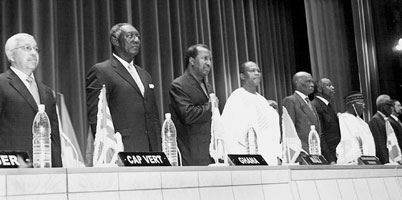 |
| (From left) Presidents of Cape Verde, Pedro Pires;
Ghana, John Kufuor; Mali, Alpha Omar Konare; ECOWAS executive secretary
Mohamed Chambas; presidents of Senegal, Abdoulaye Wade; Ivory Coast,
Laurent Gbagbo; Nigeria, Olusegun Obasanjo; and Benin, Mathieu Kerekou,
meet for a regional summit of the New Partnership for Africa’s
Development (NEPAD), May 2002. |
For example, the pursuit of national ownership has been central to
the poverty reduction strategy paper (PRSP) process, which has just
undergone a thorough review (see "Poverty reduction").
And the IMF and the World Bank are working hard to make the enhanced
Heavily Indebted Poor Countries Initiative a success—to provide
deeper, broader, and faster debt relief to eligible countries and to
strengthen the links between debt relief, poverty reduction, and social
policies (see "Debt strategy"). There is
also greater recognition that good economic advice cannot be separated
from an understanding of national political processes and the social
dimension of development.
| Strength of global economic recovery
in doubt |
|
At the time of the terrorist attacks
in the United States on September 11, 2001, global
economic growth was sluggish, but the slowdown that
had begun in mid-2000 appeared to be close to bottoming
out. Some major countries—the United States,
Japan, and Germany—were in or near recession,
but some others—China, India, and Russia—continued
to experience robust growth.
The terrorist attacks sparked new
uncertainties, but the immediate economic effects
of the attacks turned out to be moderate. By early
2002, it seemed that a global economic recovery, led
by the United States, was under way. By mid-2002,
however, weaknesses in emerging markets, as well as
in mature equity markets, indicated increased risk
aversion among investors. This sentiment, in turn,
raised questions about the strength of the recovery.
The financial difficulties experienced by some emerging
market economies, particularly in Latin America, meanwhile
pointed to the importance of the IMF’s continuing
work to prevent and resolve crises.
This annual IMF Survey Supplement
describes the institution’s policies and operations
against the background of global economic and financial
developments. It is updated each year to reflect any
changes prompted by world events. The section on the
IMF and Africa (see "The IMF and
Africa Overview" )
represents a new feature of the IMF Survey Supplement.
In future years, the feature will continue to showcase
areas in which the IMF has devoted considerable attention
in the year under review.
|
|
|
Increasingly, the IMF sees that progress in African countries can show
the way forward. Notably, African leaders themselves have designed and
will carry out the New Partnership for Africa’s Development (NEPAD),
a plan to revive the continent and end its marginalization. Under NEPAD,
African countries have committed themselves to encouraging peace, democracy,
and good governance; designing and implementing action plans to develop
the key pro-poor sectors of health care, education, infrastructure,
and agriculture; achieving economic integration at the regional and
global levels by building a strong private sector and fostering a climate
conducive to domestic and foreign investment; and developing more productive
partnerships with Africa’s bilateral and multilateral development
partners.
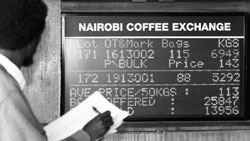 |
| Kenyan entrepreneurs have launched East Africa’s
first Internet coffee auction. |
The IMF is committed to supporting NEPAD wholeheartedly. Recognizing
that the biggest obstacle encountered by African economies striving
for sustainable growth often is not lack of political will but lack
of capacity, the IMF will set up Africa Regional Technical Assistance
Centers (AFRITACs) in Abidjan and Dar es Salaam as part of its commitment.
Through the AFRITACs, IMF resident experts and short-term specialists
will help West and East African countries build local capacity for economic
and financial management. Working closely with the World Bank, the African
Development Bank, and donors, the IMF will focus on its core expertise—including
macroeconomic policy, tax policy and revenue administration, public
expenditure management, financial sector policies, and macroeconomic
statistics. These AFRITACs, to begin operating later this year, are
the first of five such centers eventually envisaged for the region.
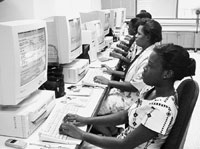 |
| Ghana is promoting high-tech development to reduce
its dependence on mining and agriculture. |
Given its ability to generate income and reduce aid dependency, trade
is an important avenue for self-help, which is the cornerstone of NEPAD
and a major weapon in the international community’s fight against
poverty. Increased and better-coordinated support from rich countries
in the form of more generous aid flows is also a major component of
the poverty-fighting arsenal. The IMF continues to be an advocate for
industrial countries to increase development assistance to poor countries
with strong policies and to open their markets by phasing out trade-distorting
subsidies and other trade barriers.
The IMF also supports stronger implementation of African regional initiatives
as a way to increase access to markets both inside and outside Africa,
improve competitiveness, and promote economic growth. NEPAD identifies
regional cooperation and integration as key conditions that must be
present in order for Africa to develop (see box).
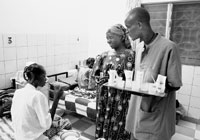 |
| This medical center in Burkina Faso exemplifies
one country’s efforts to develop health care under NEPAD. |
Implementing the “Monterrey Consensus,” which emerged from
the International Conference on Financing for Development held in Monterrey,
Mexico, in March 2002 (see box), is an important
next step in the international community’s efforts to improve living
conditions in Africa. The IMF remains committed to contributing to this
global effort—through its economic policy advice and financial
and technical assistance.
| Supporting regional integration |
|
Eastern and southern Africa
In eastern and southern Africa, regional integration
is being fostered by several subregional arrangements
that have overlapping country membership. Among these
are the Southern African Development Community (SADC),
which is starting to phase in a free trade area set
for 2008; the Common Market for Eastern and Southern
Africa (COMESA), which established a free trade area
between nine of its members in 2000 and plans a customs
union in 2004; the Southern African Customs Union
(SACU); and the East African Community (EAC), which
is planning to implement a free trade area and common
external tariff in 2004. Long-term objectives for
both COMESA and EAC include a common currency and,
for SADC, the formulation of guidelines for the convergence
of macroeconomic policies and the promotion of economic
stability.
The IMF is providing analytical support
and advice to the secretariats of SADC and COMESA
on trade and macroeconomic issues, as well as on financial
sector modernization and reform, macroeconomic statistics,
and the fiscal impact of trade reform. The IMF also
supports the work of the Regional Integration Facilitation
Forum (RIFF), particularly in its efforts to promote
economic reform, coordinate the activities of the
regional integration arrangements, and conduct peer-group
surveillance of macroeconomic and associated policies
in the region.
West Africa
Integration efforts in West Africa are subdivided
into two zones under the umbrella of the 27-year-old
Economic Community of West African States (ECOWAS),
which has 14 members. Its progress toward regional
integration has lagged behind stated aims, however.
In particular, the notional free trade zone is ineffective.
Eight ECOWAS members belong to a smaller
regional grouping, the West African Economic and Monetary
Union (WAEMU), within which the CFA franc is the common
currency. WAEMU’s CFA franc is issued by a common
central bank, the Banque Centrale des Etats de l’Afrique
de l’Ouest (BCEAO), and has been pegged to the
French franc since 1948 and at the French franc/euro
conversion rate since 1999. Of all the regional groupings
in Africa, WAEMU is the furthest along the path toward
integration. In addition to successfully maintaining
their 52-year-old currency union, WAEMU members have
implemented macroeconomic convergence criteria and
an effective surveillance mechanism, adopted a customs
union and common external tariff (in early 2000),
harmonized indirect taxation regulations, and initiated
regional structural and sectoral policies.
The IMF has granted significant technical
assistance to WAEMU and its institutions, as well
as analytical support and advice on macroeconomic,
fiscal, and trade policy and on financial sector modernization
and reform. Since 1999, WAEMU has benefited from formal
discussions to supplement the Article IV consultations
with member countries.
The other six ECOWAS members decided
in 2000 to form a second monetary zone (the West African
Monetary Zone—WAMZ) by 2003 and to merge this
zone with WAEMU’s monetary zone by 2004. The
IMF is providing technical assistance to the WAMZ
project, including in statistical/data management
and training for the West African Monetary Institute
(WAMI)––a transitional institution intended
to pave the way for a common central bank. On a policy
level, the IMF believes that the convergence among
WAMZ member economies is not strong enough to adhere
to the declared time frame for achieving a monetary
union.
Central Africa
Integration in Central Africa is concentrated on the
Central African Economic and Monetary Community (CEMAC),
which groups six countries. CEMAC’s common currency,
also the CFA franc, is issued by the Banque des Etats
de l’Afrique Centrale (BEAC). It has been pegged,
like WAEMU’s CFA franc, to the French franc since
1948 and at the French franc/euro conversion rate
since 1999. Despite this notable progress in maintaining
a long-standing currency union, CEMAC’s integration
efforts in other areas are not very advanced. A common
external tariff introduced in 1994 has not been fully
implemented, and progress in harmonizing tax policies
and adopting common sectoral and structural policies
has been slow.
Over the years, the IMF has furnished
technical assistance to CEMAC and its institutions,
as well as analytical support and advice on macroeconomic,
fiscal, and trade policy and on financial sector modernization
and reform. Since 1999, formal regional discussions
have been held to supplement the Article IV consultations
with individual member countries.
|
|
|
Advisory councils launched
Improving Africa's investment climate
Earlier this year, a joint initiative by IMF Managing Director Horst
Köhler and World Bank President James Wolfensohn came to fruition
with the inauguration of Investment Advisory Councils (IACs) in Ghana
and Tanzania. These councils are intended to promote dialogue between
the government and senior executives of local and international companies
on ways to improve the investment climate.
Ghana’s IAC was launched in May 2002 under the chairmanship of
President John Kufuor, who was joined by Köhler and senior Ghanaian
and foreign business executives. At its inaugural meeting, the council
identified a number of priority areas for government action, including
regulatory reforms related to land ownership and mining and labor laws;
safety and security; infrastructure, especially for energy, telecommunications,
and information technology; financial services infrastructure; public
sector sensitivity to the private sector; restoration of competitiveness
to the mining sector; the economy’s dependence on aid and commodity
exports; and the need for a partnership among government, private sector
industries, and labor. The council will convene again in November to
assess progress and update its recommendations.
The Tanzania Investors’ Round Table, chaired by President Benjamin
Mkapa, held its opening meeting in July 2002 in the presence of Wolfensohn.
Preparations for creating the Investment Advisory Council in Senegal
before the end of the year are well under way, and several other African
countries have expressed interest in launching their own IACs.
IMF and World Bank staff plan to attend future IAC meetings as observers
and offer assistance and support where needed. The two institutions’
resident offices stand ready to cooperate with IAC working groups and
provide information. The IMF and the Bank will also consider any technical
assistance requests related to the councils’ work, especially for
follow-up implementation needs and capacity building in their respective
areas of expertise.
| The Monterrey Consensus |
|
The UN International Conference on
Financing for Development marked an important milestone
for the partnership on global development. Held March
18–22, 2002, in Monterrey, Mexico, the conference
brought together more than 50 heads of state, 300
ministers, and representatives of international organizations,
civil society, and businesses to agree on a common
vision of what is required to overcome world poverty.
The conference was widely seen as
a success, and the participants adopted the Monterrey
Consensus, a plan for sustainable development that
defines development priorities and how to achieve
them. Although broad development objectives—such
as halving poverty by 2015 and achieving universal
primary education—had been defined at the Millennium
summit, a UN-sponsored conference held two years ago,
the Monterrey Consensus focuses on how best to finance
the measures taken toward these goals.
The consensus calls for a partnership
between developing and developed countries, based
on a mutually accountable commitment to promoting
growth and reducing poverty. The developing countries
must take the initiative to improve governance, pursue
appropriate policies, strengthen domestic financial
systems, invest in economic and social infrastructure,
and provide a transparent, stable environment for
potential investors. The developed countries, for
their part, must match these efforts by boosting aid;
reducing barriers to free trade; pursuing debt-relief
measures, such as the full implementation of the enhanced
Heavily Indebted Poor Countries Initiative; and helping
developing countries build capacity, in terms of both
institutions and human capital.
The IMF and other international financial
institutions have a coordinating and regulating role
to play in the partnership. They can also encourage
the more efficient use of development aid and provide
the technical assistance that is vital to capacity
building.
The next step is to build support
for the Monterrey Consensus within the countries that
have adopted it, in order to turn its abstract vision
into concrete action. Poverty reduction strategy papers
will serve as important tools in this process (see
"Poverty reduction"), helping
countries articulate nationally owned policies consistent
with reform objectives. But while the Monterrey Consensus
lays the groundwork for future action, details remain
to be worked out. One is the question of how to monitor
progress toward achieving the development goals—or
even how to define progress. In light of these questions,
the dialogue continues.
|
|
|
Debt strategy
Poor countries’ goal is to reduce debt, fight poverty,
and achieve durable growth
The IMF plays a central role, through its policy guidance and financial
support, in helping member countries cope with external debt problems.
The IMF’s ultimate objective is to ensure that debtor countries
achieve sustainable growth and balance of payments viability and establish
normal relations with creditors, including gaining access to international
financial markets. The basic elements of the IMF’s debt strategy
have remained the same, even though the instruments it uses have evolved
over time:
- promote growth-oriented adjustment and structural reform in debtor
countries,
- maintain a favorable global economic environment, and
- ensure adequate financial support from official (bilateral and multilateral)
and private sources.
Paris Club
Debtor countries seeking to reschedule their official bilateral debt
typically approach the Paris Club—an informal group of creditor
governments, mainly those of the Organization for Economic Cooperation
and Development. Under such agreements, debtor countries generally reschedule
their arrears and the current maturities of eligible debt service, with
repayment stretching over many years. To ensure that such relief helps
countries restore balance of payments viability and achieve sustainable
economic growth, the Paris Club links debt relief to the formulation
of an economic program supported by the IMF. In deciding on the coverage
and terms of individual rescheduling agreements, Paris Club creditors
also draw on the IMF’s analysis and assessment of countries’
balance of payments and debt situations.
Over the past two decades, rescheduling has helped some distressed
middle-income countries return to financial stability. For low-income
countries, the Paris Club began not only to reschedule, but also to
reduce, their debts in the late 1980s.
New approach needed
Although the terms for Paris Club reschedulings became increasingly
concessional over the years to bring more lasting relief, many poor
countries did not grow as rapidly as had been hoped and their debt remained
high. For these low-income, heavily indebted countries, creditors recognized
the need for a new approach.
Launched in 1996, the original Heavily Indebted Poor Countries (HIPC)
Initiative marked the first time that multilateral, Paris Club, and
other official bilateral and multilateral creditors combined efforts
to reduce the external debt of the world’s most debt-laden poor
countries to “sustainable levels”—that is, levels that
will allow these countries to service their debt through export earnings,
aid, and capital inflows without compromising long-term, poverty-reducing
growth. This exceptional assistance, which entails a reduction in the
net present value (see box) of the public external
debt of the indebted country, aims to free up resources that debtor
countries can use to reduce poverty and invigorate growth.
Assistance under the HIPC Initiative is limited to countries that have
per capita incomes low enough to qualify for World Bank and IMF concessional
lending facilities and face unsustainable debt burdens even after traditional
debt relief (see box). The vast majority of the
eligible countries are in Africa.
Modifying HIPC
Following a review of the HIPC Initiative and extensive public consultations,
a number of modifications were approved in 1999 to provide deeper, broader,
and faster debt relief to eligible countries and to strengthen the links
between debt relief, poverty reduction, and social policies.
| Net present value of debt |
|
The face value of the external debt
stock is not a good measure of a country’s debt
burden if a significant part of the external debt
is contracted on concessional terms with an interest
rate below the prevailing market rate. The net pres-
ent value of debt takes into account the degree of
concessionality. It is defined as the sum of all future
debt-service obligations (interest and principal)
on existing debt, discounted at the market interest
rate. Whenever the interest rate on a loan is lower
than the market rate, the resulting net present value
of debt is smaller than its face value, with the difference
reflecting the grant element.
|
|
|
But the enhanced HIPC Initiative is no panacea.
Debt relief—no matter how generous—is only the first step
to economic recovery for heavily indebted poor countries. These countries
can achieve long-term debt sustainability only if they directly address
the underlying causes that triggered the debt problem in the first place.
To avoid slipping back into a situation where poverty-reducing investments
are sacrificed to mounting external debt repayments, these countries
must use the debt-relief proceeds to create the basis for sustained
growth and poverty reduction.
What has the HIPC Initiative achieved?
By July 2002, 26 countries had reached their decision points under the
enhanced HIPC Initiative, with commitments for over $40 billion of debt
relief (in nominal terms) over time. This initiative, along with other
debt relief, will reduce these countries’ external debts by about
two-thirds, from $62 billion in net present value terms to $22 billion.
Resources are being allocated to education; health care, including HIV/AIDS
prevention and treatment; rural development and water supply; and road
construction. Six countries—Bolivia, Burkina Faso, Mauritania,
Mozambique, Tanzania, and Uganda—have received unconditionally
all debt relief committed under the initiative. Two additional countries,
Côte d’Ivoire and the Democratic Republic of the Congo, have
been considered for HIPC relief on a preliminary basis and are expected
to reach their decision points soon.
Challenges ahead
The first challenge is to bring more heavily indebted poor countries
to their decision points. What makes this challenge particularly difficult
is that many of the countries that have not yet qualified for HIPC relief
are either engaged in, or have recently ended, domestic or cross-border
armed conflict. Their need for debt relief is particularly acute because
they suffer from abject poverty and face major reconstruction tasks.
Many are also struggling with severe governance problems. These countries
require help to develop a track record of good policy performance that
will allow them to move toward their decision points and begin receiving
debt relief. The second challenge is to keep the countries that have
reached their decision points on track to implement sound, poverty-reducing
policies so that they can reach their completion points under the HIPC
Initiative and achieve sustainable growth.
| How the HIPC Initiative works |
|
To qualify for HIPC assistance, a
country must pursue strong economic policies supported
by the IMF and the World Bank. Its efforts are complemented
by concessional aid from all relevant donors and institutions
and traditional debt relief from bilateral creditors,
including the Paris Club.
During this phase, the country’s
external debt situation is analyzed in detail. If
its external debt ratio, after the full use of traditional
debt relief, is above 150 percent for the net present
value of debt to exports (or, for small open economies,
above 250 percent of government revenue), it qualifies
for HIPC relief. At the decision point, the IMF and
the World Bank formally decide on the country’s
eligibility, and the international community commits
to reducing the country’s debt to a sustainable
level.
Once it qualifies for HIPC relief,
the country must continue its good track record with
the support of the international community, satisfactorily
implementing key structural policy reforms, maintaining
macroeconomic stability, and adopting and implementing
a poverty reduction strategy (see "Poverty
reduction"). Paris Club bilateral creditors
reschedule obligations coming due, with a 90 percent
reduction in net present value, and other bilateral
and commercial creditors are expected to do the same.
The IMF and the World Bank and some other multilateral
creditors provide interim relief between the decision
and completion points.
A country reaches its completion point
once it has met the objectives established at the
decision point. It then receives the balance of the
debt relief committed. This means all creditors are
expected to reduce the net present value of their
claims on the country to the agreed sustainable level.
|
|
|
Why not just forgive all the debt?
There have been repeated appeals to the international community to simply
erase all the debt of the world’s poorest countries, but such a
step would not be the most effective or equitable way to support the
fight against poverty with the limited resources available. Today’s
greatest development challenge––reducing world poverty––requires
a comprehensive strategy that includes the efforts of the poorest countries
to help themselves, as well as increased financial assistance from the
international community and improved access to industrial country markets.
Debt relief under the HIPC Initiative is only one element of the international
support for poor countries that removes debt as an obstacle to growth.
For many years to come, these countries will continue to need financial
support on concessional terms to help them implement their growth and
poverty reduction strategies and stand on their own feet.
Total debt cancellation would imperil the funds that multilateral creditors
would have for future lending and would come at the expense of resources
available to other developing countries, some of which are equally poor
but have less external debt. Over 80 percent of the world’s poor
live in countries that are not HIPCs. For the IMF, total debt cancellation
would exhaust the resources that finance the Poverty Reduction and Growth
Facility (PRGF) and the HIPC Initiative, and the IMF would have to stop
providing concessional support to its poorest members.
Poverty reduction
Supporting country-led efforts
In 1999, the replacement of the IMF’s concessional lending facility,
the Enhanced Structural Adjustment Facility (ESAF), with the better-focused
Poverty Reduction and Growth Facility (PRGF) raised expectations about
the IMF’s role in the fight against poverty. Loans under the PRGF—like
ESAF loans—carry very low interest rates, long repayment terms,
and a grace period. The PRGF differs from the ESAF in that it is based
more directly on the premise of a mutually reinforcing relationship
between macroeconomic stability, structural reform, growth, and poverty
reduction. Yet this focus on poverty was not entirely new: since the
late 1980s, IMF advice to its members has increasingly emphasized pro-poor
policies while recognizing that the IMF’s traditional focus on
macroeconomic stabilization—especially on price stability—also
benefits the poor.
Demand for PRGF resources has been high. In recent years, more than
40 countries have had new PRGF arrangements or had ESAF arrangements
transformed to include the new features of the PRGF. Overall in 2001,
the IMF committed new PRGF loan resources of $2.7 billion, a record
high, up from $1 billion in 2000. Last year’s increase partly reflected
approval of a few large new commitments. Current projections indicate
that new commitments in 2002 could reach $2 billion. If high levels
of new commitments continue, consideration will need to be given to
mobilizing new PRGF loan and subsidy resources.
All poor countries seeking assistance under the enhanced HIPC Initiative
or low-cost loans from the IMF or the World Bank are expected to prepare
comprehensive poverty reduction strategies. These strategies—formulated
by a country’s government based on wide-ranging participation,
including by civil society, donors, and international organizations,
and spelled out in a poverty reduction strategy paper (PRSP)—now
provide the basis for all concessional lending by the IMF and the World
Bank.
There is no single blueprint for a country to follow in preparing its
poverty reduction strategy. Rather, each country’s PRSP should
reflect its specific circumstances. But each PRSP should describe the
poor’s main characteristics and specify strategies for the medium
and long terms that would have the highest impact on poverty reduction.
And it should also identify realistic and trackable poverty reduction
goals and set out macroeconomic, structural, and social policies for
reaching them.
Locally produced PRSPs are expected to generate fresh ideas about how
shared growth and poverty reduction goals can be reached and should
help create a sense of ownership and national commitment to those goals.
The IMF and the World Bank participate in the process and, along with
other multilateral and bilateral donors, provide advice and expertise.
But the strategies and policies should emerge from national debates
in which the voices of the poor, especially, are heard.
Taking stock: the PRSP and the PRGF
Although implementation of the PRSP approach and the PRGF is still at
an early stage, it is not too soon to take stock of lessons learned
so far. The IMF and the World Bank together recently reviewed the first
two years’ experience with the PRSP approach, and the IMF reviewed
experience with the PRGF. The reviews drew on internal evaluations and
extensive external consultations, engaging those with firsthand knowledge
of the PRSP process and PRGF-supported programs: participating governments,
international organizations, other aid agencies, and civil society organizations
worldwide. Respondents provided written evaluations and voiced their
opinions at regional forums as well as at the “International Conference
on Poverty Reduction Strategies,” held in Washington, D.C., in
January 2002, organized by the IMF and the World Bank.
Review of the PRSP process
Because only 10 full PRSPs were completed at the time, the review focused
primarily on process and offered a tentative assessment of emerging
content. While countries are completing their full PRSPs more slowly
than originally expected, there is still enough information to begin
defining “good practices.” A second review, planned for 2005,
should provide an opportunity to assess progress more fully, including
the impact on poverty outcomes and indicators.
What were the review’s main findings? The central one is that
there is widespread support for the PRSP approach and broad agreement
that its objectives remain valid. Most donors have indicated their intentions
to align assistance programs with PRSPs, but more needs to be done to
improve practices, especially to reduce the cost for low-income countries
of mobilizing and using aid. It is noteworthy that the PRSP process
has carved out a more prominent place for poverty reduction in policy
debates. Data collection, analysis, and monitoring are becoming more
systematic.
Supporting this, there is a growing sense of country ownership and
more open dialogue within governments themselves and also between governments
and civil society groups—even in countries that lack a well-established
tradition of consultation. Nevertheless, the review saw much room for
improvement, the main challenge being to promote broader and more substantive
participation by domestic stakeholders. The quality of participation
has varied widely from country to country. Discussions have often been
limited to a narrow set of issues related to targeted poverty reduction
programs, effectively excluding civil society organizations from the
broader debate over structural reforms and macroeconomic policies. The
review recommended that development partners increase technical assistance
to bolster civil society’s ability to participate fully and effectively
in the PRSP process. The review also recognized the need to involve
parliamentarians in preparing, approving, and monitoring country strategies.
| IMF expands antipoverty work in the
former Soviet Union |
|
After the breakup of the Soviet Union
just over a decade ago, the seven lowest-income members
of the Commonwealth of Independent States (CIS)—Armenia,
Azerbaijan, Georgia, the Kyrgyz Republic, Moldova,
Tajikistan, and Uzbekistan—were confronted with
the dual challenge of building new states and market
economies. Most of these countries have made significant
progress toward these goals during the past decade.
But the complexity of the transition challenges has
caused living standards to fall sharply and, in some
cases, has made it very difficult to implement market-oriented
reforms effectively.
 |
The CIS-7 Initiative is designed
to improve living standards in the former Soviet
Union. At right,
an agricultural market in Moldova, one of the
target countries. |
The IMF—together with the World
Bank, the Asian Development Bank, the European Bank
for Reconstruction and Development, bilateral donors,
and neighboring countries—recently launched the
CIS-7 Initiative intended specifically to help reduce
poverty and promote economic growth in these seven
countries. With nearly 20 million people living in
extreme poverty within their borders, these countries
clearly still have some way to go in overcoming the
economic and social disruptions that have occurred
in tandem with the transition from centrally planned
to market economies.
While each country obviously faces
its own specific adjustment problems, the IMF and
the other international financial institutions sponsoring
the CIS-7 Initiative identified some common development
challenges. In the area of political reforms, government
capacity must be strengthened to resist corruption
and deliver public services more effectively and accountably.
All of these countries need more adequate health and
education services for their people and must take
action to fight the devastating human toll taken by
diseases such as HIV/AIDS, tuberculosis, and malaria.
Improved macroeconomic stability is key for establishing
an environment for local businesses to plan, invest,
and grow, and for helping attract technological know-how
and capital flows from foreign direct investors to
improve productivity and build a dynamic private sector.
Enhanced regional cooperation—for example, in
trade and energy—is indispensable in boosting
the competitiveness of national economies and can
be helpful in resolving regional disputes and dividing
the cost of large infrastructure investments. Finally,
urgent action is needed to reduce debt to sustainable
levels.
The seven countries will be responsible
for making headway in these areas by intensifying
their development and reform efforts. But trade and
development partners and creditors will complement
this work by strongly supporting these countries in
strengthening conditions for growth and poverty reduction.
This assistance to the CIS-7 is expected to include
low-cost loans, debt relief, or debt restructuring
(where needed), as well as greater access to industrial
countries’ markets and promotion of direct investment.
Development agencies plan to better coordinate the
way they administer support under the CIS-7 initiative
while also ensuring that this support is anchored
in country-led poverty reduction programs. International
and regional institutions intend to give added support
through technical assistance and policy advice.
|
|
|
Looking ahead, the focus must shift to implementation of PRSPs and
the need to better understand the links between policies and poverty
outcomes. The review suggested that efforts would have the biggest payoff
in the following four areas:
- Macroeconomic frameworks. Every country’s PRSP is underpinned
by a macroeconomic framework in support of its growth and poverty
reduction objectives. But attention needs to be given to setting more
realistic growth targets that are in line with country circumstances
and constraints, and more care needs to be given to identifying the
sources of pro-poor growth underpinning these targets. Poor countries
must also pay more attention to their heightened vulnerability to
external shocks by identifying in advance potential areas of vulnerability
and appropriate social safety nets or other relevant policy responses.
- Prioritizing policy actions. Trade-offs and better prioritization
of policy actions are needed to make poverty reduction strategies
realistic, especially in the face of tight budget constraints. Uncertainties
about their overall growth strategies, the costs of various actions,
and available financial resources often make it difficult for PRSP
countries to set priorities. Development partners need to provide
more technical and financial assistance to countries building capacities
for setting priorities.
- Poverty and social impact analysis. National capacity constraints
and technical difficulties can hinder countries’ ability to clearly
link policy actions to either a comprehensive diagnosis of poverty
or an analysis of their impact on the poor. Countries, with the assistance
of development partners, should undertake more systematic poverty
and social impact analyses of major policy changes.
- Public expenditure management systems. Countries need to
assess the current state of these systems—which often face problems
such as incomplete coverage, inappropriate classifications, limited
capacity to track spending, and weak auditing—and develop realistic
plans for improving them, seeking technical support as appropriate.
Review of the PRGF
Is the PRGF living up to expectations? To answer this, the IMF carried
out a major review between July 2001 and February 2002 to assess the
extent to which country ownership had been enhanced and PRGF-supported
programs had been based on countries’ poverty reduction strategies.
Since the PRGF is only a few years old and arrangements run three years,
the review was necessarily limited and focused primarily on program
design. An assessment of whether PRGF-supported programs are achieving
their poverty-reduction or growth goals will have to await the later
review scheduled for 2005. Among the major findings of the recent review
were the following:
- The composition of budgeted and actual public spending is becoming
more pro-poor and pro-growth in countries with PRGF-supported programs.
These countries are allocating a larger share of government spending
to education and health care, and PRGF-supported programs are incorporating
measures to improve the efficiency of spending in these areas.
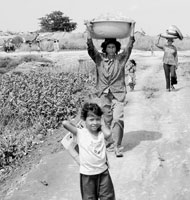 |
Farmers in Cambodia, a
PRGF country, are
experiencing the country’s worst drought in recent history. |
- PRGF-supported programs are characterized by greater fiscal flexibility—whereby
the fiscal framework permits an increase in poverty-reducing spending
when additional resources are available—than the preceding ESAF-supported
programs. PRGF-supported programs target noninterest public spending
that is 2 percentage points of GDP higher, on average, than that targeted
under the preceding ESAF-supported programs. PRGF-supported programs
also show greater flexibility by accommodating more spending when
foreign financing (including grants) is greater than expected, or
by allowing additional domestic financing to compensate for shortfalls
in external financing.
- Almost all PRGF-supported programs emphasize strengthening governance
by improving public expenditure management. Most of these measures
focus on budget control––in particular, keeping spending
within the limits set in the budget. Others are designed to strengthen
auditing procedures or anticorruption strategies.
- Around three-fifths of the country authorities responding to the
survey said that the PRGF provided more opportunity to influence program
design than in the past and that IMF resident representatives and
Washington staff were increasingly engaged in the national dialogue
associated with the PRSP process.
- Conditionality was substantially streamlined in PRGF-supported programs,
in line with an overall streamlining of structural conditionality
in all IMF arrangements. The review found that there were more performance
criteria, prior actions, and structural benchmarks in PRGF arrangements
than there had been for the same countries under the ESAF.
While the review concluded that PRGF-supported programs have had a
promising beginning, it found that there is scope for a more systematic
application of best practices:
- More systematic discussion and analysis of macroeconomic frameworks
and policies are needed—including the sources of growth, alternative
policy choices, and the constraints and trade-offs involved.
- The IMF and the World Bank need to make continued improvements in
differentiating between their roles and coordinating their activities.
IMF documents and joint assessments should more fully report conditions
set by other donors to provide a better picture of total donor conditionality.
- Further efforts are needed on public expenditure issues—including
improving the quality and efficiency of government spending, and strengthening
public expenditure management systems.
- Documentation should clearly set out the PRGF’s role in the
country’s overall poverty reduction strategy as well as the options
considered and the commitments made by government officials.
Beyond the design of PRGF-supported programs, the review pointed to
other improvements that are needed, including
- an increased focus on the sources of growth in PRGF-supported programs;
- more extensive and effective communication with government officials,
development partners, and civil society in countries on the policy
options for PRGF-supported programs;
- PRGF documents that routinely describe the poverty and social impact
analyses being carried out, as well as discussions with country authorities
on the social impact of key reforms;
- further capacity building to develop and assess macroeconomic frameworks,
analyze poverty profiles, and conduct poverty and social impact analyses;
and
- an examination of the structure of the PRGF and its adequacy in
meeting the diverse needs of low-income countries.
| Social dimensions of IMF financing |
|
By pursuing its mandate to promote
international monetary cooperation, the balanced growth
of international trade, and a stable system of exchange
rates, the IMF contributes to sustainable economic
and human development. The IMF recognizes that successful
macroeconomic programs must also include policies
that directly address poverty and social concerns
and that, to support these objectives, IMF-supported
programs must integrate social sector spending that
focuses on improving the education and health status
of the poor.
The reason for attention to social
policy issues is twofold: it reflects the recognition
that “country ownership” is necessary if
the programs are to succeed and that good health and
education contribute to, and benefit from, growth
and poverty reduction.
In pursuing this aspect of its work,
the IMF collaborates extensively with other institutions,
including regional development banks, the United Nations
Development Program, the International Labor Organization,
the World Health Organization, and, especially, the
World Bank. Drawing on their expertise, the IMF advises
countries on how social and sectoral programs aimed
at poverty reduction can be accommodated and financed
within a growth-enhancing macroeconomic framework.
It does so by identifying not only unproductive spending
that should be reduced to make more money available
for basic health care and primary education, but also
key categories of public expenditure that must be
maintained or increased. Through policy discussions
and technical assistance, the IMF also plays a role
in improving the transparency of governments’
decision making and their ability to monitor poverty-reducing
spending and social developments.
Poverty and social impact analysis
The IMF is committed to integrating poverty and social
impact analysis in PRGF-supported programs. The purpose
of this analysis is to assess the implications of
key policy measures on the well-being of different
social groups, especially the vulnerable and the poor.
When such analysis indicates that
a particular measure (for example, currency devaluation)
may adversely affect the poor, such effects would
be addressed through the choice or timing of policies,
the development of countervailing measures, or social
safety nets. Safety nets built into IMF-supported
programs have included subsidies or cash compensation
for particularly vulnerable groups; improved distribution
of essential commodities, such as medicines; temporary
price controls on some essential commodities; severance
pay and retraining for public sector employees who
have lost their jobs; and employment through public
works programs.
For those countries that are able
to do so, poverty and social impact analyses ideally
should be undertaken in making policy choices in the
development of poverty reduction strategy papers (PRSPs).
For those countries where national capacity is weak,
the IMF will draw on poverty and social impact analysis
done by the World Bank and other development partners
in the PRSP process.
|
|
|
Financial architecture
Fast-changing world economy drives IMF reforms
Much of what the world now knows about the complexity and dynamism
of global finance was learned—sometimes the hard way—in the
1990s. The decade was a testament to the power of the markets to create
wealth and destroy it. The suddenness, velocity, and scope of crises
in the 1990s were unprecedented, but, in their wake, they yielded two
lessons: crises need to be prevented whenever possible and resolved
quickly when they do erupt.
These dramatic changes in the world economy and the lessons they imparted
are at the heart of the reforms the IMF has advocated and itself absorbed
in recent years. These reforms have emphasized the critical importance
of more information and greater transparency, highlighted the role that
global standards and accepted codes of good practices can play in improving
performance and increasing levels of trust, underscored the need for
expanded cooperation among countries and international organizations,
and called for heightened vigilance over the types of vulnerabilities
that can trigger crises.
More information, please
Markets, as recent crises have demonstrated, don’t like surprises.
A dearth of information or the belated discovery of misinformation fosters
unease, even alarm. The IMF translated this early lesson from the Asian
crisis into action, encouraging countries to provide more information—and
more reliable data—to markets. High on its list of reforms was
a series of statistical initiatives:
Special Data Dissemination Standard (SDDS). Created in 1996,
the SDDS is a voluntary standard whose subscribers—countries with
market access or seeking it—commit to meeting internationally accepted
levels of data coverage, frequency, and timeSpecial Data Dissemination
Standard (SDDS). Created in 1996, the SDDS is a voluntary standard whose
subscribers—countries with market access or seeking it—commit
to meeting internationally accepted levels of data coverage, frequency,
and timeliness. Subscribers also agree to issue calendars on data releases
and follow good practices with regard to data quality and integrity.
Information on subscriber data dissemination practices is posted on
the IMF’s website on the Data Standards Bulletin Board, which is
linked to subscriber websites.
General Data Dissemination System (GDDS). For countries that
do not have market access but are eager to improve the quality of their
national statistical systems, the GDDS offers a “how to” manual.
Voluntary participation allows countries to set their own pace but provides
a detailed framework that promotes the use of widely accepted methodological
principles, the adoption of rigorous compilation practices, and ways
in which the professionalism of national systems can be enhanced. Participating
countries post their detailed plans for improvement on the Data Standards
Bulletin Board, thus permitting both domestic and international observers
to view their progress.
Data Quality Assessment Framework. The success of both the SDDS
and the GDDS, and the growing recognition that good statistics are essential
for effective policymaking, spurred the IMF, in consultation with national
statistical offices, other international agencies, and data users, to
take a further step and evaluate the quality of data as well. This new
framework, developed in 2001, provides the means to assess data integrity,
methodological soundness, accuracy and reliability, serviceability,
and accessibility.
| The openness revolution |
|
Some of the most dramatic changes
over the past decade have taken place in information
exchange. Technological changes have revolutionized
the speed and ease with which information can be shared
and have democratized the production and consumption
of data. What was once arcane and in the province
of the highly specialized is now, via the Internet,
available to everyone with access to a computer.
In an age in which global communications
make the world very small indeed, the availability
of information and commitment to openness matter more
than ever. In the mid-1990s, when the IMF first began
encouraging its members to be more open with their
economic and financial data, its carefully vetted
Annual Report contained virtually the only publicly
available summary of the regular (Article IV) consultations
the IMF conducted with its member countries on the
current state and prospects of their economies.
By 2000, the IMF’s Internet site––www.imf.org––was
serving as the chief vehicle for what amounted to
a sea change in the openness of the IMF and its membership.
The website now posts Public Information Notices summarizing
the IMF Executive Board’s discussions of Article
IV staff reports for many member countries. It has
become a key tool for the authorities and the IMF
to share with the public the goals and means of country
adjustment efforts. Documents outlining the authorities’
intentions are now routinely published, as are more
than half of IMF staff reports on the use of IMF resources.
The IMF has also become much more
transparent about its own policies and operations.
Staff papers outlining the pros and cons of various
policy issues and summaries of Executive Board discussions
of these papers are also now routinely released. On
some key issues of wide public interest, the IMF uses
its website to initiate a dialogue—soliciting
opinions or offering early drafts of papers for comment.
The IMF is also expanding its outreach
to parliamentarians, nongovernmental organizations,
and other interested groups to improve public understanding
of its policies and operations and to broaden and
deepen its dialogue with these groups.
In 2001, the IMF took a formal step
to improve the transparency and effectiveness of its
policies and procedures when it created the Independent
Evaluation Office (see "Independent
evaluation office"). The office, intended
to complement traditional internal evaluations, selects
several major topics for review annually, carries
out these reviews, and posts its findings on the Internet.
|
|
|
Role of standards and codes
Better data, while important in themselves, are an element of a larger
project. Agreement on and implementation of broadly agreed standards
of accepted practices and codes of good behavior provide yardsticks
to measure the quality of policies and performance. They help national
authorities formulate and assess policies and permit market participants
to evaluate how well a country is doing. Widely accepted standards and
codes also have a ripple effect by encouraging greater transparency,
better governance, and improved accountability and policy credibility.
In cooperation with a wide range of international institutions and with
input from numerous national authorities, the IMF has been active in
both developing standards and codes and incorporating them in their
annual review (surveillance) of member country economies.
In 1999–2000, the IMF, with the World Bank, launched a joint program
of voluntary and summary reports in a wide range of areas in which the
two organizations have long-standing expertise. These Reports on the
Observance of Standards and Codes (ROSCs)—about 70 percent of which
are subsequently published—principally examine three broad areas:
transparency, financial regulation and supervision, and corporate governance
(including accounting, auditing, and insolvency). In these areas, the
ROSCs promote the following:
- Transparent governmental policymaking and operations. The
underlying assumption is that better-informed publics are more likely
to hold their governments accountable for their policies and that
investors, armed with better data and a standard against which to
evaluate them, are more likely to invest wisely. Key tools are the
IMF’s statistical initiatives (SDDS and GDDS) and codes of transparency
in monetary, financial, and fiscal policies.
- Stable financial sectors. As a rule of thumb, financial sectors
are as sound and consistent as their regulatory environments are vigilant.
The IMF and the World Bank each year undertake a certain number of
Financial Sector Assessment Programs (FSAPs). These detailed analyses
review and test financial sectors for vulnerabilities, evaluate how
risks are managed, weigh possible technical assistance needs, and
help countries prioritize policy responses. In addition, ROSCs evaluate
banking supervision, securities and insurance regulation, and payments
systems, as well as the transparency of monetary and financial policies.
- Healthy corporate sectors. With the private sector serving
as the engine of growth in most economies, the health of the corporate
sector is a critical concern. The World Bank typically takes the lead
in assessing the quality of corporate governance, the adequacy of
accounting and auditing standards, and the state of insolvency procedures
and creditor rights.
When are countries vulnerable?
More information and more openness can go a long way toward averting
the shocks that ignite serious problems, but as the IMF and other institutions
surveyed the damage done by recent crises, they also asked another question:
how do we know when a country is at risk? The crises of the 1990s were
different, reflecting a larger role for private sector financing, greater
scope for cross-border contagion, and stronger links between external
financing difficulties and distress in domestic financial and corporate
sectors. All of this suggested the value of taking a fresh, hard look
at the sources of vulnerability and the tools available to identify
problems before they become crises.
As a first step, it was clear that the IMF needed to monitor capital
market developments more closely and more continuously. This prompted
the creation of the International Capital Markets Department in 2001
to complement the work of the organization’s traditional regional
(area) and functional departments. As a result, country vulnerability
assessments have been strengthened and now cover a more comprehensive
set of inputs, including the impact of the latest changes in the global
economic and financial environment, early warning systems and indicators,
and ROSC and FSAP findings (when available).
An IMF Executive Board review of vulnerability assessments also pointed
to the need for more data on foreign exchange exposures in financial
and non-financial corporate sectors and more information on country
financing needs. It urged international institutions to convey greater
urgency when they discussed perceived vulnerabilities with national
authorities, and it called for continued work on the formulation of
policy guidelines. In recent years, detailed guidelines have been drawn
up on public debt management (in consultation with the World Bank) and
foreign reserves management (in close collaboration with both member
countries and other international institutions).
Strengthening financial sectors
As the Asian crisis demonstrated, weaknesses in the financial sector
can both amplify crises and cause them. Given the critical role that
resilient financial sectors can play in heading off crises and the fuel
that ailing financial sectors can add to the fire when economies are
under siege, the IMF has been giving added attention to this sector.
It has redirected its FSAP resources to large economies and key emerging
markets that could have a systemic impact on the world economy. And
it has supplemented the FSAPs with newly devised “core” and
“encouraged” Financial Soundness Indicators. These indicators
are meant to guide country surveillance efforts and alert national authorities
to the qualities that characterize healthy financial sectors. The core
indicators focus on crucial elements in the banking system, while those
that are encouraged take a more detailed look at the banking sector
and address aspects of nonbank financial, corporate, household, and
real estate sectors.
Assessing offshore financial centers
Traditionally, global finance was the sum of its national parts, but
the rise in offshore banking centers and a sharp increase in the volume
of funds channeled through these centers have added another dimension—and
level of complexity—to global finance. In response to increasing
calls for more information about offshore banking activities, the IMF
has helped these centers gather data and conduct self-assessments, providing
technical assistance where needed.
Money laundering and financing of terrorism
Money laundering and its now allied concern, the financing of terrorism,
affect both onshore and offshore financial centers. The IMF’s own
work in this area began in the context of financial abuses that threatened
the integrity and stability of the international financial system. The
events of September 11 lent new scope and urgency to the work and hastened
efforts to better coordinate responsibilities among international institutions
to implement the recommendations of the Financial Action Task Force
(FATF) on Money Laundering. The IMF, whose core expertise lies in economic
assessment and in helping member countries build up the quality and
effectiveness of their supervision and regulation of financial institutions,
has focused its efforts on relevant supervisory principles, closer cooperation
with major anti-money-laundering groups; increased technical assistance;
and greater attention to anti-money-laundering issues in its surveillance
and other activities.
 |
Specifically, the staffs of the World Bank and the IMF have prepared
a methodology to assess whether adequate controls and procedures are
in place to prevent abuse; the document is currently being piloted as
part of the institutions’ financial sector assessments. Their Boards
will consider whether to add the FATF 40+8 Recommendations to the list
of standards that includes preparation of a ROSC to combat money laundering
and the financing of terrorism, and possible mechanisms for carrying
out such assessments. IMF and World Bank staff are also working closely
with the Financial Action Task Force on Money Laundering to adapt its
recommendations so that they are consistent with the work being done
in the context of the ROSCs.
When to liberalize the capital account
For many of the IMF’s emerging market economies, two important
questions are when and how to liberalize their capital accounts. Access
to capital markets provides the opportunities to finance the investment
that is essential for growth, but the crises of the past decade are
also vivid reminders that the transition can be tricky and the risks
large.
What should countries do to lay the proper groundwork for opening their
capital accounts, and how can they sequence reforms to enhance stability
and minimize volatility?
The IMF, in the course of its annual consultations with member countries,
has helped them gauge their readiness for capital account liberalization
and prioritize financial sector reforms; it has also underscored the
key role played by transparency. Although no foolproof recipe for liberalization
exists yet, experience in many countries suggests that liberalizing
longer-term flows (notably, foreign direct investment) first may be
safer than starting with the more volatile short-term flows.
Resolving crises
Crises will occur no matter how many preventive measures are in place.
The IMF’s goal is to reduce the number and severity of these crises
and help countries deal decisively and effectively with those that do
arise. In April, the IMF’s Managing Director, Horst Köhler,
laid out a four-point work program to strengthen the IMF’s framework
for crisis resolution. It called for increased capacity to assess the
sustainability of a country’s debt, a clear-cut policy on access
to IMF resources in capital account crises, enhanced means to secure
private sector involvement in resolving financial crises, and continued
work on a more orderly and transparent legal framework for sovereign
debt restructuring.
| Public information on IMF finances |
|
In recent years, the IMF has significantly
expanded the volume, quality, and timeliness of information
available on its finances to the public. During financial
year 2002, a new edition of a pamphlet providing detailed
information on the IMF’s financial structure
was published (Financial Organization and Operations
of the IMF, IMF Pamphlet Series, No. 45, 6th ed.,
2001). The IMF also provides background and current
data on its financial activities on its website (http://www.imf.org/external/fin.htm),
including
- current financial position
- IMF liquidity and sources of financing
- SDR valuation and interest rate
- rates of charge on IMF loans and
the interest rate paid to creditors
- country information on
- current lending arrangements
- loan disbursements and credit
outstanding
- loan repayments and projected
obligations
- arrears
- SDR allocations and holdings
- financial statements
|
|
|
Debt sustainability. The ability to distinguish
between types and degrees of debt crises is key to tailoring an appropriate
response. To provide effective assistance, the IMF must be able to differentiate
among cases where restructuring is needed and a substantial write-down
of claims may be in order; where the official sector will need to encourage
creditors to reach voluntary agreements; and where it is appropriate
for the IMF, along with others, to provide financing in support of a
member’s adjustment program and to help restore confidence and
catalyze the resumption of private capital flows.
When is debt sustainable? Hard and fast answers are typically hard
to come by, but the IMF is working to strengthen its analytical tools
to ensure that judgments are well informed. It will be looking in greater
detail at the elements that go into these decisions—and testing
the underlying assumptions about earnings growth, interest rates, and
the primary balance
of spending and income.
Access to IMF resources. For members coping with capital account
crises, there is often a wide gap between their large immediate financing
needs and the IMF resources, as defined by quotas, that would normally
be available to them. A clearer policy on access limits would allow
the IMF to both provide the scale of financing needed in such cases
and reinforce incentives for responsible policies and prudent assessment
of risk.
Strengthened tools for involving the private sector. Within
existing legal frameworks, how can the private sector play a more significant
role in resolving financial crises? Alternative financing tools can
help manage crises, but the IMF’s work in this area suggests that
individual circumstances must be examined carefully and the benefits
weighed against possible risks, including unsettled markets and a transfer
of risk from sovereigns to the domestic financial systems. Where a restructuring
of sovereign debt is needed, it is crucial to contain the erosion of
confidence and keep the process orderly.
Sovereign restructurings. These become necessary when countries
run up unsustainable debt burdens. They are infrequent but can be unusually
costly because no legal framework currently exists to handle this process
in a timely, predictable, and orderly manner.
In November 2001, IMF First Deputy Managing Director Anne Krueger renewed
the discussion on what could be done to provide for a speedier and more
orderly way to resolve these problems. Her proposal to create a sovereign
debt restructuring mechanism (see box) has set
off a lively debate about the form the mechanism should take. The IMF
is expected to continue its work on this reform in advance of its 2002
Annual Meetings, where the SDRM proposal is expected to be taken up.
| When countries can’t repay their
debts |
|
Countries, like individuals, may run
up debt and find themselves unable to keep up the
payments on it. To avoid defaulting, they must restructure
their debt. But, unlike bankruptcy provisions in domestic
situations, the global financial system lacks a legal
framework for sovereign debtors and their creditors
to restructure debt in an orderly and timely way.
One major challenge to sovereign debt restructuring
stems from the way international capital markets have
evolved over the past 20 years or so. They have become
more integrated and there has been a shift from syndicated
bank loans to bond issues. As a result, sovereign
borrowers are increasingly able to issue debt in a
range of legal jurisdictions, using a variety of instruments,
to a diverse and diffuse group of creditors. Although
this has expanded the sources of financing available
to emerging market countries, it has also exacerbated
the problems of coordination, collective action, and
equal treatment of creditors when a restructuring
becomes necessary.
IMF proposes a solution
In November 2001, IMF First Deputy Managing Director
Anne Krueger proposed a sovereign debt restructuring
mechanism (SDRM) to facilitate the orderly, predictable,
and rapid restructuring of unsustainable sovereign
debt. Since November, the proposal has undergone various
changes, and the IMF’s decision-making role is
envisaged to be smaller in the latest incarnation.
The resulting twin-track —that is, statutory
and contractual—approach has since received the
endorsement of the international community.
For the mechanism to be effective,
there must be incentives both for debtors to address
their problems promptly and for debtors and creditors
to agree quickly on the restructuring terms. The IMF’s
policies spelling out the availability of its resources
before, during, and after the restructuring process
would help shape these incentives. However, use of
the mechanism would be for the debtor country to decide
and not for the IMF or a country’s creditors
to impose. The debtor country and a majority of its
creditors would have the essential decision-making
authority.
How the mechanism would work
The first track of the SDRM would involve greater
use of collective action clauses in sovereign bond
contracts. The second track would involve creating
a statutory mechanism to empower a qualified majority
of a country’s creditors to negotiate a restructuring
agreement that would then be binding on all of the
country’s creditors. There would also be provisions
to prevent creditors from pursuing litigation against
debtors while a restructuring agreement is being negotiated;
safeguards to protect creditor interests during this
period; and a mechanism that would encourage new financing
by guaranteeing that fresh private lending would not
be restructured. The statutory approach would use
a treaty obligation—probably achieved through
an amendment of the IMF’s Articles of Agreement—that
would provide for legal uniformity in all jurisdictions.
 |
IMF First Deputy Managing Director
Anne Krueger first proposed a plan
for restructuring
sovereign debt in November 2001. |
To coordinate a debtor’s varied
creditors, a framework must be created that will aggregate
claims across instruments for voting purposes while
taking account of the seniority and varying economic
interests of the creditors. As part of this framework,
a forum is envisaged for the resolution of disputes
between a sovereign debtor and its creditors as well
as disputes among creditors. The dispute resolution
forum would be small, have a limited role, and be
independent in its membership and operation.
The international community has learned
its lesson from the turmoil that emerging market economies
have experienced in recent years: cooperation helps
the global financial system work more smoothly. To
address the protracted, disorderly, and costly restructuring
process, the IMF will continue to examine the legal,
institutional, and procedural aspects of establishing
the sovereign debt restructuring mechanism.
For a fuller explanation of the proposed
SDRM, see the IMF’s website (www.imf.org).
|
|
|
Effective surveillance and crisis prevention
Helping IMF members reduce vulnerabilities, promote
stability, and foster growth
In today’s global economy, the economic developments and policy
decisions of one country may affect many other countries, and financial
market information can be transmitted around the world instantaneously.
In this environment, there must be some mechanism for monitoring countries’
exchange rate and macroeconomic policies to ensure that the international
monetary system operates effectively. The IMF does this by holding regular
dialogues with its member countries about their economic and financial
policies and by continuously monitoring and assessing economic and financial
developments at the country, regional, and global levels. Through this
function, referred to as “surveillance,” the IMF seeks to
signal dangers on the economic horizon and enable its members to take
corrective policy action.
How surveillance is conducted
 |
Country surveillance. As a result of a recent IMF Executive
Board decision, the IMF will generally conduct regular consultations
every year with each of its member countries. (The consultations are
referred to as “Article IV consultations” because they are
required by Article IV of the IMF’s Articles of Agreement.) These
consultations focus on the member’s exchange rate, fiscal, and
monetary policies; its balance of payments and external debt developments;
the influence of its policies on the country’s external accounts;
the international and regional implications of its policies; and the
identification of potential vulnerabilities. As financial markets around
the world become more integrated, IMF surveillance has become increasingly
focused on capital account and financial and banking sector issues.
When relevant from a macroeconomic perspective, policies that affect
a country’s labor market, the environment, and governance are also
covered by surveillance.
Global surveillance. The IMF’s World Economic Outlook report,
prepared twice a year, features comprehensive analyses of prospects
for the world economy, individual countries, and regions and also examines
topical issues. The quarterly Global Financial Stability Report (GFSR)
provides timely coverage of mature and emerging financial markets as
part of the IMF’s stepped-up tracking of financial markets. The
GFSR seeks to deepen policymakers’ understanding of the potential
weaknesses in the global financial system and identify the fault lines
that could lead to crises.
Regional surveillance. To supplement country consultations,
the IMF also examines policies pursued under regional arrangements,
holding regular discussions with the European Union, the West African
Economic and Monetary Union, the Central African Economic and Monetary
Community, and the Eastern Caribbean Currency Union. The IMF has increased
its participation in member countries’ regional initiatives, including
the Southern African Development Community, the Association of South
East Asian Nations, the Manila Framework Group, the Gulf Cooperation
Council, the Common Market for Eastern and Southern Africa, and the
Meetings of Western Hemisphere Finance Ministers.
Improving the effectiveness of surveillance
Provision of information. Timely, reliable, and comprehensive
data are essential. The IMF encourages countries to introduce greater
policy transparency, for instance, by providing detailed data on external
reserves, related liabilities, and short-term external debt. Members
having, or seeking, access to international capital markets can now
do this through the Special Data Dissemination Standard (SDDS) (see
"Financial architecture").
Continuity. To ensure that surveillance is continuous and effective,
the IMF supplements regular consultations with interim staff visits
to member countries and frequent informal meetings of the IMF Executive
Board to review major developments in selected countries.
Focus. In light of the globalization of capital markets, the
IMF recognizes that its focus must extend beyond short-term macroeconomic
issues. Surveillance must involve a closer and more detailed examination
of the functioning of countries’ financial sectors; capital account
issues; and external vulnerability, including attention to policy interdependence
and the risks of contagion. Conclusions drawn from the IMF–World
Bank Financial Sector Assessment Program are intended to promote early
detection of financial system weaknesses that may have macroeconomic
implications and to help national authorities develop appropriate policy
responses.
Observance of standards and codes. Following internationally
recognized standards, or codes of good practices, can improve countries’
economic and financial policies and systems and thereby strengthen the
international financial system. Monitoring countries’ observance
of international standards increases their incentives to adopt and adhere
to such standards. (see discussion on ROSCs) Thus,
IMF surveillance provides a framework for discussing with national authorities
the implications of assessments of adherence to standards and codes.
Transparency. The importance of credibility in maintaining and
restoring market confidence underlines the value of policy transparency.
The IMF has taken steps to encourage its members to make their policies
more transparent and has made its own policy advice more transparent.
To this end, the IMF Executive Board has agreed to do the following:
- Publish information on countries’ IMF-supported programs, including
letters of intent, memorandums of economic and financial policies,
staff reports, and Chairman’s statements on Executive Board discussions
of such programs.
- Publish information about IMF surveillance of members, including
public information notices (PINs), and Article IV consultation reports
where the member agrees.
- Publish staff reports on policy issues, together with PINs, based
on case-by-case decisions of the Board.
- Carry out internal and external evaluations of IMF practices.
- Continue dialogue and consultation with the public on IMF activities—to
that effect, the Managing Director’s work program statement was
published for the first time in June 2001.
- Release more financial information about the IMF (for example, financial
statements are posted on the IMF’s website).
| Biennial review of IMF surveillance |
|
Every two years, the IMF assesses
the implementation of its surveillance and examines
the continued validity of the principles that guide
it, as originally set out in a 1977 Executive Board
decision. In its latest review of April 2002, the
Executive Board began to take stock of the evolution
of surveillance—both the framework within which
surveillance has taken place and its actual implementation.
The Board noted that coverage had expanded over the
years—from an original focus on exchange rate,
fiscal, and monetary policy, and the exchange regime
to structural policies, financial sector issues, institutional
issues, and more comprehensive and detailed assessments
of countries’ crisis vulnerabilities, with greater
attention to capital account and external debt issues.
The broadened framework was considered a necessary
and positive move to adapt to a changing global environment,
most notably to the rapid expansion of international
capital flows. Surveillance had generally achieved
the dual objectives of wider coverage and continued
focus on key issues. Issues covered in Article IV
consultations were generally determined by their macroeconomic
relevance in country-specific circumstances. The current
procedures for global surveillance are working well,
and multilateral surveillance of capital markets has
been improved by the creation in 2001 of the IMF’s
International Capital Markets Department.
Given this record of coverage and
focus, the IMF Executive Board identified a number
of specific areas where further efforts were needed
to ensure that IMF
policy advice was sound and persuasive.
- More candid and comprehensive assessments
of exchange arrangements and exchange rates within
the framework of macroeconomic policies should become
the normal practice throughout the membership.
- Coverage of financial sector issues
should be brought up to par with coverage of other
areas of surveillance.
- Vulnerability assessments and analysis
of debt sustainability should be improved, particularly
through the use of meaningful stress tests and alternative
scenarios.
- Coverage of institutional issues,
such as public sector and corporate governance in
certain countries, had sometimes been hampered by
a lack of expertise and should be strengthened.
Work on standards and codes and Reports on the Observance
of Standards and Codes were essential to meeting
this objective.
- Structural issues outside the IMF’s
traditional areas of expertise were, at times, key
to a country’s macroeconomic situation and,
thus, needed to be addressed. The IMF should make
effective use of the expertise of appropriate outside
institutions, in particular the World Bank.
- The IMF can enhance the focus of
surveillance by concentrating on countries whose
trade policies have either appreciable global or
regional influence or significant deleterious effects
on domestic macroeconomic prospects.
- Results of multilateral surveillance
exercises and the IMF’s comparative advantage
in cross-country analyses should be reflected in
bilateral surveillance in a comprehensive and consistent
manner. Particular attention should continue to
be paid––in the Article IV consultations
of the largest economies––to the systemic
impact of their policies.
- Surveillance in program countries
should be considered further, with a view to ensuring
that Article IV consultations with these countries
provide an effective reassessment of economic conditions
and policies.
Sound advice on economic policy objectives
complemented with discussions with country authorities
on alternative objectives and on social, political,
and institutional factors would enhance ownership
of policy recommendations and increase the likelihood
of successful policy implementation.
|
|
|
Independent Evaluation Office
Evaluators look at prolonged IMF borrowing, fiscal
reforms, and capital account crises
The Independent Evaluation Office (IEO), established by the IMF’s
Executive Board in July 2001, provides objective and independent evaluations
of IMF policy and operations. It is independent of IMF management and
operates at arm’s length from the IMF’s Executive Board. It
enhances the learning culture of the IMF, promotes understanding of
its work, and supports the IMF’s Executive Board in its governance
and oversight. There is a strong presumption that the IEO’s evaluation
reports will be published after their consideration by the IMF’s
Executive Board.
Since it started its operations in the fall of 2001, the IEO has been
working on three projects.
 |
| Staff of the IEO (from left): Ali Mansoor, David
Goldsbrough, Montek Singh Ahluwalia (Director), Tsidi Tsikata, Isabelle
Mateos y Lago, and Kevin Barnes. |
Prolonged use of IMF resources. Some 25 countries have been
indebted to the IMF for more than 30 years out of the past 50. Sixteen
countries have been under IMF-supported programs for 12 years or more
out of the past 18. Such prolonged use contradicts the mandate set forth
in the IMF’s Articles of Agreement. Drawing on case studies of
Pakistan, Senegal, and the Philippines, along with cross-country analyses,
this project aims to answer the following questions: What are the causes
of this pattern of repeat use of IMF resources? Are there specific program-design
or other weaknesses that might have contributed to the pattern? What
costs has repeat use entailed for the borrowers, for the IMF, and for
the rest of the membership? The project will also assess possible remedies—whether
in the design of lending facilities and programs, in the IMF’s
internal governance, or in the division of labor with providers of long-term
financing. The IEO released a final issues paper and terms of reference
on the prolonged use of IMF resources in March 2002.
Fiscal adjustment in IMF-supported programs. Fiscal adjustment,
especially in low-income countries, has long been the subject of criticism
largely because it involves severe trade-offs between stability and
growth, or stability and social expenditures. Often, these trade-offs
are not adequately articulated or quantified and involve distributional
issues that are highly sensitive politically. Based on a sample of (mainly
low-income) countries that have limited access to private international
capital markets, the study is examining the major features of fiscal
program design, the dialogue between IMF staff and the country authorities
and other groups, the extent of country ownership, and the results in
terms of the efficiency, sustainability, and social impact of the fiscal
adjustment. The IEO released a final issues paper and terms of reference
for the evaluation of fiscal adjustment in IMF-supported programs in
mid-June 2002.
Role of the IMF in a group of recent capital account crises cases.
Beginning with Mexico in 1994, a number of emerging market economies
have been affected by currency crises, against the background of increasing
financial market integration in recent years. When the IMF was called
in to help resolve these crises, it was sometimes criticized for failing
to mitigate the adverse consequences of the associated rapid and substantial
capital flow reversals. The severity of output loss in some of the affected
countries and the impact the crises had on the global economy have generated
interest in how the IMF handled the past crises and how it should handle
future ones. The study, focusing on Brazil, Indonesia, and Korea, evaluates
the effectiveness of both the IMF’s role in spotting vulnerabilities
during the precrisis period and of IMF-supported programs in resolving
the crises. The proposed country cases represent contrasting examples
of the factors underlying a crisis and also of outcomes. The IEO released
a final issues paper and terms of reference for the capital account
crises cases evaluation in mid-June, 2002.
More information on the scope of these projects and on the IEO’s
work program is available on the IEO’s website at www.imf.org/ieo.
Conditionality
IMF reviews its approach to conditionality, emphasizes
country ownership of reforms
When the IMF commits its financial support to a member country, the
country is expected to implement policy adjustments and reforms to correct
the underlying problems that gave rise to its balance of payments difficulties
and its need for assistance.
Why is it necessary?
Conditions for financial support help ensure that borrowing countries
solve their external balance of payments problems in an orderly way,
without resorting to measures that would harm their own or other countries’
prosperity. By meeting the conditions, a country is assured of continued
financing.
To safeguard its resources, the IMF must be sure that the policy adjustments
required to achieve medium-term sustainability are being undertaken
so that the country can eventually repay its loans.
How should conditionality be applied?
A flexible approach to conditionality is called for because the IMF
must take care to treat all its members equitably while considering
each country’s circumstances and problems. Conditions should be
focused on those policy measures that are critical to achieving the
program objectives and should be applied particularly sparingly outside
the IMF’s core areas of responsibility.
How is it monitored?
The IMF requires a “letter of intent” or a memorandum from
the country’s authorities outlining their policy intentions during
the program period; any policy changes they will make before the program
can be approved, if necessary; and objective indicators that show whether
the country has complied with specific performance criteria. The IMF
periodically reviews a country’s progress by assessing if its policies
are consistent with the program objectives.
How has IMF conditionality changed?
Conditionality has evolved over the IMF’s history as the circumstances
and challenges facing its members have changed. Since the 1950s, the
IMF has attached conditions to its lending, focusing initially on monetary,
fiscal, and exchange rate policies.
Beginning in the late 1980s, the IMF increasingly emphasized the need
to achieve adjustment through improvements in the supply side of the
economy. This raised the issue of how IMF-supported programs should
try to address structural bottlenecks. The IMF’s response was to
increase structural conditionality. Consequently, the average program
involved 2 or 3 structural conditions a year in the mid-1980s, climbing
to 12 or more by the second half of the 1990s.
The increase in the number of conditions raised concerns that the IMF
might be overstepping its mandate and expertise. Excessively detailed
policy conditions can undermine a country’s sense that it is in
charge of its own reforms. Without such “ownership,” reform
will not happen.
Moreover, poorly focused conditionality can overburden countries attempting
to implement nonessential reforms at the expense of reforms truly needed
for economic growth and continued access to IMF financing.
To ensure continued effectiveness, the IMF has regularly reviewed developments
in conditionality. In its latest review, which began in September 2000,
the IMF took steps to streamline conditionality to make it more efficient,
effective, transparent, and focused. The review also aimed to enhance
the effectiveness of programs by concentrating on those conditions that
are critical to the success of countries’ macroeconomic objectives
while taking account of their decision-making processes and ability
to carry out reforms.
- September 2000: The IMF Managing Director issued interim
guidelines that set out general principles, which IMF staff are now
applying in both new and existing IMF-supported economic programs.
- March 2001: Papers prepared by IMF staff were posted on the
IMF website to invite public comment on the principles and issues
related to conditionality. Country officials, academic experts, and
representatives of other organizations also added their views. Among
their suggestions were the need to pay attention to the sequence and
pace of policy implementation and the importance of a clear and coherent
strategy for assistance from the international community.
- April 2002: The IMF Executive Board agreed on the general
principles to be embodied in new conditionality guidelines. These
guidelines are to be finalized in the fall of 2002.
Can country ownership be strengthened?
Country authorities should be involved in the early stages of designing
a program. They must be convinced that the reforms can be achieved and
are in the country’s best interests. Moreover, ownership should
involve not only the executive branch of a country’s government
but also its parliament and other major stakeholders.
The IMF should be open to programs that differ from the staff’s
preferred options, as long as the core objectives of the program are
not compromised.
What if a country is not fully committed?
The IMF has to strengthen its analysis of political economy issues to
better understand what might block or weaken program implementation.
It should develop a more effective dialogue on feasible policy options
and become more selective in supporting programs.
In countries with entrenched structural problems in which the IMF is
likely to be involved for a considerable period, it is desirable for
the country to take charge of building a consensus to strengthen national
ownership of effective policies.
IMF technical assistance could be redirected toward the medium and
long term and aim at improving countries’ capacity building (including
program design). This would help countries take charge of their economic
policies.
A country’s authorities should have primary responsibility for
communicating policy intentions and program content to the public, with
the IMF playing a supporting role.
Financial facilities
IMF borrowing and lending
The volume of financing that the IMF has provided to its member countries
has fluctuated significantly over time. The oil shock of the 1970s and
the debt crisis of the 1980s were both followed by sharp increases in
IMF lending. In the 1990s, the transition process in Central and Eastern
Europe and the crises in emerging market economies led to another surge
in the demand for IMF lending.
Only countries that are members of the IMF can borrow. Membership in
the IMF is practically universal, currently comprising 184 countries.
Why and how does the IMF lend?
The IMF provides financial assistance to member countries with temporary
balance of payments problems. It does not provide financing for specific
purposes or projects, as development banks typically do (see “IMF
at a glance”). The IMF’s Executive Board must approve
financial assistance.
The IMF extends financing through three channels:
- Regular financial assistance is made available—subject to interest
at the IMF’s standard rate of charge —through a number of
policies and facilities designed to address specific balance of payments
problems.
- The IMF provides low-interest loans to low-income member countries
through its Poverty Reduction and Growth Facility (PRGF), which helps
them restructure their economies to increase growth and reduce poverty.
The IMF also provides grants or interest-free loans to qualifying
members under the enhanced Heavily Indebted Poor Countries (HIPC)
Initiative to help reduce their external debt to sustainable levels.
(For more information on the PRGF and the enhanced HIPC Initiative,
see "Poverty reduction")
- The IMF can also create international reserve assets by allocating
SDRs to members, which they can use to obtain foreign exchange from
other members and to make payments to the IMF (see"What
is SDR?".)
Financing is provided under different facilities and policies (see
table). The main ones are the credit tranche policies, which address
members’ short-term, cyclical balance of payments difficulties,
and the Extended Fund Facility (EFF), which focuses on external payments
difficulties arising from longer-term structural problems. Loans under
these facilities can be supplemented with very short term resources
under the Supplemental Reserve Facility (SRF) to assist members experiencing
a sudden and disruptive loss of capital market access.
The IMF levies charges on the financing. Charges and repayment periods
vary by facility. The amount of financing a member can obtain from the
IMF is generally based on the size of its quota.
The IMF has also developed special facilities that provide additional
assistance for certain specific balance of payments difficulties, such
as following a conflict or a natural disaster.
To discourage excessive use of IMF funds and free up funds for use
by other members, the IMF levies surcharges on credit outstanding above
a threshold level. The IMF also levies surcharges on SRF resources.
The IMF has introduced accelerated repayment schedules to encourage
early repayment of IMF financing. Members are expected to repay on the
earlier schedule (in advance of the standard repayment schedule). Members
unable to meet the earlier repayment schedule may request an extension,
but the repayment schedule cannot be extended beyond the standard repayment
schedule.
Where does the IMF get its money?
The capital subscriptions of the IMF’s member countries are the
primary source of financial resources for the IMF. Each member country
pays in a subscription, equal to its quota, on joining the IMF (see
"Quotas"). The IMF also has two lines of
credit with a subset of its members to supplement its quota resources
in case of unusually high demand for IMF financial assistance. These
credit lines, known as the New Arrangements to Borrow (NAB) and the
General Arrangements to Borrow (GAB), currently are not in use. They
were last activated in 1998 following the Asian financial crisis and
before the most recent quota increase took effect.
The IMF is authorized to borrow from private capital markets and has
considered the option on several occasions. It has, however, concluded
each time not to do so because of organizational and operational drawbacks.
The resources for the PRGF and the HIPC Initiative are financed through
contributions from a broad spectrum of member countries and the IMF
itself. They are separate from the quota subscriptions and are administered
under the PRGF and PRGF-HIPC Trusts, for which the IMF acts as trustee.
The PRGF Trust borrows at market or below-market interest rates from
loan providers—central banks, governments, and government institutions—and
lends them to PRGF-eligible member countries at an annual interest rate
of 0.5 percent. The PRGF Trust receives grant contributions to subsidize
the rate of interest on PRGF loans and maintains a Reserve Account as
security for loans to the Trust.
| IMF facilities have different
terms and conditions |
| |
Repayment Terms
|
| Facility or policy |
Charges
|
Obligation
schedule
(years)
|
Expectation
schedule1
(years)
|
Installments
|
| Regular facilities |
| Stand-By Arrangement |
Basic rate plus surcharge2 |
3 1/4–5 |
2 1/4–4 |
Quarterly |
| Extended Fund Facility |
Basic rate plus surcharge2 |
4 1/2–10 |
41/2–7 |
Semiannual |
| Compensatory Financing Facility |
Basic rate |
3 1/4–5 |
2 1/4–4 |
Quarterly |
| Emergency Assistance |
Basic rate |
3 1/4–5 |
. . .3 |
Quarterly |
| Supplemental Reserve Facility |
Basic rate plus 300–500 basis points |
2–21/2 |
1–1 1/2 |
Semiannual |
Contingent Credit Lines
|
Basic rate plus 150–350 basis points |
2–2 1/2 |
1–1 1/2 |
Semiannual |
| |
| Concessional facility |
| Poverty Reduction and Growth Facility |
0.5 percent a year |
51/2–10 |
. . .3 |
Semiannual |
| |
| Memorandum items (applicable
to regular facilities): |
| Service charge |
0.5 percent |
| Commitment charge |
25 basis points on committed
amounts of up to 100 percent of quota,
10 basis points thereafter |
| |
|
1Disbursements made after November
28, 2000—with the exception of disbursements of Emergency
Assistance and loans from the Poverty Reduction and Growth
Facility—are intended to be repaid on the expectation
schedule, as are all repayments under the Supplemental Reserve
Facility and the Contingent Credit Line
2Surcharges are applied to the combined credit
outstanding under the Stand-By Arrangements and the Extended
Fund Facility of 100 (200) basis points on the amounts in
excess of 200 (300) percent of quota.
3Not applicable
Data: IMF, Treasurer’s Department.
|
|
How much can the IMF lend?
The IMF has limited resources. Only a portion of its quota subscriptions
is usable, because the IMF cannot use the currencies of members that
it is assisting or that its Executive Board does not consider to be
The IMF has limited resources. Only a portion of its quota subscriptions
is usable, because the IMF cannot use the currencies of members that
it is assisting or that its Executive Board does not consider to be
financially strong. The IMF’s liquidity position is further reduced
by the existing demand for assistance—undrawn commitments under
current IMF arrangements—and the need to always hold an additional
amount of resources for working balances.
| IMF financing in 2001/2002 |
|
Unfavorable global economic and financial
conditions contributed to a sharp rise in new IMF
commitments in financial year 2002, to SDR 41.3 billion
up from SDR 14.5 billion in financial year 2001.
Under the IMF’s regular (nonconcessional)
financing facilities, the IMF approved nine new
Stand-By Arrangements involving commitments totaling
SDR 26.7 billion, most of which was earmarked for
Brazil and Turkey, and augmented commitments by SDR
12.7 billion to Argentina and Turkey under Stand-By
Arrangements already in place. Total drawings under
the IMF’s regular financing facilities amounted
to SDR 29.1 billion, while repayments totaled SDR
19.2 billion, in financial year 2002. Consequently,
IMF credit outstanding rose by SDR 9.9 billion, to
SDR 52.1 billion by end-April 2002.
In financial year 2002, the mobilization
of loan and grant resources for the continuation of
the Poverty Reduction and Growth Facility (PRGF)
during 2002–05 and the Heavily Indebted Poor
Countries (HIPC) Initiative was completed, with
10 lenders providing SDR 4.4 billion in new loan resources
to finance future PRGF operations. The IMF Executive
Board approved 9 new PRGF arrangements during the
year, with commitments totaling SDR 1.8 billion. In
addition, augmentations of existing commitments totaling
SDR 66 million were approved. Total PRGF disbursements
amounted to about SDR 1.0 billion in financial year
2002, compared with SDR 0.6 billion in the previous
financial year. As of end-April 2002, the IMF had
also committed HIPC Initiative assistance (grants)
of SDR 1.6 billion to 26 eligible member countries
that had reached their decision points under the enhanced
framework. Of these commitments,
SDR 0.7 billion has been disbursed.
On May 4, 2001, an administered account
was established to accept contributions from bilateral
donors that would enable the IMF to provide Postconflict
Emergency Assistance at a concessional rate of
charge of 0.5 percent a year for PRGF-eligible members.
As of April 30, 2002, total pledged contributions
of SDR 7 million had been made, of which SDR 1.4 million
by the United Kingdom and Sweden had been paid. During
the financial year, disbursements totaled SDR 0.8
million to subsidize the rate of charge on postconflict
assistance for six countries (Albania, the Republic
of Congo, Guinea-Bissau, Rwanda, Sierra Leone, and
Tajikistan).
|
|
|
Overdue payments
To maintain the cooperative nature and protect the financial resources
of the IMF, and to keep other financial sources open to them, members
must meet their financial obligations to the IMF on time. However, if
a member does fall behind in its debt-service obligations, it is expected
to take steps that will enable it to settle its arrears as quickly as
possible.
The IMF’s strategy to help prevent new cases of arrears has three
main elements:
Prevention. To prevent new cases of arrears from emerging, the
IMF attaches conditions on the use of its resources, assesses members’
ability to repay, cooperates with donors and other official creditors,
undertakes safeguard assessments of the central banks receiving IMF
resources, and provides technical assistance to members.
Intensified collaboration and the rights approach. Intensified
collaboration helps members design and implement economic policies to
resolve their balance of payments and arrears problems. It also provides
for members in arrears to establish a track record of policy and payments
performance, mobilize resources from international creditors and donors,
and become current in their obligations to the IMF and other creditors.
In some cases, a country’s economic policies are formulated in
the context of a “rights-accumulation program.” This program
allows a country in protracted arrears—owing amounts to the IMF
that are overdue by more than six months—to accumulate “rights”
to future drawings of IMF resources through its adjustment and reform
efforts. Future drawings are made only after the member has completed
the program and cleared its arrears and the IMF has approved a successor
arrangement. Only 11 IMF members were eligible for the rights approach
and, of those countries, only Liberia, Somalia, and Sudan remain in
arrears.
Remedial measures. The arrears strategy includes a timetable
of remedial measures of increasing intensity to be applied to member
countries with overdue obligations that do not actively cooperate with
the IMF in seeking a solution to their arrears problems. Such measures
can range from a temporary limit on the member’s use of IMF resources
to compulsory withdrawal from the IMF.
Protracted arrears to the IMF increased in financial year 2002 to SDR
2.36 billion as of April 30, 2002, from SDR 2.24 billion a year earlier.
This increase reflected the continued accumulation of new arrears by
Zimbabwe—the first case of arrears accumulation under the PRGF—and
further increases in arrears by most of the other protracted arrears
countries. In addition to Zimbabwe, three other countries in protracted
arrears—Liberia, Somalia, and Sudan—account for almost all
of the overdue financial obligations to the IMF.
Since April 2002, the Democratic Republic of the Congo has cleared
all of its arrears to the IMF
(SDR 0.4 billion), reducing total overdue obligations to the IMF to
below SDR 2 billion, the lowest level since March 1988. Bridge loans
provided by Belgium, France, South Africa, and Sweden facilitated the
arrears clearance. Following the clearance of arrears, the Executive
Board decided to lift all remedial measures that had been imposed on
the Democratic Republic of the Congo and restored the country’s
eligibility to use IMF resources and its voting and related rights in
the IMF. This decision also paved the way for the approval of a three-year
SDR 580 million PRGF arrangement.
What does the IMF charge to borrow?
The IMF, like other financial institutions, earns income from interest
charges and fees levied on members using its resources. In addition,
the IMF also earns interest on its holdings of SDRs, an
interest-bearing reserve asset.
The basic rate of charge on the use of IMF resources is determined
at the beginning of the financial year to achieve an agreed net income
target for the year. This rate, a proportion of the SDR interest rate,
is set so as to cover the cost of funds and administrative expenses
as well as add to the IMF’s reserves. At year-end, any income in
excess of the target is usually refunded to members that paid interest
charges during the year, and any income shortfalls are made up the following
year.
In addition to basic charges, the IMF also receives income from debtor
members in the form of service charges, commitment fees, and special
charges on overdue principal payments.
The IMF levies surcharges to discourage excessively large use of credit
in the credit tranches and under the Extended Fund Facility, based on
the total amount of credit outstanding relative to each member’s
quota. The IMF also imposes surcharges on financing under the Supplemental
Reserve Facility and the Contingent Credit Lines, two facilities under
which the amounts of financing provided to a member are large. Income
derived from surcharges is added to the IMF’s reserves and is not
taken into account in determining the net income target for the year.
The IMF increases the rate of charge to borrowers and reduces the rate
it pays creditors to distribute the cost of overdue financial obligations
evenly between creditor and debtor members. When member countries settle
their overdue charges, the IMF refunds the additional amounts collected.
The same mechanism is used to finance additions to the IMF’s special
contingent account, which has been established to protect the IMF against
potential losses from members’ ultimate failure to settle their
financial obligations.
Safeguarding IMF resources
The IMF conducts Safeguard Assessments to provide assurance that
the central banks of members receiving financial assistance have appropriate
controls to manage their resources, including IMF disbursements. Safeguard
Assessments are conducted at central banks because they are typically
the direct recipients of IMF resources.
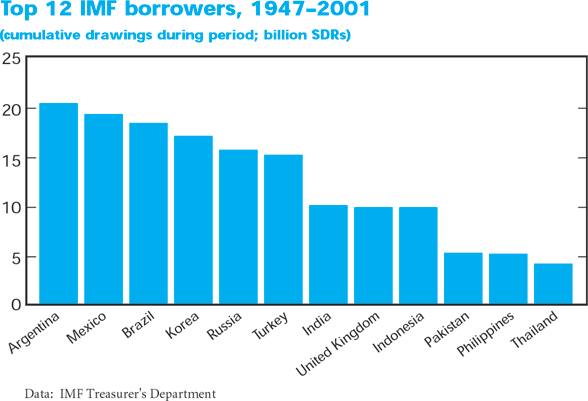
The safeguards policy was initiated in March 2000 on an experimental
basis against the background of two countries under IMF-supported programs
providing inaccurate information on international reserves and allegations
of misuse of IMF resources. During the Safeguard Assessments, IMF staff
examine internal control, accounting, reporting, and auditing systems
at the central banks of borrowing members and propose remedies to address
any vulnerabilities they identify. In some cases, the proposed measures
need to be implemented before further disbursements of IMF resources
are made to the member in question.
As a result of the safeguards policy, central banks have become more
aware of the need for transparency and proper governance. The policy
has also enhanced the IMF’s reputation as a prudent lender.
Technical assistance
Wide-ranging needs translate into increased demand
for IMF technical assistance
The IMF provides technical assistance to its member countries in policy
areas within its core mandate––namely, macroeconomic, monetary
and foreign exchange, fiscal, external debt, and statistics. The IMF
began to provide technical assistance to its members in 1964 in response
to requests from newly independent African and Asian countries for help
in establishing their central banks and ministries of finance.
The IMF’s technical assistance activities grew rapidly and, by
the mid-1980s, the number of staff years devoted to these activities
had almost doubled. In the 1990s, many countries––those of
the former Soviet Union as well as a number of countries in Eastern
Europe––moved from command to market-oriented economies, turning
to the IMF for technical assistance. The IMF has also helped countries
and territories establish governmental institutions following severe
civil unrest––for example, in Angola, Cambodia, East Timor,
Haiti, Kosovo, Lebanon, Namibia, Rwanda, and Yemen. In addition to supporting
the work of crisis prevention and management, and restoration of macroeconomic
stability in postcrisis situations, the IMF provides assistance to countries
that are following up on recommendations from Financial Sector Assessments,
adopting international standards and codes, improving their tracking
of public expenditures, and combating money laundering and the financing
of terrorism.
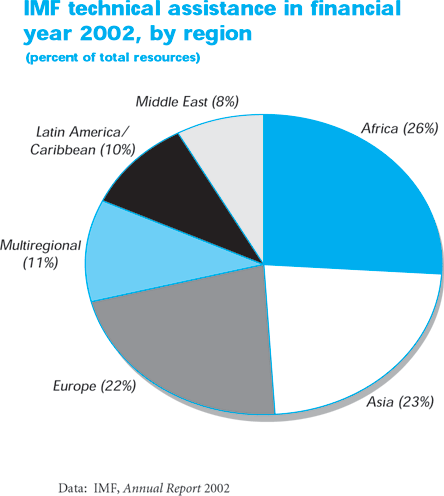
The IMF’s technical assistance has grown from just under 70 person-years
in 1970 to approximately 340 person-years annually and represents about
25 percent of the IMF’s total administrative budget.
Types of technical assistance
The IMF provides technical assistance in three broad areas:
- designing and implementing fiscal and monetary policies;
- drafting and reviewing economic and financial legislation, regulations,
and procedures; and
- institution and capacity building in central banks, treasuries,
tax and customs departments, and statistical services.
Technical assistance is provided through missions, short- and long-term
assignment of experts, and regional technical assistance centers. Two
regional technical assistance centers have been established, one serving
the small island economies of the Pacific, and the other serving the
CARICOM countries and the Dominican Republic. Two more centers are planned
to open later this year in Africa (see "The IMF and
Africa Overview"). In addition, the IMF trains officials from
its member countries through courses offered at its headquarters in
Washington, as well as at the Joint Vienna Institute, the Singapore
Training Institute, the Joint Africa Institute, the Joint Regional Training
Center for Latin America, and other regional and subregional locations.
Assistance is provided through several IMF departments.
The Monetary and Exchange Affairs Department focuses on central
banking and exchange system issues, as well as on designing and improving
monetary policy instruments. Its assistance covers banking regulation,
supervision, and restructuring; foreign exchange management and operations;
central bank organization and management; central bank accounting; clearing
and settlement systems for payments; monetary operations and money market
developments and monetary analysis and research.
The Fiscal Affairs Department is responsible for providing policy
advice and capacity building for revenue collection and tax and customs
administration; public expenditure management, including budget preparation
and execution, as well as treasury operations; and pension reform and
social safety net issues.
The Statistics Department assists members in meeting internationally
accepted standards of statistical reporting. The agreement on the Special
Data Dissemination Standard has increased the demand for the department’s
assistance, which covers monetary, balance of payments, national accounts,
and government finance statistics.
The IMF Institute provides training to officials at IMF headquarters,
at its regional centers, and through in-country courses. The courses
and seminars cover a variety of topics, including financial programming
and policy, financial analysis, public finance, external sector policies,
statistics, banking supervision, and monetary exchange operations. The
Institute also manages scholarship programs for economists from Asia
that are funded by Japan and Australia in those countries and at North
American universities.
The Legal Department helps members prepare legislation and advises
senior government lawyers, mainly in the laws of central banking, commercial
banking, foreign exchange, and fiscal affairs.
The Policy Development and Review Department provides advice
on debt policy and management and on the design and implementation of
trade policy reforms.
The Treasurer’s Department provides technical assistance
and training on the IMF’s financial organization and operations,
the establishment and maintenance of IMF accounts, accounting for IMF
transactions and positions by members, and other matters related to
members’ transactions with the IMF.
The Technology and General Services Department helps member
countries automate and modernize computer operations in their central
banks, finance ministries, and statistical offices.
External cooperation
In recent years, technical assistance projects have grown both larger
and more complex, requiring multiple sources of financing. Large projects
may involve more than one IMF department and more than one development
partner. Donors with which the IMF cooperates include the United Nations
and the United Nations Development Program; the World Bank; the Asian
Development Bank; the European Union; and the governments of Australia,
Canada, Denmark, France, Ireland, Italy, Japan, the Netherlands, New
Zealand, Switzerland, the United Kingdom, and the United States. The
government of Japan also makes generous annual contributions to IMF
scholarship programs. Such cooperative arrangements with multilateral
and bilateral donors not only support activities financially but also
help prevent conflicting advice and redundant activities and have led
to a more integrated approach to the planning and implementation of
technical assistance. As the demand for technical assistance in macroeconomic
and financial management grows, such arrangements will become even more
valuable.
 |
| IMF staff team visits tax collection center in
Kabul, Afghanistan. |
In response to the ever-increasing demand for technical assistance,
the IMF sets clear priorities so that its resources can be allocated
among member countries and regions in the most effective and efficient
manner. The IMF’s area (regional) departments are instrumental
in identifying countries’ technical assistance needs, and an interdepartmental
committee of senior IMF staff—the Technical Assistance Committee,
which is chaired by a Deputy Managing Director—takes part in this
process. The Office of Technical Assistance Management has been established
to help management develop policies guiding the delivery of technical
assistance and the coordination of technical assistance within the IMF,
as well as the collaboration with donor partners and technical assistance
providers.
A number of conditions have been identified as being crucial for the
successful implementation of technical assistance—in particular,
commitment of the country authorities to policy and institutional reforms,
a stable and cohesive macroeconomic environment, and an adequate administrative
structure and local counterparts with appropriate skills.
Quotas
Basic building blocks of the IMF
 |
| East Timor became the184th IMF member on July 23,
2002. Above, East Timorese Prime Minister Mari Alkatiri (left) is
welcomed to the IMF by Managing Director Horst Köhler. |
The IMF is a financial cooperative, in some ways like a credit union.
On joining, each member country pays in a subscription equal to its
quota (see box).
A country’s quota is broadly determined by its economic position
relative to other members and takes into account members’ GDP,
current account transactions, and official reserves.
The combined capital subscriptions of the IMF’s members form a
pool of resources, which the IMF uses to help countries experiencing
temporary financial difficulties. An adequate level of resources allows
the IMF to provide balance of payments financing to support members
implementing economic and financial reform programs.
At regular intervals of not more than five years, the IMF’s Executive
Board reviews members’ quotas and decides—in light of developments
in the global economy and changes in members’ economic positions
relative to other members—whether to propose an increase of their
quotas to the Board of Governors. Four of the general reviews concluded
that no increase was needed.
| What are quotas? |
|
A member’s quota defines the
basis of its relationship with the IMF.
Subscription: A member’s
IMF subscription is equivalent to its quota. A member
must pay its subscription in full: up to 25 percent
in the form of international reserve assets specified
by the IMF (SDRs or widely accepted foreign reserve
currencies, namely U.S. dollars, euros, Japanese yen,
or pounds sterling) and the rest in its own currency.
Voting power: Each IMF member
has 250 basic votes plus 1 additional vote for each
SDR 100,000 of quota. Thus, the quota defines a member’s
voting power in the IMF.
Access to financing: The amount
of financing a member can obtain from the IMF (access
limits) is based in part on its quota.
Allocation of SDRs: Members’
shares in SDR allocations are set in proportion to
their quotas.
|
|
|
A member may also request an adjustment of its
own quota at any time. The most recent such request, by China following
its resumption of sovereignty over Hong Kong in 1997, resulted in an
increase of China’s quota in 2001 from SDR 4,687.2 million to SDR
6,369.2 million.
In 1998, the IMF’s Board of Governors, at the completion of the
Eleventh General Review of Quotas, approved an increase of total IMF
members’ quotas by 45 percent, from SDR 146 billion (about $200
billion at the time) to the current SDR 213 billion (about $282 billion).
Its decision was based on the expansion of the world economy since quotas
were last increased in 1990; the scale of potential payments imbalances;
the rapid globalization and liberalization of trade and payments, including
the capital account; and the IMF’s current and prospective liquidity
needs and the characteristics of IMF financing arrangements.
Developments
The Twelfth General Review of Quotas formally began in December 2001
and is currently under way. As part of this process, the IMF Executive
Board held a seminar in February 2002 on conceptual issues involved
in assessing the adequacy of the IMF’s resource base. The seminar
provided an opportunity for a preliminary exchange of views on the implications
of developments in the world economy and the evolving role of the IMF
for the institution’s resource base. A follow-up staff paper will
take into account these views and quantify the possible size of the
IMF’s resources under various scenarios.
The IMF Executive Board has also been conducting a comprehensive review
of the formulas used by the IMF to help determine quotas of individual
members, with a view to simplifying them and updating them to reflect
developments in the world economy, including the growing role of financial
markets. The Board discussed IMF staff papers on the quota formulas
in October 2001 and June 2002. Earlier, at the Board’s request,
an independent panel of experts from outside the IMF also examined the
quota formulas and made recommendations. The Board is now awaiting the
outcome of additional analysis by the IMF staff.
After achieving independence in May 2002, East Timor became the IMF’s
184th member country on July 23, 2002, with a quota of SDR 8.2 million.
IMF quotas
(million SDRs) |
| Member |
Aug. 15, 2002
|
Member |
Aug. 15, 2002
|
|
Afghanistan, Islamic State of
Albania
Algeria
Angola
Antigua and Barbuda
Argentina
Armenia
Australia
Austria
Azerbaijan
Bahamas, The
Bahrain
Bangladesh
Barbados
Belarus
Belgium
Belize
Benin
Bhutan
Bolivia
Bosnia and Herzegovina
Botswana
Brazil
Brunei Darussalam
Bulgaria
Burkina Faso
Burundi
Cambodia
Cameroon
Canada
Cape Verde
Central African Rep.
Chad
Chile
China
Colombia
Comoros
Congo, Dem. Rep. of the
Congo, Republic of
Costa Rica
Côte d’Ivoire
Croatia
Cyprus
Czech Republic
Denmark
Djibouti
Dominica
Dominican Republic
East Timor1
Ecuador
Egypt
El Salvador
Equatorial Guinea
Eritrea
Estonia
Ethiopia
Fiji
Finland
France
Gabon
Gambia, The
Georgia
Germany
Ghana
Greece
Grenada
Guatemala
Guinea
Guinea-Bissau
Guyana
Haiti
Honduras
Hungary
Iceland
India
Indonesia
Iran, Islamic Rep. of
Iraq
Ireland
Israel
Italy
Jamaica
Japan
Jordan
Kazakhstan
Kenya
Kiribati
Korea
Kuwait
Kyrgyz Rep.
Lao People’s Dem. Rep.
Latvia
Lebanon
Lesotho
Liberia
Libya
|
120.4
48.7
1,254.7
286.3
13.5
2,117.1
92.0
3,236.4
1,872.3
160.9
130.3
135.0
533.3
67.5
386.4
4,605.2
18.8
61.9
6.3
171.5
169.1
63.0
3,036.1
150.0
640.2
60.2
77.0
87.5
185.7
6,369.2
9.6
55.7
56.0
856.1
6,369.2
774.0
8.9
533.0
84.6
164.1
325.2
365.1
139.6
819.3
1,642.8
15.9
8.2
218.9
8.2
302.3
943.7
171.3
32.6
15.9
65.2
133.7
70.3
1,263.8
10,738.5
154.3
31.1
150.3
13,008.2
369.0
823.0
11.7
210.2
107.1
14.2
90.9
60.7
129.5
1,038.4
117.6
4,158.2
2,079.3
1,497.2
504.0
838.4
928.2
7,055.5
273.5
13,312.8
170.5
365.7
271.4
5.6
1,633.6
1,381.1
88.8
52.9
126.8
203.0
34.9
71.3
1,123.7
|
Lithuania
Luxembourg
Macedonia, FYR
Madagascar
Malawi
Malaysia
Maldives
Mali
Malta
Marshall Islands
Mauritania
Mauritius
Mexico
Micronesia, Fed. States of
Moldova
Mongolia
Morocco
Mozambique
Myanmar
Namibia
Nepal
Netherlands
New Zealand
Nicaragua
Niger
Nigeria
Norway
Oman
Pakistan
Palau, Rep. of
Panama
Papua New Guinea
Paraguay
Peru
Philippines
Poland
Portugal
Qatar
Romania
Russia
Rwanda
St. Kitts and Nevis
St. Lucia
St. Vincent and the Grenadines
Samoa
San Marino
São Tomé and Príncipe
Saudi Arabia
Senegal
Seychelles
Sierra Leone
Singapore
Slovak Republic
Slovenia
Solomon Islands
Somalia
South Africa
Spain
Sri Lanka
Sudan
Suriname
Swaziland
Sweden
Switzerland
Syrian Arab Rep.
Tajikistan
Tanzania
Thailand
Togo
Tonga
Trinidad and Tobago
Tunisia
Turkey
Turkmenistan
Uganda
Ukraine
United Arab Emirates
United Kingdom
United States
Uruguay
Uzbekistan
Vanuatu
Venezuela
Vietnam
Yemen, Rep. of
Yugoslavia, Fed Rep. of
Zambia
Zimbabwe
Total
|
144.2
279.1
68.9
122.2
69.4
1,486.6
8.2
93.3
102.0
2.5
64.4
101.6
2,585.8
5.1
123.2
51.1
588.2
113.6
258.4
136.5
71.3
5,162.4
894.6
130.0
65.8
1,753.2
1,671.7
194.0
1,033.7
3.1
206.6
131.6
99.9
638.4
879.9
1,369.0
867.4
263.8
1,030.2
5,945.4
80.1
8.9
15.3
8.3
11.6
17.0
7.4
6,985.5
161.8
8.8
103.7
862.5
357.5
231.7
10.4
44.2
1,868.5
3,048.9
413.4
169.7
92.1
50.7
2,395.5
3,458.5
293.6
87.0
198.9
1,081.9
73.4
6.9
335.6
286.5
964.0
75.2
180.5
1,372.0
611.7
10,738.5
37,149.3
306.5
275.6
17.0
2,659.1
329.1
243.5
467.7
489.1
353.4
212,666.1
|
| 1On May 29, 2002,
the IMF’s Board of Governors approved East Timor’s
application for membership in the IMF. The East Timorese authorities
signed the Articles of Agreement on July 23, 2002, making
membership effective.
Data: IMF Treasurer’s Department
|
|
What is the SDR?
In 1969, the IMF created the SDR as an international reserve asset
to supplement members’ existing reserve assets. It is the unit
of account of the IMF and some other international and regional organizations.
The SDR is a purely official asset, held by member countries, the IMF,
and certain other international institutions. It is used primarily in
transactions with the IMF, either by members settling obligations to
the IMF, some of which must be paid in SDRs, or by the IMF making interest
payments and loan disbursements to members.
| SDR valuation on August 19,
2002 |
| Currency |
Currency amount
|
Exchange rate1
|
U.S. dollar equivalent
|
| Euro |
0.4260
|
0.98060
|
0.417736
|
| Japanese yen |
21.0000
|
118.67000
|
0.176961
|
| Pound sterling |
0.0984
|
1.53800
|
0.151339
|
| U.S. dollar |
0.5770
|
1.00000
|
0.577000
|
| |
|
|
Total 1.323036
|
SDR 1 = US$1.32304
US$1 = SDR 0.755837
1Exchange rates in terms of U.S.
dollars per currency unit, except for the yen, which is
expressed as currency units per U.S. dollar.
Data: IMF Treasurer’s Department
|
|
How are SDRs allocated?
The IMF allocates SDRs to its members in proportion to their IMF quotas.
The last allocation took place in January 1981 to the IMF’s then
141 member countries, bringing total allocations to SDR 21.4 billion.
SDR allocations are not loans; members may use them to meet a balance
of payments financing need without undertaking economic policy measures
or repayment obligations. However, a member that uses its SDRs pays
the SDR interest rate on the amount by which its allocations exceed
its holdings. A member that holds SDRs in excess of its allocation receives
interest.
More than one-fifth of the IMF’s current members have never received
an SDR allocation because they joined the IMF after the last allocation.
In addition, some members have not participated in every allocation.
To bring the cumulative SDR allocations of all member countries to
a uniform 29 percent of quota, the Board of Governors adopted a resolution
in September 1997 in favor of an amendment to the IMF’s Articles
of Agreement providing for a special onetime allocation of SDR 21.4
billion. The Fourth Amendment, when approved, will double the current
level of cumulative SDR allocations. The proposed amendment needs to
be approved by three-fifths (110) of the members having 85 percent of
the total voting power. As of mid-August 2002, 121 members having 73
percent of the total voting power had agreed. Thus, approval by the
United States would put the amendment into effect.
How is the SDR’s value determined?
The SDR’s value is based on the value of a basket of currencies.
Movements in the exchange rate of any one component currency will tend
to be partly or fully offset by movements in the exchange rates of the
other currencies. Thus, the value of the SDR tends to be more stable
than that of any single currency in the basket, which makes the SDR
a useful unit of account.
The basket is reviewed every five years to ensure that the currencies
included in it are representative of those used in international transactions
and that the weights assigned to the currencies reflect their relative
importance in the world’s trading and financial system.
The latest change in the valuation basket was in 2001 and took account
of the introduction of the euro. The new valuation basket includes the
U.S. dollar, the euro, the Japanese yen, and the pound sterling. Its
value is determined daily based on exchange rates quoted at noon in
the London market and is posted each day on the IMF’s website (www.imf.org/external/np/tre/sdr/basket.htm).
How is the SDR interest rate determined?
The SDR interest rate is the basis for calculating the interest charges
on regular IMF financing and the interest rate paid to members that
are creditors to the IMF. Adjusted weekly, the SDR interest rate is
a weighted average of interest rates on selected short-term domestic
instruments in the markets of the currencies included in the SDR valuation
basket and is posted
each week on the IMF website (www.imf.org/external/np/tre/tad/sdr_ir.cfm).
The SDR interest rate for the week beginning August 26, 2002, was 2.23
percent.
 |
 |
 |
 |
| Germany’s Horst Köhler became the
IMF’s eighth Managing Director in May 2000. |
A U.S. national, Anne O. Krueger has been
First Deputy Managing Director of the IMF since September
2001. |
Shigemitsu Sugisaki, from Japan, became a
Deputy Managing Director of the IMF in February 1997. |
Eduardo Aninat, from Chile, has been a Deputy
Managing Director of the IMF since December 1999. |
|
IMF Executive Board
(as of August 20, 2001) |
|
Director
Alternate
Casting votes1 of
(percent of IMF total)
Randal Quarles
Meg Lundsager
United States
(371,743–17.11 percent)
Ken Yagi
Haruyuki Toyama
Japan
(133,378–6.14 percent)
Karlheinz Bischofberger
Ruediger von Kleist
Germany
(130,332–6.00 percent)
Pierre Duquesne
Sébastien Boitreaud
France
(107,635–4.95 percent)
Thomas W. Scholar
Martin A. Brooke
United Kingdom
(107,635–4.95 percent)
Willy Kiekens (Belgium)
Johann Prader (Austria)
Austria
Belarus
Belgium
Czech Republic
Hungary
Kazakhstan
Luxembourg
Slovak Republic
Slovenia
Turkey
(111,696–5.14 percent)
J. de Beaufort Wijnholds (Netherlands)
Yuriy G. Yakusha (Ukraine)
Armenia
Bosnia and Herzegovina
Bulgaria
Croatia
Cyprus
Georgia
Israel
Macedonia, FYR of
Moldova
Netherlands
Romania
Ukraine
(105,412–4.85 percent)
Hernán Oyarzábal
(Venezuela)
Fernando Varela (Spain)
Costa Rica
El Salvador
Guatemala
Honduras
Mexico
Nicaragua
Spain
Venezuela
(92,989–4.28 percent)
Pier Carlo Padoan (Italy)
Harilaos Vittas (Greece)
Albania
Greece
Italy
Malta
Portugal
San Marino
(90,636–4.17 percent)
Ian E. Bennett (Canada)
Nioclás A. O’Murchú (Ireland)
Antigua and Barbuda
Bahamas, The Barbados
Belize
Canada
Dominica
Grenada
Ireland
Jamaica
St. Kitts and Nevis
St. Lucia
St. Vincent and the Grenadines
(80,636–3.71 percent)
|
Ólafur Ísleifsson
(Iceland)
Benny Andersen (Denmark)
Denmark
Estonia
Finland
Iceland
Latvia
Lithuania
Norway
Sweden
(76,276–3.51 percent)
Michael J. Callaghan
(Australia)
Diwa Guinigundo (Philippines)
Australia
Kiribati
Korea
Marshall Islands
Micronesia, Fed.States of
Mongolia
New Zealand
Palau
Papua New Guinea
Philippines
Samoa
Seychelles
Solomon Islands
Vanuatu
(72,413–3.33 percent)
Sulaiman M. Al-Turki
Ahmed Saleh Alosaimi
Saudi Arabia
(70,105–3.23 percent)
Cyrus D. R. Rustomjee (South Africa)
Ismaila Usman (Nigeria)
Angola
Botswana
Burundi
Eritrea
Ethiopia
Gambia, The
Kenya
Lesotho
Liberia
Malawi
Mozambique
Namibia
Nigeria
Sierra Leone
South Africa
Sudan
Swaziland
Tanzania
Uganda
Zambia
Zimbabwe
(69,968–3.22 percent)
Dono Iskandar Djojosubroto (Indonesia)
Kwok Mun Low (Singapore)
Brunei Darussalam
Cambodia
Fiji
Indonesia
Lao PDR
Malaysia
Myanmar
Nepal
Singapore
Thailand
Tonga
Vietnam
(68,367–3.15 percent)
A. Shakour Shaalan (Egypt)
Mohamad B. Chatah (Lebanon)
Bahrain, Kingdom of
Egypt
Iraq
Jordan
Kuwait
Lebanon
Libya
Maldives
Oman
Qatar
Syrian Arab Republic
United Arab Emirates
Yemen, Republic of
(64,008–2.95 percent)
|
WEI Benhua
Wang Xiaoyi
China
(63,942–2.94 percent)
Aleksei V. Mozhin
Andrei Lushin
Russia
(59,704–2.75 percent)
Roberto F. Cippa (Switzerland)
Wieslaw Szczuka (Poland)
Azerbaijan
Kyrgyz Republic
Poland
Switzerland
Tajikistan
Turkmenistan
Uzbekistan
(56,900–2.62 percent)
Murilo Portugal (Brazil)
Alternate (vacant)
Brazil
Colombia
Dominican Republic
Ecuador
Guyana
Haiti
Panama
Suriname
Trinidad and Tobago
(53,422–2.46 percent)
Yaga V. Reddy (India)
R.A. Jayatissa (Sri Lanka)
Bangladesh
Bhutan
India
Sri Lanka
(52,112–2.40 percent)
Abbas Mirakhor (Islamic Republic
of Iran)
Mohammed Daïri (Morocco)
Algeria
Ghana
Iran, Islamic Rep. of
Morocco
Pakistan
Tunisia
(51,793–2.38 percent)
A. Guillermo Zoccali (Argentina)
Guillermo Le Fort (Chile)
Argentina
Bolivia
Chile
Paraguay
Peru
Uruguay
(43,395–2.00 percent)
Alexandre Barro Chambrier (Gabon)
Damian Ondo Mañe
(Equatorial
Guinea)
Benin
Burkina Faso
Cameroon
Cape Verde
Central African Republic
Chad
Comoros
Congo, Rep. of
Côte d’Ivoire
Djibouti
Equatorial Guinea
Gabon
Guinea
Guinea-Bissau
Madagascar
Mali
Mauritania
Mauritius
Niger
Rwanda
São Tomé and Príncipe
Senegal
Togo
(25,169–1.16 percent)
|
| 1As of August 1,
2002, members’ votes totaled 2,172,661, and votes in the Executive
Board amounted to 2,159,676. This total does not include the
votes of the Islamic State of Afghanistan, the Democratic
Republic of the Congo, East Timor, Somalia, and the Federal
Republic of Yugoslavia, which did not participate in the 2000
Regular Election of Executive Directors. |
|
Time line
Twelve years in review
The hallmarks of the IMF, as reflected in the policy implementation
showcased in this time line, are twofold: its universality and
the responsibility it bears to interact cooperatively with each of its
members on economic policies; and its flexibility, its ability
to adapt its activities rapidly to the demands of a continually evolving
global economy. It is a perennially “self-reforming” institution,
mindful of its obligation to its entire membership.
In recent years, this has meant facing three major challenges: the
gathering pace—and expanding opportunities and risks—of globalization;
the transition from planned to market economies in many countries; and
an intensified response to the plight of the world’s poorest countries.
In the future, the world is expected to confront a deepening integration
of markets, but it will need to address additional challenges, such
as the aging of populations, and the potential for a surge in extremism
and violence if the trend toward greater inequalities between the poorest
and most affluent countries is not reversed.
What happened at the IMF…
 |
| Bebi Heybat mosque and bay in Baku, Azerbaijan. |
1990
- Facilities temporarily expanded to support countries affected by
Middle East crisis
- Interim Committee agrees to a 50 percent quota increase
1991
- Completion of joint study (IMF, World Bank, Organization for Economic
Cooperation and Development, and European Bank for Reconstruction
and Development) on the Soviet economy, with recommendations for reform
- Former USSR countries receive technical assistance
1992
- Quota increase takes effect
- Executive Board approves membership of former USSR countries
- Third Amendment to the Articles of Agreement permits members with
arrears to establish record on policies and payments performance and
accumulate rights for future drawings
- Executive Board increased from 22 to 24 seats
1993
- Systemic Transformation Facility (STF) created to assist countries
in transition from
a planned to a market economy
1994
- Madrid Declaration calls on industrial countries to sustain growth,
reduce unemployment, and prevent a resurgence of inflation; developing
countries to extend growth; and transition countries to pursue bold
stabilization and reform efforts
- New era of transparency initiated
- Arrangements approved for 13 countries of the CFA franc zone
1995
- Stand-By Arrangement of SDR 12.1 billion (about $17.8
billion) approved for Mexico
 |
| Many of the world’s poor live in Africa. |
1996
- Extended Fund Facility (EFF) Arrangement of SDR 6.9 billion (about
$10.1 billion) approved for Russia
- IMF establishes data standards for member countries
- Approval of Heavily Indebted Poor Countries (HIPC) Initiative and
permanent financing for the Enhanced
- Structural Adjustment Facility (ESAF)
Website established as part of transparency effort [www.imf.org]
1997
- Public information notices (PINs) issued following IMF consultation
with countries are published if country agrees
- Board of Governors approves Fourth Amendment, calling for special
allocation of SDRs
- Creation of Supplemental Reserve Facility (SRF)
- Establishment of New Arrangements to Borrow (NAB)
Activation of SRF and NAB and Approval of Stand-By Arrangement of
SDR 5.5 billion for Korea
1998
- General Arrangements to Borrow (GAB) activated for Russia
- NAB activated for Brazil
- To address far-reaching problems facing world economy, Board of
Governors endorses
- concept of new “financial architecture”
1999
- Newly established European Central Bank granted observer status
in IMF
- Quotas increased by 45 percent
- Contingent Credit Lines Facility established to protect countries
with sound policies from crises in other countries
- Revaluation of gold holdings to help finance ESAF-HIPC Trust
- ESAF replaced by Poverty Reduction and Growth Facility
- HIPC Initiative is enhanced to provide faster and broader debt relief
- Interim Committee transformed into the International Monetary and
Financial Committee
 |
| Stock market operators negotiate trades in São
Paulo, Brazil, during currency crisis. |
2000
- Major push for HIPC-eligible countries to reach decision points
- Steps taken to monitor more closely the use of its resources by
borrowing countries
- Independent Evaluation Office established to assess operations and
policies
- Financing facilities streamlined
2001
- International Capital Markets Department established to enhance
surveillance, crisis prevention, and crisis management
- Conditionality streamlined; country ownership of reforms stressed
- China’s quota increased to SDR 6.4 billion (about $8.3 billion)
- First Deputy Managing Director proposes mechanism to help sovereign
debtors and their creditors resolve debt problems
2002
- Focus on Millennium Development Goals intensified
$30 billion Stand-By Arrangementwith Brazil approved
- For the complete IMF chronology, see http://www.imf.org
…and in the world
 |
| West Berliners stand in front of Berlin Wall as
a section is being demolished, November 1989. |
1990
- Middle East crisis
- Two Germanys (and currencies) unify
- Establishment of European Bank for Reconstruction and Development
1991
- Dissolution of Soviet Union and Yugoslavia
- Maastricht Treaty creates European Union
- Establishment of MERCOSUR (common market for Argentina, Brazil,
Paraguay, and Uruguay)
1992
- Japan enters deep economic slump
- North American Free Trade Agreement signed
- European Exchange Rate Mechanism (ERM) crisis
1993
- Radical reform of the ERM
1994
- Debt crisis in Mexico
- World Trade Organization replaces General Agreement on Tariffs and
Trade
- Devaluation of CFA franc
 |
| Hong Kong SAR prepares for millennium celebration. |
1995
- Latin American financial markets feel contagion effects of Mexican
crisis
- Uruguay Round trade agreement concluded
1996
- Problems of some heavily indebted poor countries worsen
1997
- China resumes sovereignty over Hong Kong
- Thai baht collapses; contagion affects Korea and Southeast Asia
 |
| World Trade Center shortly after terrorist attacks. |
 |
Euro symbol sculpture marks launch of new
currency in Germany. |
1998
- Asian crisis spreads, reaching as far as Brazil and Russia
- Collapse of Long Term Capital Management hedge fund
- World’s first regional stock exchange launched in Abidjan,
linking 8 West African countries
1999
- Launch of euro —single European currency—in 11 countries
2000
- Meltzer Commission Report on role and effectiveness of IMF and multilateral
development banks
- Jubilee 2000 calls for total debt cancellation
- African leaders hold economic summit to discuss poverty and growth
2001
- U.S. recession begins
- Terrorists attack United States on 9/11
- China and Taiwan Province of China join WTO at Doha meeting
- Banking crisis in Turkey
2002
- Argentina debt default is largest in history
- Euro replaces physical currencies of 12 euro-area countries
- UN Conference on Financing for Development held in Monterrey, Mexico.
- New Partnership for Africa’s Development
Organization of the IMF
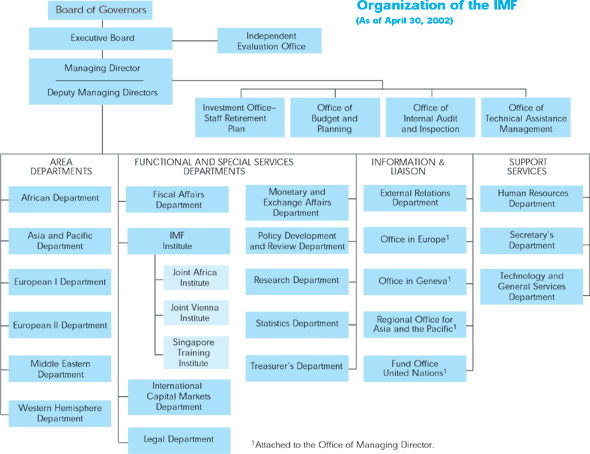
IMF at a glance
| When was the IMF set up? |
It was founded in 1945 and began financial
operations on March 1, 1947 |
| What is its current membership? |
184 countries |
| What are its governing bodies? |
Board of Governors and Executive Board |
| Who heads the IMF? |
Horst Köhler is Managing Director |
| How many staff work at the IMF? |
About 2,650 from 140 countries |
| What are its total resources? |
SDR 212.7 billion (nearly $283 billion) |
|
Primary purposes
- Promote international monetary
cooperation.
- Facilitate the expansion and balanced
growth of international trade.
- Promote exchange stability and
maintain orderly exchange arrangements among member countries.
- Assist in establishing a multilateral
system of payments in respect of current transactions
between member countries as well
as in eliminating foreign exchange restrictions that hamper
the growth of world trade.
- Make available to member countries
the IMF’s general resources on a temporary basis
to enable them to correct balance of payments difficulties
without resorting to measures that would harm national
or international prosperity.
- Shorten the duration and lessen
the degree of disequilibrium in the international balances
of payments of member countries.
|
|
Main areas of activity
- Surveillance, or appraisal, of
its members’ macroeconomic policies within the framework
of a comprehensive analysis of both the general economic
climate and each member’s policy strategy.
- Financial assistance, in the form
of credits and loans to member countries with balance
of payments problems, to support adjustment and reform
policies.
- Technical assistance, consisting
of IMF expertise and financial support for member countries
in several broad areas, including design and implementation
of fiscal and monetary policy, institution building (such
as central banks and treasuries), collection and refinement
of statistical data, and training of government officials.
|
|
Laura Wallace, Editor-in-Chief,
Sheila Meehan, Senior Editor
Elisa Diehl, Assistant Editor
Natalie Hairfield, Assistant Editor
Jacqueline Irving,
Assistant Editor
Lijun Li,
Editorial Assistant
Kelley McCollum,
Editorial Assistant
Philip Torsani, Art Editor
Julio R. Prego, Graphic Artist
_______
Prakash Loungani, Contributing Editor
The IMF Survey (ISSN 0047-083X) is published in English,
French, and Spanish by the IMF 23 times a year, plus an annual Supplement
on the IMF and an annual index. Opinions and materials in the IMF Survey
do not necessarily reflect official views of the IMF. Any maps used
are for the convenience of readers, based on National Geographic’s
Atlas of the World, Sixth Edition; the denominations used and the boundaries
shown do not imply any judgment by the IMF on the legal status of any
territory or any endorsement or acceptance of such boundaries. Text
from the IMF Survey may be reprinted, with due credit given, but photographs
and illustrations cannot be reproduced in any form. Address editorial
correspondence to Current Publications Division, Room IS7-1100, IMF,
Washington, DC 20431 U.S.A. Tel.: (202) 623-8585; or e-mail any comments
to imfsurvey@imf.org. The IMF
Survey is mailed first class in Canada, Mexico, and the United States,
and by airspeed elsewhere. Apply for subscriptions to Publication Services, Box
X2002, IMF, Washington, DC 20431 U.S.A. Tel.: (202) 623-7430; fax: (202)
623-7201; e-mail: publications@imf.org.
|