Unleashing Brazil’s Growth
IMF Blog, November 27, 2013
Source details
- Canonical URL
- Unleashing Brazil’s Growth
Other formats
Bibliographic details
- Authors: Martin Kaufman, Mercedes Garca-Escribano
- Published: November 27, 2013
Background and recent performance
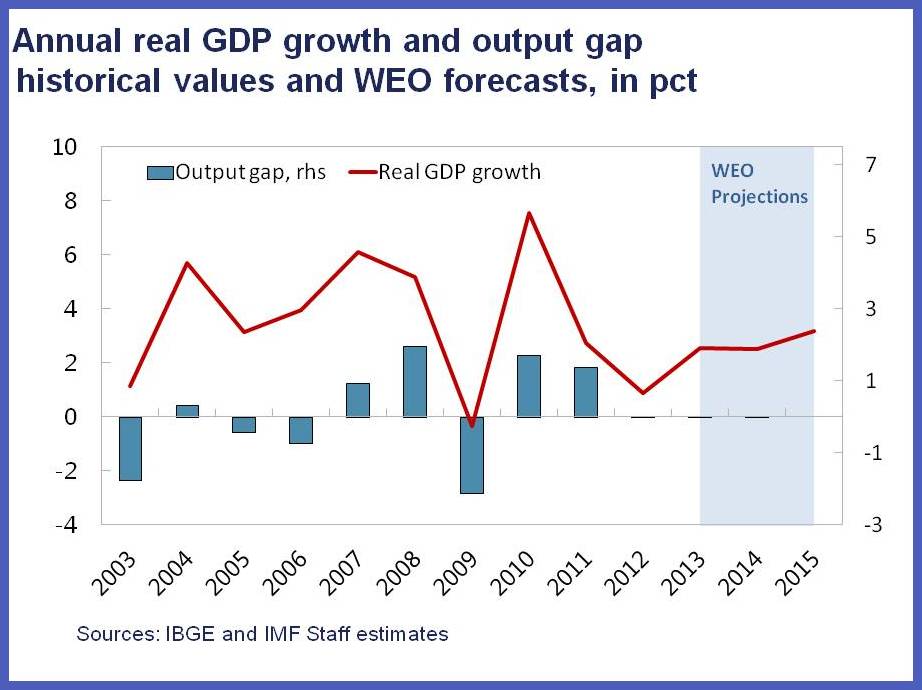
- Since the early 2000s, Brazil’s economy has grown at a robust clip, with growth in 2010 reaching 7.5 percent—its strongest in a quarter of a century.
- A key pillar of this success has been sound economic policies and the adoption of far-reaching social programs, which resulted in a substantial decline in poverty.
- In the last couple of years Brazil’s growth slowed down; although other emerging market economies experienced a similar slowdown, the growth outturns in Brazil were particularly disappointing.
- Measures taken to stimulate the economy did not produce a sustained recovery because unleashing sustained growth requires changing the composition of demand towards investment and increasing productivity rather than stimulating domestic demand alone.
Home-grown woes
- Inadequate infrastructure and imbalances in demand are hampering Brazil’s growth process.
- During 2011-13 private consumption was strongly supported by:
- very low unemployment,
- broad gains in real wages (partly owing to large increases in minimum wages),
- buoyant credit expansion.
- Investment has been disappointingly weak.
- While global uncertainties played a role (especially in 2011), the main factors behind sluggish investment have been home-grown, including the steady loss of competitiveness.
Restarting growth — IMF staff recommendations
- Solidify Brazil’s macroeconomic policy framework.
- Adopt measures and reforms geared at increasing the economy’s productive potential and improving competitiveness.
- Monetary policy:
- The tightening of monetary conditions initiated by Brazil’s central bank in April is a step in the right direction; it has helped lower inflation expectations and contain inertia.
- Fiscal policy:
- Sustained fiscal consolidation through adherence to a fiscal primary surplus of about 3 percent of GDP would:
- keep domestic demand in check,
- lower public indebtedness,
- bolster a recovery in confidence and investment.
- Structural policies:
- The government’s renewed focus on policies to alleviate constraints on the economy’s productive capacity, in particular infrastructure concessions to the private sector, is welcome.
Near-term outlook and risks
- Staff projects that Brazil will grow by about 2½ percent this year and next.
- Although higher than the growth rate of 2012, this performance will keep Brazil below its potential growth.
- Risks to the outlook:
- The recovery could prove more unbalanced—excessively dependent on consumption—and sluggish.
- The factors underlying weak investment and supply constraints may be more severe than anticipated.
- Investor confidence may not be restored.
- Policy guidance if downside risks materialize:
- The response should not be further demand stimulus, which would:
- exacerbate domestic demand imbalances,
- widen the external current account deficit,
- reignite inflationary pressures,
- weaken confidence.
- External risks:
- Stemming from Brazil’s reliance on foreign savings and its highly integrated financial markets.
- Mitigating factors: the flexible exchange rate, strong monetary policy framework and large holdings of international reserves.
Reaching full potential — medium-term priorities
- Goal: get the Brazilian economy close to potential growth—currently estimated at about 3½ percent.
- Priority policy actions:
- Enhance productivity.
- Step up investment, including in infrastructure.
- Complement infrastructure efforts with:
- an overhaul of the minimum wage indexation mechanism,
- reforms to keep labor costs in check and prevent further erosion in competitiveness,
- lowering and simplifying taxes,
- improving business conditions to lower the "custo Brasil".
IMF blog post by Martin Kaufman and Mercedes García-Escribano, November 27, 2013.
Content in this bundle
- A arrancada do crescimento no Brasil-- Por Martin Kaufman e Mercedes García-Escribano