The Growth of Shadow Banking
IMF Blog, October 3, 2014
Source details
- Canonical URL
- The Growth of Shadow Banking
Other formats
Bibliographic details
- Authors: Gaston Gelos, Nico Valckx
- Published: October 3, 2014
Size and measurement
- Shadow banking "is now worth over $70 trillion."
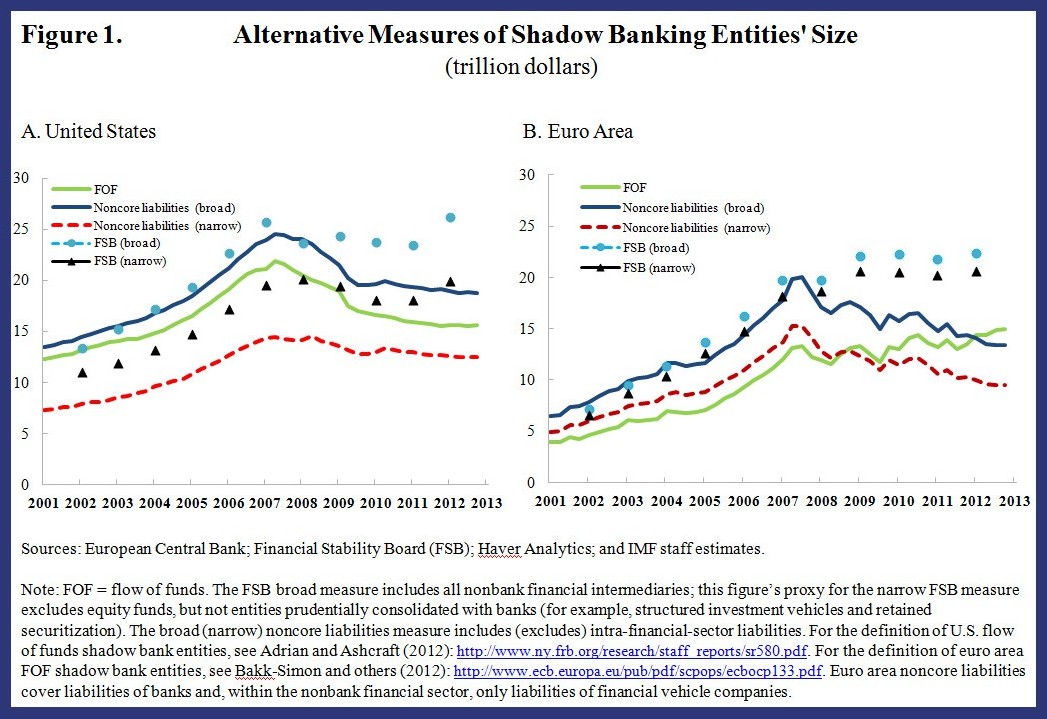
- Three measurement approaches discussed:
- Financial Stability Board (FSB) definitions:
- A broad definition: nonbank financial intermediaries engaged in credit intermediation (including investment funds).
- A narrow definition: excludes entities that do not directly undertake credit intermediation or are consolidated into banking groups.
- Flow of funds–derived measure for a smaller set of countries:
- Focuses on “other financial intermediaries.”
- Excludes non-money market investment funds (which mainly manage assets on behalf of clients and thus do not engage directly in credit intermediation).
- Activity-based alternative definition:
- Defines shadow banking as financial activities using nontraditional funding, independently of the financial institution involved.
- Example: securitization is classified as shadow banking whether done on-balance sheet by banks or off-balance sheet through special purpose vehicles.
- Comparative trends:
- All measures show similar growth until 2007, then diverge markedly.
- FSB measures: after a mild drop around 2008, now surpass pre-crisis levels—positive valuation effects and growth in the investment fund industry are cited as reasons.
- The IMF’s (flow-of-funds–based) measures: remain broadly constant or have fallen, reflecting a decline in some activities after the crisis (securitization; securities and repo lending) and a rise in other activities (country-specific entities such as special financial institutions in the Netherlands and U.S. holding corporations).
- Monitoring implication:
- For broad monitoring, multiple measures are useful because they capture different developments across the shadow banking spectrum.
- Geographic note:
- Largest shadow banking markets: the United States and Europe.
- Emerging markets: rapid expansion from a low base.
Drivers of growth
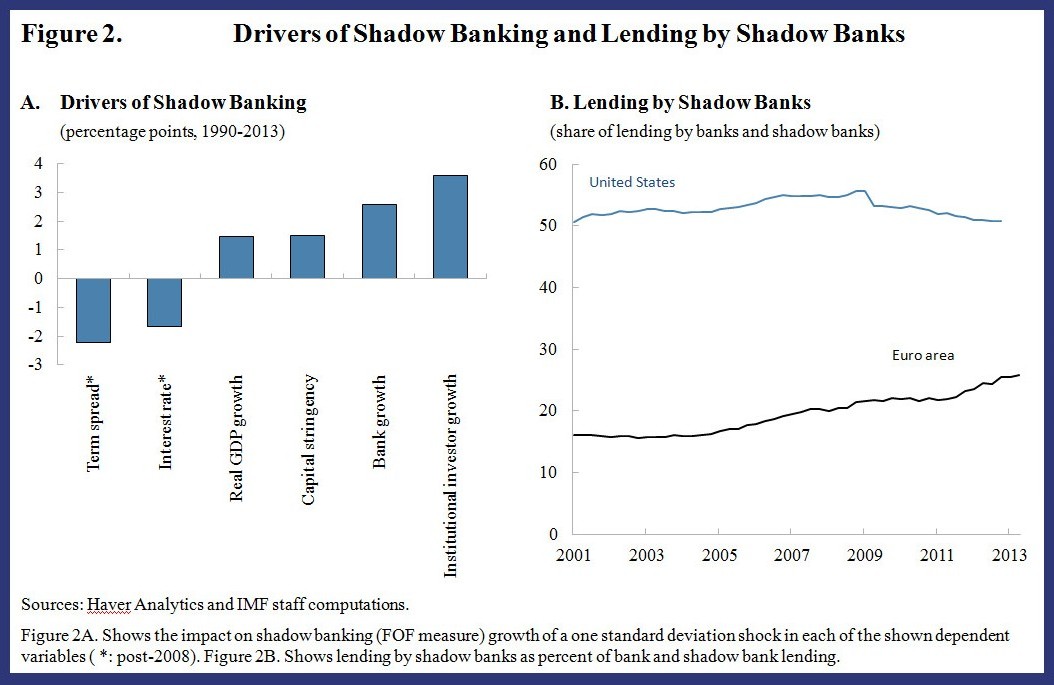
- Empirical associations identified:
- Shadow banking growth is associated with GDP growth.
- Low interest rates and low term spreads (inducing search for yield).
- Bank capital stringency (capturing regulatory circumvention).
- Growth of institutional investors.
- Controlling for the above, there appears to be some complementarity with the size of the banking sector.
- Ongoing dynamics and outlook:
- The current financial environment remains conducive to further growth in shadow banking.
- Evidence of migration of some activities (such as lending to firms) from traditional banks to the nonbank sector.
- Euro area: growth of lending by shadow banks appears to be gathering force.
- United States: share of total lending by shadow banks remains high.
- Sectoral behavior since 2009:
- Investment funds in the euro area and the United States have been growing the fastest since 2009 and are taking on more risk.
- Some funds have been venturing into less liquid assets, including loans to companies.
- Figures referenced:
- Growth drivers summarized in Figure 2.A.
- Lending patterns by sector summarized in Figure 2.B.
Risks, data gaps, and policy recommendations
- Risk assessment:
- Shadow banks can be both "a boon and a bane."
- Concerns focus on institutions that provide credit intermediation and borrow and lend like banks but are not regulated like them and lack a formal safety net.
- There are indications of risk build up in some sectors, but a definitive assessment of whether growth is good or bad for financial stability cannot yet be given.
- Data and analytical needs:
- Need more data on balance sheets of shadow banking entities to understand:
- Whether they engage in excessive maturity or liquidity transformation.
- How much leverage is involved.
- How risky their credit positions are.
- How interconnected they are with the rest of the financial system.
- Current analysis can be undertaken only in very broad terms for some broad shadow banking sectors.
- Policy recommendation:
- Policymakers should monitor how different shadow banking activities and entities grow and may contribute to systemic risk.
Gaston Gelos, Nico Valckx, October 3, 2014