Latin America and the Fiscal Stimulus: A Mild Hangover, Not Yet an Addiction
IMF Blog, May 6, 2015
Source details
- Canonical URL
- Latin America and the Fiscal Stimulus: A Mild Hangover, Not Yet an Addiction
Other formats
Bibliographic details
- Authors: Alexander Klemm
- Published: May 6, 2015
Overview
- Author: Alexander Klemm
- Date: May 6, 2015
- Context: Assessment of how six large emerging Latin American countries—Brazil, Chile, Colombia, Mexico, Peru, and Uruguay—reacted to the 2008-2009 global financial crisis, the longer-term consequences of those policy choices, and lessons for policymakers.
- Short summary: Regional growth is expected to dip below 1 percent in 2015, partly due to the drop in global commodity prices. Fiscal positions entering the current slowdown are generally weaker than at the onset of the global financial crisis because crisis-era fiscal stimulus was not fully reversed.
The golden decade (pre-crisis decade)
- Regional features before the crisis:
- Strong growth, high commodity prices, buoyant investor optimism, and better policy frameworks.
- Public debt declined, reliance on dollar-denominated borrowing decreased, and foreign exchange reserves were built up.
- Policy choices:
- Most countries avoided excessive spending during the boom, despite social and infrastructure needs.
- Countries could have done more to pay down debts and prepare for downturns.
- Fiscal position at the start of the crisis: in generally good shape.
The storm (response to the 2008-2009 global financial crisis)
- Transmission to region: Initially hit through the drop in commodity prices and global trade.
- Policy response:
- Latin America implemented a more expansionary fiscal stance instead of procyclical tightening.
- Explicit fiscal stimulus programs were implemented in five out of the six countries studied.
- Impact of stimulus:
- These programs helped to reduce output losses by about 0.75 to 2 percent of GDP.
The aftermath (post-crisis behavior)
- Recovery drivers: Quick recovery of commodity prices and wide availability of global financing.
- Policy reversal failure:
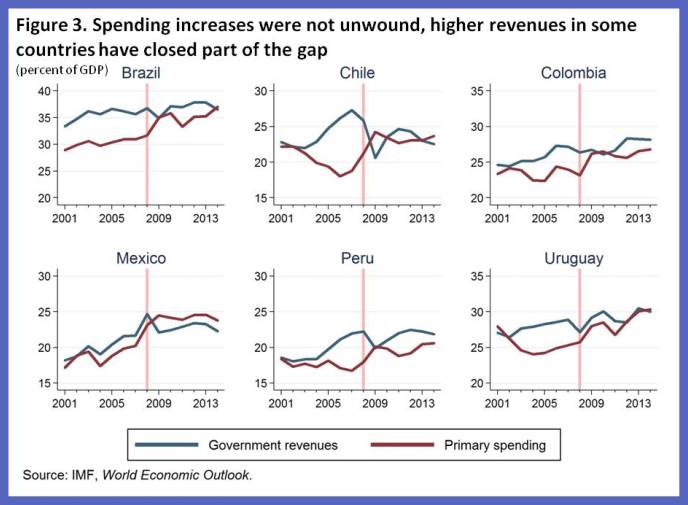
- Except for Chile, countries insufficiently tightened fiscal policy as they recovered.
- Spending proved difficult to cut back to pre-crisis levels even as employment returned to full employment.
- Resulting vulnerabilities:
- Fiscal accounts are weaker now than on the eve of the crisis.
- While fiscal deficits and debt levels are not described as alarming, fiscal vulnerabilities have increased, reducing policy room for maneuver.
- If another crisis occurred immediately, most of Latin America would find it difficult to provide the same level of fiscal support as in 2009.
Structural and institutional legacies
- Composition changes:
- Spending on wages and social benefits has increased and will be politically difficult to reverse.
- Revenue increases are helping close gaps, but trade-offs about the desired size of government and taxation capacity remain.
- Institutional weakening:
- Fiscal institutions and controls have weakened in many countries.
- Evidence includes rule bending during the crisis, little effort to re-anchor fiscal objectives during the subsequent boom, changes to targets and coverage of fiscal rules, and some off-budget operations.
- For many, this weakening has become a permanent feature.
Main takeaways and policy recommendations
- Symmetric countercyclical policy:
- Countercyclical fiscal policy—if used at all—should be applied symmetrically: a major fiscal stimulus during a crisis needs to be offset with fiscal conservatism in good times.
- Strengthen fiscal institutions:
- Design institutions to support a prudent buildup of buffers during good times while providing flexibility to react when headwinds build.
- Set goals in terms of structural balance targets that adjust for the cycle and movements in commodity prices.
- Alternatively, use expenditure rules as a technically easier option.
- Include well-defined escape clauses for unexpected catastrophes (for example, events like the failure of Lehman Brothers).
- Put safeguards in place to ensure fiscal authorities make up for lost ground once crises dissipate.
- Improve spending efficiency:
- The region has ample scope to improve the efficiency of public spending.
- Smarter adjustments may take more time to identify and implement but will help build social support for addressing post-crisis imbalances.
Key figures and facts (verbatim)
- Regional growth is expected to dip below 1 percent in 2015.
- Stimulus programs helped to reduce output losses by about 0.75 to 2 percent of GDP.
- Explicit fiscal stimulus programs were implemented in five out of the six countries.
- Crisis referenced: Global financial crisis of 2008-2009.
- Countries studied: Brazil, Chile, Colombia, Mexico, Peru, and Uruguay.
Source: IMF blog post "Latin America and the Fiscal Stimulus: A Mild Hangover, Not Yet an Addiction" by Alexander Klemm, May 6, 2015.
Content in this bundle
- América Latina e o estímulo fiscal: uma leve ressaca, mas ainda não um vício; 6 de maio de 2015