Peer Pressure: Tax Competition and Developing Economies
IMF Blog, July 11, 2017
Source details
- Canonical URL
- Peer Pressure: Tax Competition and Developing Economies
Other formats
Bibliographic details
- Authors: Michael Keen, Jim Brumby
- Published: July 11, 2017
Overview and core problem
- Economists recognize competition as important for markets, but when governments compete to attract investors by lowering tax burdens they can erode each other’s revenues.
- Developing countries are especially vulnerable because they are "especially reliant on the corporate income tax for revenues."
- Resulting effects include reliance on other—“typically more distortive”—sources of financing, reductions in public spending, or both.
Mechanisms and amplification
- Cross-border mobility of tax bases (labor income, commodity transactions, capital income) increases responsiveness of activity to national tax changes compared with collective responsiveness.
- Multinational firms can use transfer pricing and other avoidance devices to shift profits from high-tax countries to low-tax jurisdictions and can choose investment locations, intensifying pressure on national corporate tax bases.
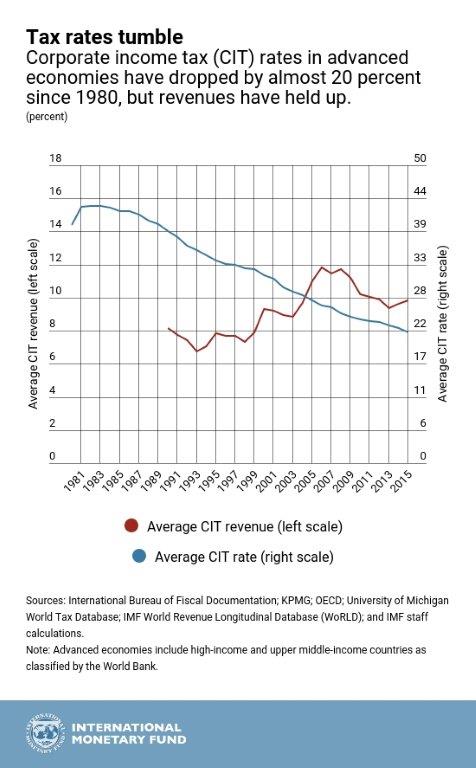
- Headline corporate income tax rates have "plummeted since 1980, by an average of almost 20 percent."
- Even though revenues so far have remained steady in developing countries and increased in advanced economies, "there is nothing to guarantee that this will continue."
- The OECD-G20 'BEPS' project could reduce tax avoidance, but "competition through other means could increase" as a consequence.
Empirical findings and debate
- Presentation cited: Kimberly Clausing reported that a paper finds that "for every percentage point drop in the average tax rate in a low-tax jurisdiction, profits reported there by foreign corporations of U.S. multinationals increase by between 3.5 and 7 percentage points."
- The result is "contentious"; some, such as Paul Ryan (Irish Department of Finance), argue the cross-border impact on less advanced economies has been exaggerated.
- Consensus view in the discussion: "tax competition is generally seen as a real threat to revenue, most notably for developing countries."
Partial solutions and limits of coordination
- International coordination can limit the race to the bottom, but is "much more easily said than done."
- Partial coordination has limits: if only some countries coordinate, they can become more vulnerable to non-participants; even full coordination can leave vulnerabilities if it does not cover all relevant tax-system aspects.
- Specific proposals discussed:
- Common Consolidated Corporate Tax Base (European Commission proposal): first stage consolidates taxable profits for multinationals across EU countries allowing cross-border loss offsets; second stage allocates profits across member states by a formula based on assets, employment, or other activity indicators. This would not eliminate incentives to use low tax rates to attract activities reflected in the allocation formula.
- Destination-based cash-flow tax (discussed in U.S. debate): taxes based on where goods are sold (destination) rather than produced. If "adopted universally, and well designed, this would ease pressures of tax competition." If adopted unilaterally, it "would amplify profit shifting problems for others" because profits from sales elsewhere could be taken tax-free in destination-tax jurisdictions, prompting further competition or wider adoption.
Policy implications and agenda
- Developing countries face significant stakes from ongoing and potential "tectonic shifts in tax systems, such as a move to a destination-based corporate taxation."
- Key policy priorities implied by the discussion:
- Strengthen multilateral coordination on corporate taxation to limit harmful tax competition.
- Design reforms (e.g., consolidation and allocation formulas, or destination-based systems) with attention to cross-border spillovers and incentives they create for non-participants.
- Continue empirical study of profit sensitivity to tax rates and the cross-border impact of national tax policy.
- The IMF and World Bank plan to continue analysis, including engagement at a high-level event co-organized with the Ministry of Finance of Indonesia and through the Voyage to Indonesia ahead of the World Bank-IMF Annual Meetings in 2018, focusing on challenges for Association of Southeast Asian Nations members.
Source: IMF blog page "Peer Pressure: Tax Competition and Developing Economies", July 11, 2017.
Content in this bundle
- 同侪压力:税收竞争与发展中经济体; IMF blog; 2017 年7 月11 日
- 透明性のすすめ:新興市場国の統計データ公表範囲が拡大; サンギュプ・チョイ 、 ステファニー・メディナ・カス, IMFブログ2017 年7月7日
- 071117r
- CBTWP1701 - Preface
- Spillovers in International Corporate Taxation; IMF Policy Paper; May 9, 2014
References
- عربي
- https://www.imf.org/wp-content/uploads/2017/07/BLOG-1099x500-INDIA-New-Delhi-Salesman-checking-customer-iPhone_Adnan-Abidi_Reuters_Newscom.rtrleight566334.jpg
- https://www.imf.org/wp-content/uploads/2017/07/Tax-rates-tumble.jpg
- https://www.imf.org/wp-content/uploads/2017/07/ENG_Jul_7_International_taxation_2.jpg
- gathered together
- high-level event