Climate Change Will Bring More Frequent Natural Disasters & Weigh on Economic Growth
IMF Blog, November 16, 2017
Source details
- Canonical URL
- Climate Change Will Bring More Frequent Natural Disasters & Weigh on Economic Growth
Other formats
Bibliographic details
- Authors: Sebastian Acevedo, Natalija Novta
- Published: November 16, 2017
Summary and context
- Authors: Sebastian Acevedo, Natalija Novta
- Date: November 16, 2017
- Based on analysis in Chapter 3 of the October 2017 World Economic Outlook.
- Focus: empirical analysis linking historical weather patterns to weather-related natural disasters and projections under an unmitigated climate change scenario.
Historical evidence on disaster occurrence
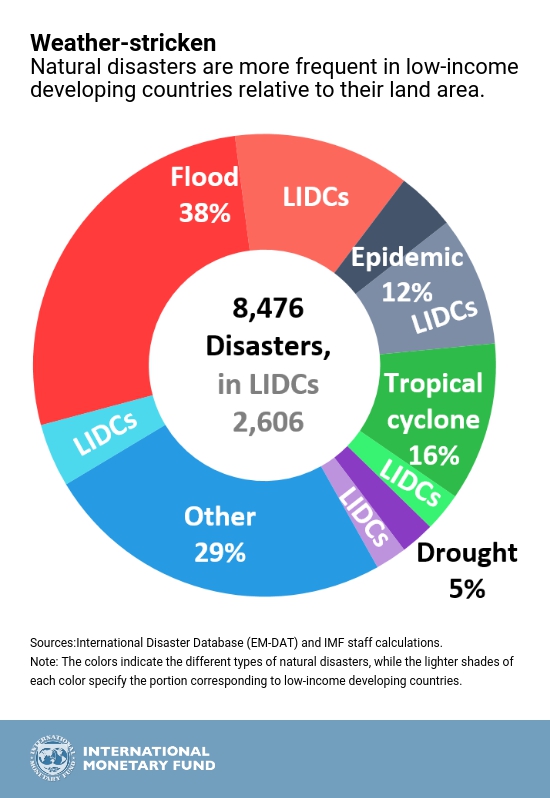
- Between 1990 and 2014, there were more than 8,000 weather related disasters.
- Sample: 228 countries and territories.
- Method: examined the historical relationship between the occurrence of each type of weather-related natural disaster and monthly weather patterns over the past 25 years.
- Key empirical finding:
- Temperature and precipitation are very important predictors of most disasters.
- Higher temperature is associated with more disasters caused by droughts, wildfires, heat waves, tropical cyclones and other storms.
- More rain is associated with fewer disasters caused by droughts, wildfires and heat waves, and with more disasters caused by floods, landslides, tropical cyclones and other storms.
Future projections under an unmitigated scenario
- Approach: combine empirical estimates from historical data with projected temperature and precipitation for each country under the unmitigated climate change scenario of the Intergovernmental Panel on Climate Change.
- Temporal horizons analyzed: 2050 and 2100.
- Climate projection cited: under the unmitigated scenario, mean global temperatures are expected to increase by about 4°C by 2100.
- Projected changes in disaster frequency:
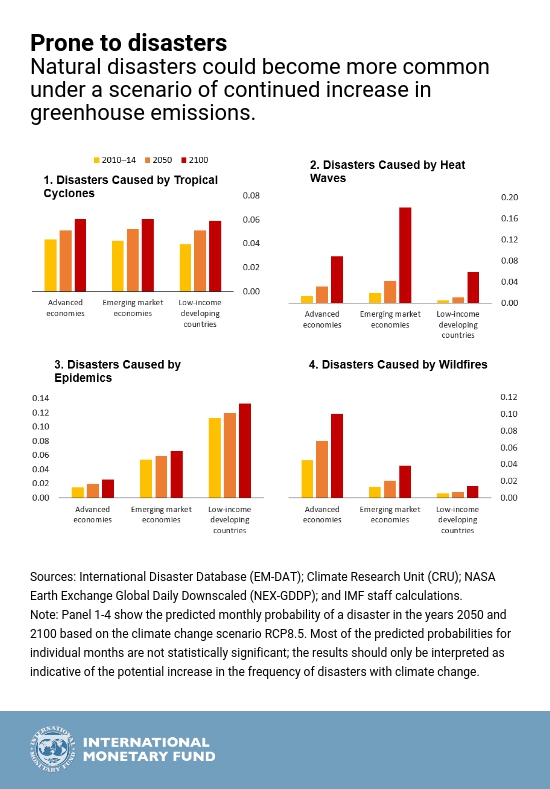
- Most types of weather-related disasters will become more common by the end of the century, across all income groups.
- The frequency of disasters caused by heat waves, tropical cyclones and wildfires will increase considerably.
- Although scientists expect the overall frequency of tropical cyclones to decline in a warmer world, storms that form are expected to be more intense, likely resulting in more disasters.
- Floods and epidemics, which primarily affect low-income countries, will also become more common.
- Warmer environments increase reproduction and spread of mosquitoes and pathogens, increasing the probability of epidemics.
Economic and social implications
- Increasing disaster risk will manifest on top of longer term negative effects that temperature increases have on macroeconomic activity.
- Potential consequences include increased migration flows from affected countries with potentially sizable spillovers across the globe.
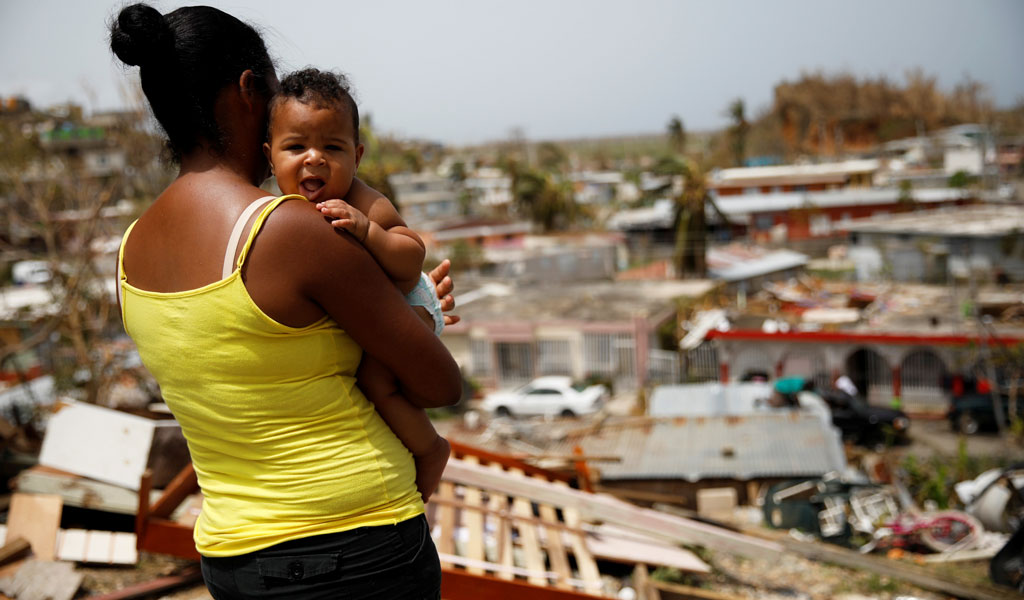
- Natural disasters are a particularly important risk to small, lower income countries because they can quickly wipe out a significant portion of their GDP.
- IMF role: for decades, the IMF has been committed to helping meet members’ post-disaster needs.
Policy recommendations and preparedness measures
- Invest in resilient infrastructure that can withstand rising sea levels and higher wind speeds, among other increased hazards.
- Update zoning laws and building codes to account for climate change.
- Improve early warning systems to reduce future costs.
- When times are good, save so that countries have room for additional government spending to support their economies when climate-related disasters hit.
- Global mitigation imperative: only a concerted global effort to curb greenhouse gas emissions will help avert the worst effects of climate change.
- International engagement: the UN’s Climate Change Conference (COP23) taking place in Bonn the week of publication is critical to make meaningful progress.
Source: IMF blog post — Sebastian Acevedo and Natalija Novta, November 16, 2017.
Content in this bundle
- 气候变化将导致更频繁的自然灾害,对经济增长造成不利影响; IMF博客; 2017 年11 月16 日
- 気候変動によって自然災害の発生頻度が増加し、経済成長の足枷となるだろう; セバスチャン・アセヴェイドー、ナタリア・ノフタ; IMF ブログ 2017年11月16日掲載
- Изменение климата приведет к более частым стихийным бедствиям и затруднит экономический рост
References
- عربي
- https://www.imf.org/wp-content/uploads/2017/11/BLOG-1024x600-Puerto-Rico-mom-holding-baby-destruction-Carlos-garcia-Rawlins-rtrlnine161973.jpg
- small, lower income countries
- https://www.imf.org/wp-content/uploads/2017/11/ENG_Nov_10Natural_disasters-4.jpg
- https://www.imf.org/wp-content/uploads/2017/11/ENG_Nov_10_Natural_disasters_2-2.jpg
- all countries