Managing Debt Vulnerabilities in Low-Income and Developing Countries
IMF Blog, March 22, 2018
Source details
- Canonical URL
- Managing Debt Vulnerabilities in Low-Income and Developing Countries
Other formats
Bibliographic details
- Authors: Tao Zhang
- Published: March 22, 2018
Overview and context
- Government debt in some low-income countries is rising to risky levels.
- Low-income countries account for a fifth of the world’s population but only four percent of global output.
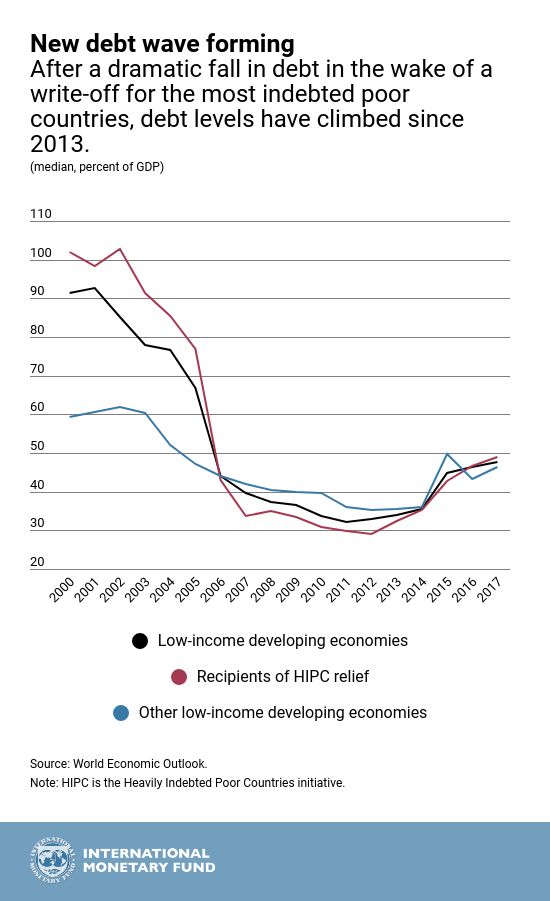
- Debt build-up follows the post-relief period after the Heavily Indebted Poor Countries (HIPC) initiative and Multilateral Debt Relief Initiative, which had left many countries with low debt and robust growth.
Drivers of the debt build-up
- Shocks: the sharp drop in commodity prices of 2014 (hitting commodity exporters’ revenues), natural disasters (including the Ebola epidemic), and civil conflict.
- High levels of public spending not linked to financing productive public investment.
- Ample global liquidity that made borrowing easier.
Recent trends and key statistics
- 70 percent of low-income countries had higher government deficits in 2017 than during 2010-14.
- For the median country, public debt levels increased to 47 percent of GDP last year, up from 33 percent of GDP in 2013.
- In about a third of low-income countries (examples: Bangladesh, Kenya, Madagascar, Moldova, and Nicaragua) where deficits rose, investment rose by at least the same amount.
- In most cases investment rose by less than the increased deficits, and in half the cases it actually fell.
- More than half of low-income countries are still at low or moderate risk of default, but the share of countries at elevated risk of debt distress or already unable to service their debt has almost doubled to 40 percent since 2013.
- Examples of countries at elevated risk or in distress: Ghana, Lao P.D.R., Mauritania, Chad, Mozambique, and the Republic of Congo.
Changes in creditor composition and implications
- Borrowers have shifted away from traditional official creditors (multilateral institutions and Paris Club members) toward:
- Non-Paris Club official bilateral creditors
- Sovereign bond issues
- Other foreign commercial lenders
- Domestic sources, mainly banks
- New private credit forms often have shorter maturities and higher interest rates, producing larger debt service burdens and higher rollover risks.
- These new creditors often lack ready mechanisms for coordination with other creditors, complicating debt resolution.
Data gaps and contingent liabilities
- One third of low-income countries do not report information on government guarantees on debts of state-owned enterprises.
- Fewer than one in ten report debt of public enterprises.
- Risks from public-private partnerships are rarely reported.
- Such contingent liabilities can rapidly become government debt in case of distress, complicating reliable assessments of debt vulnerabilities.
Policy recommendations and required actions
- For borrower countries:
- Proceed prudently when taking up new debt.
- Focus more on attracting foreign direct investment and boosting tax revenues at home.
- Prioritize investment projects with credibly high rates of return.
- Improve debt reporting to allow accurate tracking of debt situations.
- For lenders:
- Assess the impact of new loans on borrowers’ debt positions before lending.
- When debt restructuring is required, pursue timely resolution to lower costs for both debtor and creditors.
- Improve creditor coordination; prior agreement among official creditors on “rules of the game,” including information sharing and burden-sharing principles, would be beneficial.
- Donors should increase their support to low-income countries.
- For international institutions and the IMF:
- Advise low-income countries on balancing borrowing for development spending with managing debt-related risks.
- Roll out the recently revised low-income country debt sustainability framework to better inform analysis.
- Strengthen technical assistance in critical areas such as public debt reporting and management.
Outlook and conditional forecasts
- The IMF anticipates some stabilization of the debt build-up in the coming years, conditional on countries undertaking fiscal adjustment and carrying out ambitious economic reform programs to deliver stronger economic performance.
- If countries do not implement these reforms, the debt build-up is likely to continue.
Source: Managing Debt Vulnerabilities in Low-Income and Developing Countries (IMF blog post, Tao Zhang, March 22, 2018).
Content in this bundle
References
- https://www.imf.org/wp-content/uploads/2018/03/BLOG-1024x600-Dhaka-Bangladesh-Motoya-Taguchi-Jiji-Press-Newscom-jpphotos003360.jpg
- new IMF report
- Heavily Indebted Poor Countries (HIPC) initiative
- Multilateral Debt Relief Initiative
- https://www.imf.org/wp-content/uploads/2018/03/eng-march-22-lidcs-debt-2-003.jpg
- all work together