When Disaster Strikes: Preparing for Climate Change
IMF Blog, June 26, 2019
Source details
- Canonical URL
- When Disaster Strikes: Preparing for Climate Change
Other formats
Bibliographic details
- Authors: Sen Nolan, Krishna Srinivasan
- Published: June 26, 2019
Overview and context
- Cyclone Idai devastated Mozambique, Malawi, and Zimbabwe, leaving more than 1,000 people dead, thousands more missing, and damages in the billions.
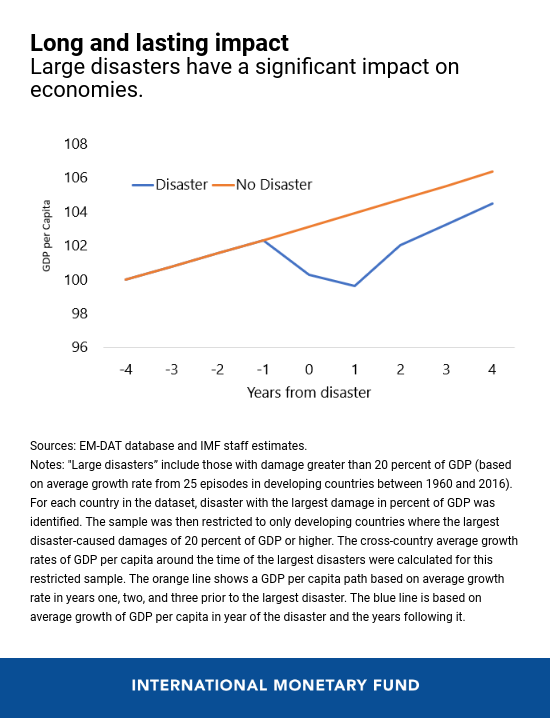
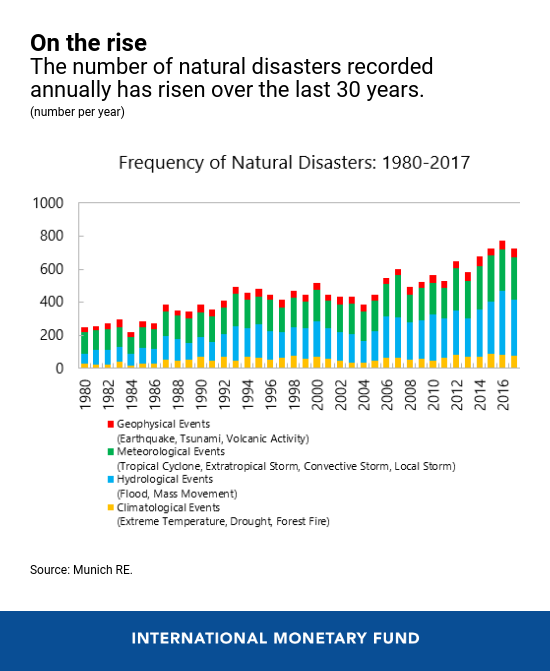
- Natural disasters destroy lives and property and have large and lasting effects on economies by reducing production and increasing debt burdens; they tend to disproportionately affect the poor.
- Small island countries in the Caribbean and Pacific have suffered, on average, disaster-related losses of 2 to 3 percent of GDP per year over the past 30 years.
- When Hurricane Maria ravaged Dominica in 2017, it caused damages estimated at some 220 percent of GDP.
Three complementary pillars of disaster resilience
- Structural resilience
- Many vulnerable countries lack disaster-resilient infrastructure covering vital services such as water, sewer, and electricity.
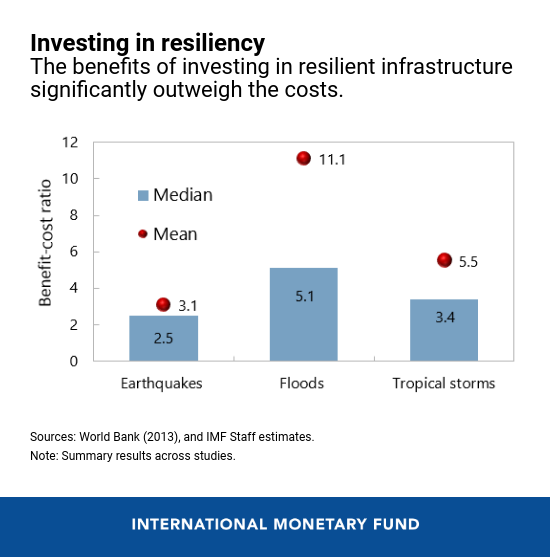
- Investment in such infrastructure can have very high returns but is hindered by high up-front capital costs and high public debt levels.
- The joint IMF-World Bank Climate Change Policy Assessments for Belize, Seychelles, and Saint Lucia estimated that annual investments of 2 to 3 percent of GDP would be required for a full decade to achieve adequate protection.
- Near-term, low-cost measures can still build resilience: enforcing strong building codes and zoning rules and improving early warning systems.
- Financial resilience
- The impact of disasters can be contained, but not eliminated; emergency financing needs for reconstruction must be planned before a disaster strikes.
- Options include budgetary provisions (possibly a dedicated saving fund) and contingency-based financial instruments that provide insurance coverage or relief from debt service payments when a disaster strikes.
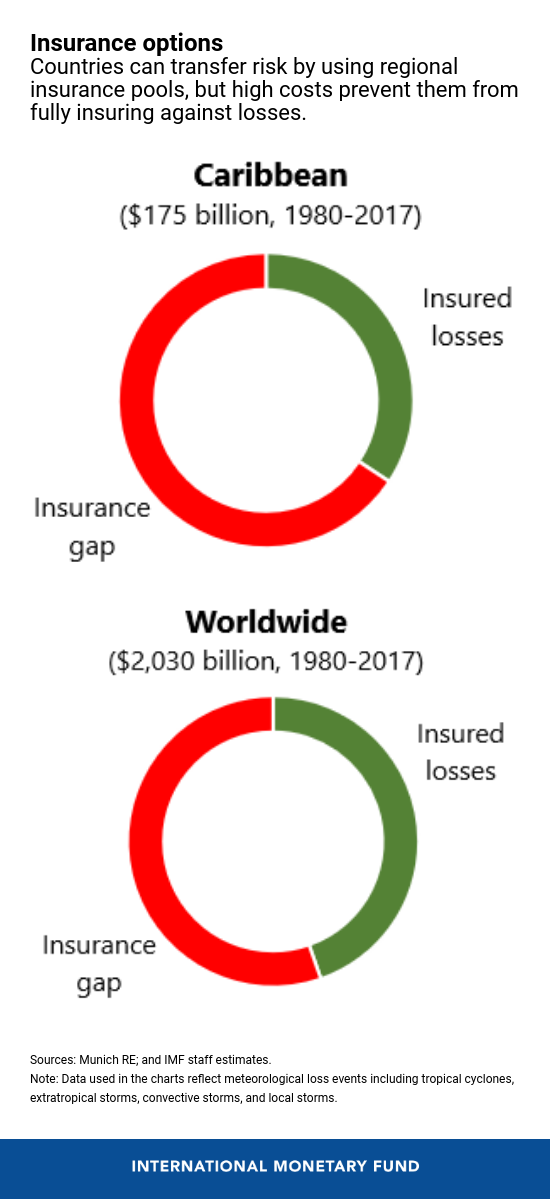
- Regional financial markets are often insufficiently developed to provide these financing options at a reasonable cost, particularly for small countries.
- Regional insurance pools (for example, the Caribbean Catastrophe Risk Insurance Facility and the Pacific Catastrophe Risk Insurance Company) exist, but countries have sought limited coverage reflecting the high costs involved and need help to reduce these costs.
- Social resilience
- Scaling up structural and financial resilience will take time, making detailed emergency response plans essential to contain disruptions to critical public services after a disaster (water, electricity, medical services, security).
- Emergency plans should limit the impact on the most vulnerable populations.
Formulating and implementing a disaster resilience strategy
- A disaster resilience strategy should:
- Identify areas of greatest vulnerability.
- Provide a road map to build resilience grounded in strong diagnostics, including risk assessments, project identification, prioritization, and costing.
- Build on, rather than displace, existing response plans.
- A strategy can help catalyze support from the international community.
Support needs and the role of stakeholders
- Many small and low-income countries need external support—expertise and financial assistance—to flesh out and implement a strategy.
- Country actions
- Raise additional domestic revenues by re-prioritizing spending and strengthening financial management to incentivize external donors.
- Seek technical support to engage effectively with climate funds and other climate finance initiatives.
- International and institutional support
- The IMF can analyze financing options and recommend how to build disaster-resilience into medium-term fiscal and macroeconomic frameworks to ensure public finances remain sustainable.
- The IMF has emergency lending facilities for speedy assistance to low-income countries hit by disasters; the IMF disbursed more than $100 million to Mozambique less than a month after Cyclone Idai hit.
- The IMF provides training and technical assistance to build government capacity to manage disaster risks and responses and commits to doing more as climate change intensifies.
Key statistics and figures
- More than 1,000 people dead (Cyclone Idai).
- Thousands more missing (Cyclone Idai).
- Disaster-related losses of 2 to 3 percent of GDP per year (small island countries, average over the past 30 years).
- Damages estimated at some 220 percent of GDP (Dominica, Hurricane Maria, 2017).
- Annual investments of 2 to 3 percent of GDP required for a full decade (Belize, Seychelles, Saint Lucia assessments).
- More than $100 million disbursed to Mozambique less than a month after Cyclone Idai.
Source: When Disaster Strikes: Preparing for Climate Change — Seán Nolan, Krishna Srinivasan, June 26, 2019
References
- https://www.imf.org/wp-content/uploads/2019/06/eng-june-18-nd1.png
- new IMF paper
- https://www.imf.org/wp-content/uploads/2019/06/eng-june-18-nd2.png
- Belize
- Seychelles
- Lucia
- https://www.imf.org/wp-content/uploads/2019/06/eng-june-18-nd3.png
- https://www.imf.org/wp-content/uploads/2019/06/eng-june-18-nd4.png
- help
- emergency lending facilities
- Getting Real on Meeting Paris Climate Change Commitments
- 5 Things You Need to Know About the IMF and Climate Change