Shifting Global Winds Pose Challenges to Latin America
IMF Blog, July 27, 2022
Source details
- Canonical URL
- Shifting Global Winds Pose Challenges to Latin America
Other formats
Bibliographic details
- Authors: Gustavo Adler, Ilan-Goldfajn, Anna Ivanova
- Published: July 27, 2022
Regional outlook and recent performance
- The region continued its strong post-pandemic rebound in early 2022, with services catching up with manufacturing and employment reaching pre-pandemic levels.
- Year-on-year growth reached 2.8 percent in the first quarter, compared to an average of 1.7 percent in the years preceding the pandemic.
- High-frequency indicators point to continued momentum in the second quarter.
- On the back of a solid first half of the year, the region is forecast to grow by 3.0 percent this year, an upgrade from the April forecast of 2.5 percent.
- Growth is expected to slow, with a downgrade to 2.0 percent in 2023, 0.5 percentage point lower than anticipated in April.
Uneven recoveries and sectoral differences
- Commodity exporters (some South American economies) generally benefited from the global rebound of commodity prices and saw stronger recoveries.
- Economies reliant on commodity imports (Central America and tourism-dependent Caribbean economies) faced constraints.
- Chile and Colombia experienced particularly dynamic rebounds, propelled by strong growth in services and fiscal stimulus in late 2021.
- Mexico’s economic output has not yet regained its pre-pandemic level; services and construction continue to lag.
- Caribbean economies remain behind in recovery because tourism has not fully returned to pre-pandemic levels despite recent rebounds.
- Central America, Panama, and the Dominican Republic have surpassed pre-pandemic output levels, driven by strong exports, remittances inflows, and supportive policies linked to the rapid recovery in the United States.
Challenging global conditions and external risks
- Global financial conditions are tightening, and commodity price upward trends appear to be reversing.
- With inflation rising worldwide and central banks in advanced economies tightening, global demand is weakening.
- Growth forecasts for 2023 were revised down from 2.3 to 1.0 percent in the US and from 2.8 to 1.8 percent in Canada.
- Even before full financial tightening impacts, 2022 growth forecasts were revised down from 3.7 to 2.3 percent for the United States, and from 3.9 to 3.4 percent for Canada.
- Worsening external financial conditions for Latin America and the Caribbean are leading to rising borrowing costs and currency pressures.
- Some commodity prices have fallen and are expected to soften further, potentially easing global inflation over time but posing further challenges to the region.
Inflation dynamics and outlook
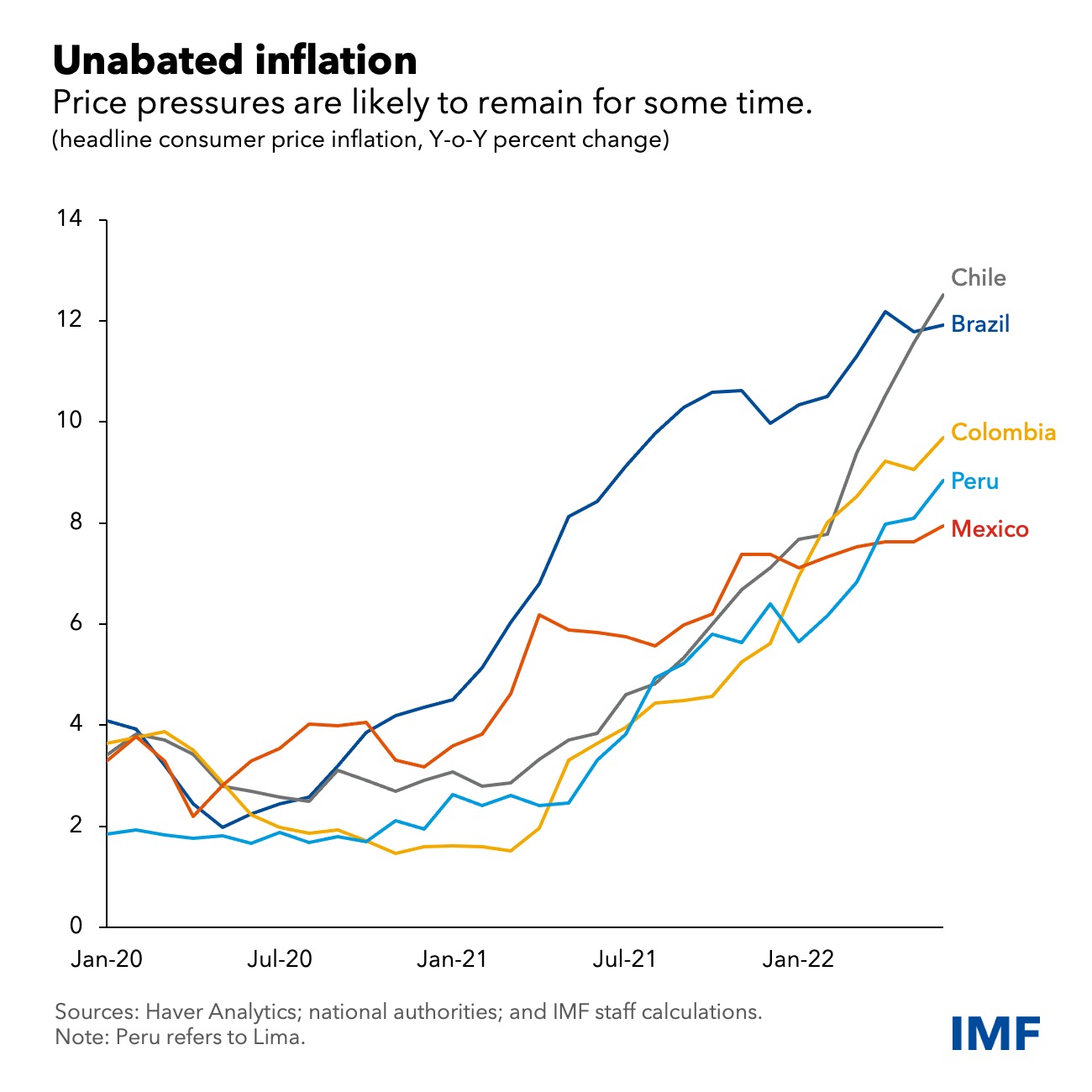
- Inflation has accelerated across the region amid rebounding domestic demand, lingering supply chain disruptions, and rising commodity prices.
- Central banks have tightened monetary policy to contain second-round effects and anchor longer-term inflation expectations.
- Inflation forecasts for the region are 12.1 percent for 2022 and 8.7 percent for 2023, the highest rates in the past 25 years.
- Inflation is expected to exceed the upper bound of central banks’ target ranges by about 400 basis points, on average, in the five largest Latin American economies (Brazil, Chile, Colombia, Mexico, and Peru) by the end of this year, and to remain outside the target range for part of next year.
- Further currency weakening, growing wage pressures, and existing indexation mechanisms in some countries could lead to additional inflationary pressures.
Fiscal and monetary context
- After last year’s withdrawal of pandemic stimulus, fiscal policy in most countries has shifted into a neutral stance in 2022.
- Neutral fiscal stances should help put fiscal balances on a more sustainable footing and support monetary policy in containing inflationary pressures.
- Amid high post-pandemic public debt levels and rising real interest rates, fiscal and monetary policies face trade-offs during slower growth and high inflation.
Policy recommendations
- Fiscal policy:
- Focus on strengthening fiscal balances and ensuring debt sustainability amid high public debt and rising real interest rates.
- Continue supporting the most vulnerable people with targeted and, if needed, temporary measures during a period of slower growth and high inflation.
- Monetary policy:
- Continue prioritizing taming inflation and anchoring inflation expectations.
- Maintain clear communication to preserve central banks’ credibility.
- Overall priority:
- Preserve macro-economic stability and social cohesion while navigating persistent inflation and decelerating economic activity.
IMF blog post by Gustavo Adler, Ilan Goldfajn, Anna Ivanova — July 27, 2022
References
- Central America, Panama, and the Dominican Republic
- https://www.imf.org/wp-content/uploads/2022/07/WHD-blog-chart-1.jpg
- https://www.imf.org/wp-content/uploads/2022/07/WHD-blog-chart-2.jpg
- https://www.imf.org/wp-content/uploads/2022/07/WHD-Blog-Chart-3.jpeg
- https://www.imf.org/wp-content/uploads/2022/07/WHD-REO-Table-2022.jpg