The Future of the State Revisited: Reforming Public Expenditure
IMF Blog, April 16, 2014
Source details
- Canonical URL
- The Future of the State Revisited: Reforming Public Expenditure
Other formats
Bibliographic details
- Authors: Sanjeev Gupta, MartineGuerguil
- Published: April 16, 2014
Context and framing
- Authors: Sanjeev Gupta, Martine Guerguil
- Date: April 16, 2014
- Theme: Drivers of rising government spending and options for public expenditure reform in the wake of the global financial crisis.
- Framing points:
- The global financial crisis highlighted sustainability concerns for public finances but exacerbated an already ongoing trend of rising government spending.
- IMF Fiscal Monitor analysis examines factors behind the increase in public spending, particularly social spending, and discusses reform options.
Explanations for the growth of government spending
- Long-run economic hypotheses supported by IMF analysis:
- "Wagner’s Law": demand for public goods and services increases as countries become richer.
- "Baumol’s cost disease": the cost of public provision of goods and services tends to increase faster than productivity (example: orchestra musicians).
- Implication: In the absence of mitigating measures, pressure on governments to spend will continue, though possibly at a slower pace as income and productivity growth level off.
- Key quantitative projection:
- In the absence of reforms, government spending in emerging market economies could increase by between 3 and 6 percentage points of GDP through 2050.
Additional upward pressures on public spending
- Population aging, which will increase the cost of providing health care and pensions.
- Normalization of monetary policy, which will increase debt payments when interest rates eventually start to rise.
Options and principles for spending reform
- Overarching objective:
- Ensure finances remain sustainable now and into the future while still fostering growth and equity; balance tax policy and spending reform.
- Country-differentiated approaches:
- Advanced economies: consolidation needs are largest and scope to raise revenue through taxes is limited → spending cuts may be necessary as part of a wider reform strategy.
- Emerging market and low-income economies: many lack access to full public services such as education and health care → scope to expand provision by raising taxes, coupled with expenditure reprioritization.
- Common policy elements and recommendations:
- Avoid across-the-board spending cuts:
- Such cuts may be expedient but are neither efficient nor welfare-enhancing and have deleterious effects on long-term growth.
- Contain social spending and the public wage bill:
- Social spending and the public wage bill make up the bulk of government spending.
- Reining in social spending requires tackling public pensions and welfare benefits.
- Pension reform: gradually raise the retirement age while protecting the vulnerable and expanding access when needed.
- Welfare: improve targeting of welfare benefits to generate fiscal savings without compromising equity.
- Public wage bill: durable reduction requires replacing wage and hiring freezes with deeper structural measures.
- Improve efficiency to achieve cost-savings:
- Large scope for efficiency gains in the provision of education and health care and in public investment.
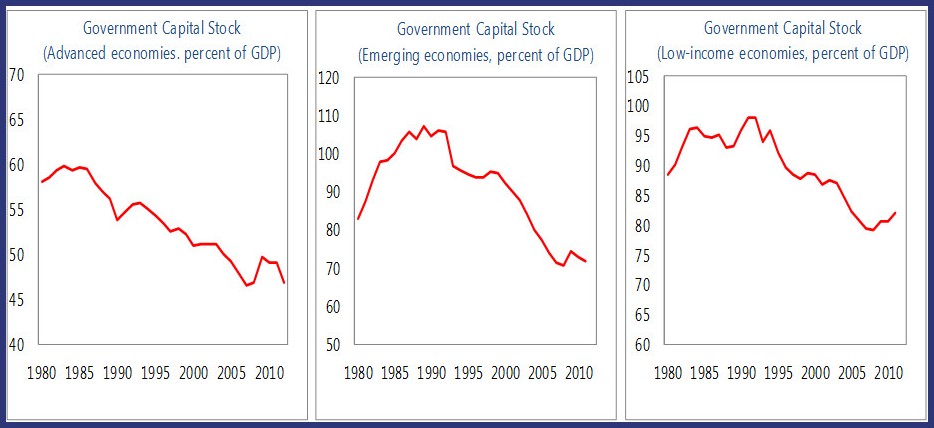
- For low-income countries, improving public investment productivity or increasing private sector participation is particularly relevant to arrest the trend decline in public capital stocks.
- Strengthen supportive fiscal institutions:
- Effective decentralization frameworks and expenditure rules can help promote spending control.
- Build political consensus and communication:
- Expenditure reforms are more likely to be successful and long-lasting if supported by wide political consensus.
- A broad communications strategy is important because political uncertainty and social pressures can derail reforms.
Empirical and trend notes
- Charts referenced in the analysis:
- Chart 1. Upward Trends in General Government Spending (percent of GDP)
- Chart 2. Downward Trends in Government Capital Stock
Source: The Future of the State Revisited: Reforming Public Expenditure, Sanjeev Gupta and Martine Guerguil, April 16, 2014.
Content in this bundle
- 再论国家的未来:改革公共支出; iMFdirect 博客;作者:Sanjeev Gupta 和 Martine Gerguil; 2014年4月16日
- 加盟国の将来を再考する: 歳出改革; サンジーブ・グプタ、マーティン・ガーギル; iMFdirect ブログ 2014年4月16日掲載
- Пересмотр будущего государства: реформа государственных расходов